
Finding Brigadoon: How the Pasadena Playhouse Is Reimagining a Classic for the Modern Age
Alexandra Silber and Katie Spelman discuss their new take on the musical.
 |
Pasadena
|
|
Pasadena
|
May 19, 2026

(© Alexandra Silber)
While there are certain classic musicals that get revisited for every generation—Oklahoma, Gypsy, My Fair Lady—others remain more elusive. Brigadoon, the first major hit from Golden Age duo Alan Jay Lerner and Frederick Loewe, is one such musical. The title enjoys popularity on the community theater circuit, but it hasn’t received a major Broadway revival since 1980.
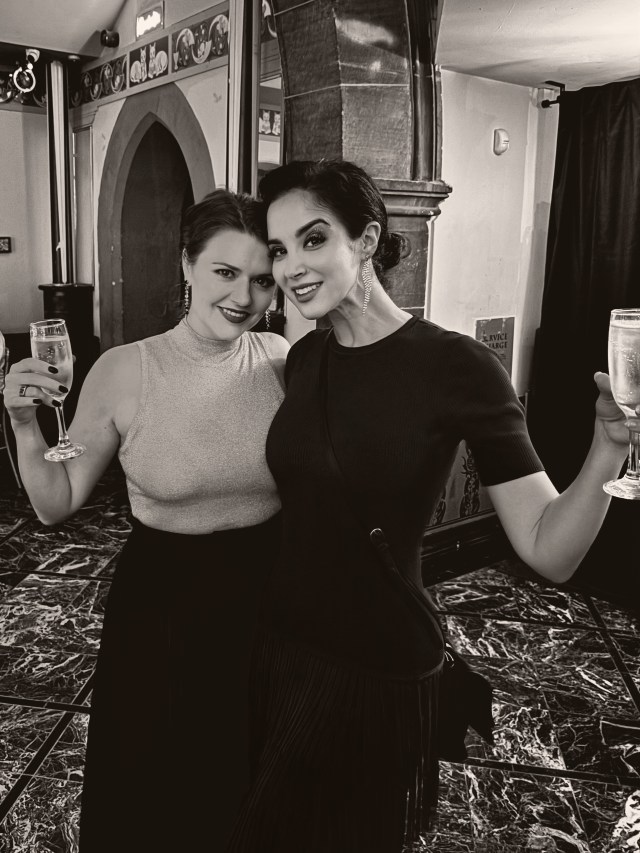
Alexandra Silber and Katie Spelman hope to change that. Silber, who has written a revised book, and Spelman, who is directing and choreographing, are bringing a fresh, vibrant production to the Pasadena Playhouse, running through June 14. They are the first female duo to formally revisit the show together, refocusing the material to feel more authentic to human life and its Scottish setting.
“I love classic musicals from the Golden Age,” says Silber, an actor making her first professional foray into book-writing. “There’s so much talk around the fact that they’re problematic and require fixing. But rather than just treating them as broken, we need to look for what is at the core of these stories and try to realign our 21st-century sensibilities with the original intentions of the piece.”
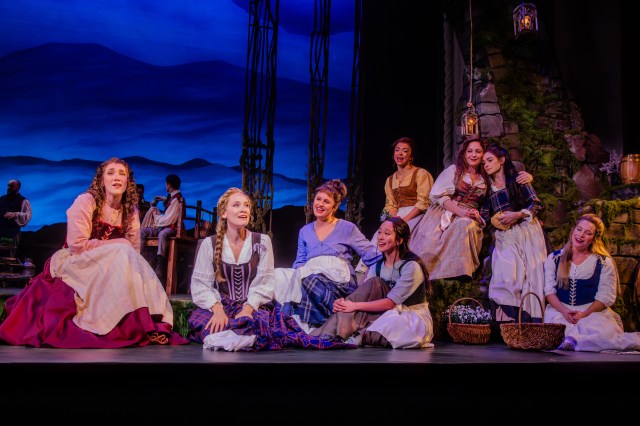
In the show, that community, the fictional title town, is disrupted by the arrival of American travelers, Tommy Albright and Jeff Douglas, who get lost hiking in the Scottish Highlands. They stumble upon Brigadoon, frozen in time in the 18th-century and enchanted to appear every 100 years with only one day passing between each century for the town’s denizens.
(© Alexandra Silber)
After only three drafts, the Lerner estate gave Silber its blessing to make changes to the original script as she saw fit, barring any major structural or lyrical changes. Similarly, Spelman wanted to lead with the legacy of original choreographer Agnes De Mille, whose name remains attached to the credits despite Spelman devising her own steps. “We kept her structure in place,” Spelman notes. “That’s why it’s very good that her name is still on it. I wish that was true for more musicals. We sideline what choreographers do for the form and structure. It gives me great joy and pride to see her name on the same page as mine. The way that she built and crafted choreography to move through the show, we are very much honoring.”
While the original production reflected the masculinity of the post-World War II, era, Silber thought it was high time to give it a contemporary angle. “When the 1947 audiences saw the show, they were looking at two men that looked like them and talked like they spoke,” Silber notes. “I don’t know why it is that we’ve never totally questioned that, but what if we did that again? What’s remarkable about that is how little changes, other than some of the ways in which masculinity and modern expectations play upon these people.”
For Spelman, making Tommy and Jeff men from 2026 allows the show to introduce questions of loneliness and isolation. “In 2026, we are arguably the most connected we’ve ever been as a world, yet you’re seeing all these stats about how isolated and lonely people are,” she says. “Watching these avatars of ours step into a place with no technology, and yet, so much more connection, life, and breath, it points to the humanity that is necessary for us all to live and survive.”
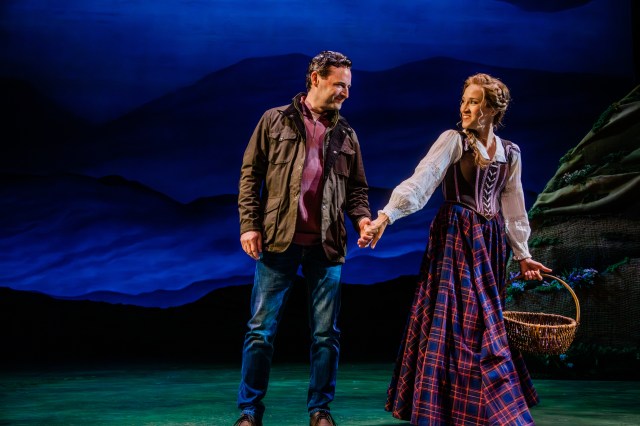
Similarly, they’ve aged the protagonists up, taking traditional young lovers Tommy and Fiona and comic relief Jeff and Meg from their 20s and 30s to their 40s and 50s. “A second act is so much more common now,” reflects Spelman. “People coming to the theater are often people in their second act. It gets a little tiresome to go, ‘Ah, yes, another 22-year-old falling in with a 22-year-old and living happily ever after.’ It starts to ring false because we’re old enough to know that life is more complicated. There’s a whole new audience for people falling in love in middle age.”
(© Jeff Lorch)
Silber wanted to create relationships steeped in realism, with a psychological depth to the characters. “The original was filled with stock characters,” notes Silber. “The ingenue, the matinee idol, the soubrette, the funny sidekick. That was the appetite at the time.” In that pursuit of more truthful human behavior, the central love scene between Tommy and Fiona became the hardest to write. “In 1947, it was, ‘Here’s our leading man and leading lady, and they are about to fall in love with a little bit of an intro and this very beautiful song,” Silber says. “That wasn’t aligning with the depth and richness that I was trying to provide. Since this play is about a believable love story that puts our modern-day protagonist at the center of choosing between having it all and having it real, this love story has to be something that we can invest in on an honest level.”
While it took her some time to crack the lovers, the bawdy, hard-drinking, comic characters, Meg and Jeff, were Silber’s entry point. Meg, known for her funny ditty, “The Love of My Life,” gets a far more self-actualized existence. “I wrote that role for every woman over 45 years old that is not done being alive,” says Silber. “She’s denying the idea of being put out to pasture and becoming invisible as a woman.”
Perhaps the most striking change comes with Jeff, who is transformed from a flat sounding board for Tommy into a widower mired in his grief, self-medicating with alcohol. “As an actor, when I see a character that is sassy, cynical, doesn’t believe in anything, using humor to deflect, and has a horrible drinking problem, my first question is, ‘Why? What is he avoiding?’” Silber explains. “It occurred to me that he was a widower.”
For Silber. that tied back to her own deeply personal reasons for connecting with Brigadoon. When she was 18 years old, her father died and she sought healing and escape by enrolling at the Royal Conservatoire of Scotland. “In the face of such a huge loss, I wanted to have an adventure,” she remembers. “Scotland caught me in this tender developmental moment, but it was not sentimental. It did not rush my healing. It provided me with something that was very sustaining, which was community, tradition, and full-bodied emotion that moves through. It was a very different culture.”
(© Jeff Lorch)
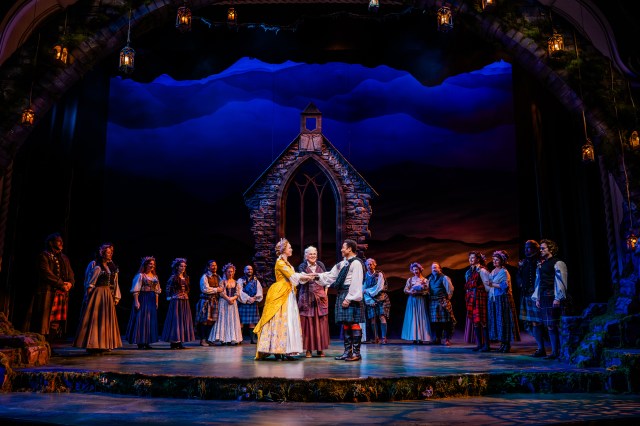
Rather than continue with the much-stereotyped take on the traditions of Scottish Highlanders, Silber’s communes with the culture in far more specific ways. The idea of making that culture a parody was horrifying to both of us,” says Spelman.” The more authentic and tied to reality it is, the fuller and richer it’s going to be.”
Their pursuit of authenticity also led Silber to change the gender of a core character, Mr. Lundie. The town’s miracle-maker is now Widow Lundie, brought to life by the estimable Tyne Daly. “The gender swap was about returning to the authentic Scotland,” she says. “The pillars of community were women. We did have female keepers of the culture, female keepers of wisdom. It felt obvious to me that this was a woman. The adding of the word widow was a way to honor that this is a community that has experienced many losses.”
Ultimately, both Silber and Spelman hope that the resounding takeaway will be one of love for these characters and this story, as well as the medium itself. “When I’m watching a musical,” says Spelman, “I can tell whether or not the person who wrote it loves musicals. [Silber’s] love is apparent because you never feel like there’s a scene and then there’s a song. The song comes out of the scene and then moves into the next idea very fluidly. We’re trying to stitch together a musical, with extreme love, in all of the threads, for the form itself.”
(© Jeff Lorch)




source on Google
Featured In This Story

Latest Reviews
See all







Latest Videos
Watch the Trailer for Elsinore Starring Andrew Scott
The film is based on the true story of Ian Charleson, who played Hamlet at London’s National Theatre after being diagnosed with AIDS.