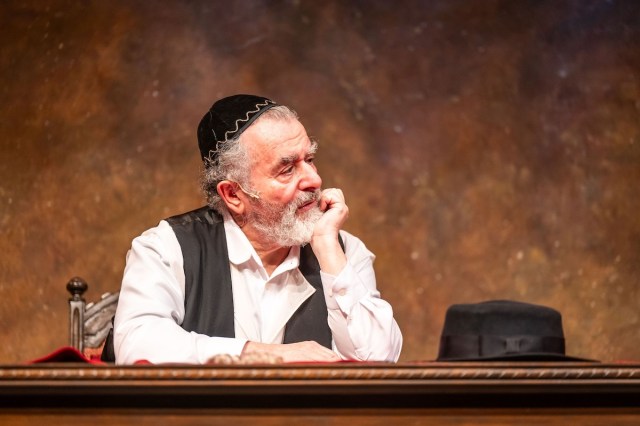
and Sarah Rosenthal in Ragtime
(© Joan Marcus)
I consider Lynn Ahrens, Stephen Flaherty, and Terrence McNally’s Ragtime, the great American musical of the late 20th Century, and Marcia Milgrim Dodge’s revival of this panoramic look at troubled race relations in a shifting society, now at Broadway’s Neil Simon Theatre, is every bit as rousing, as moving, and as trenchant on the subject of the American melting pot coming to a turbulent boil as any prior production of the show I’ve seen.
In the work, adapted from E.L. Doctorow’s best-selling novel, ragtime music is used as a brilliant metaphor for the seismic change that came over this country at the start of the last century when the artificial barriers separating various masses huddled on these shores began to crack. In 2009, the musical may impress some as even more pertinent than it did on Broadway over a decade ago, with Barack Obama now in the White House. Indeed, Ragtime — in which flags are sometimes waved sincerely and sometimes waved cynically — can count among its abundant achievements the fact that it is deeply, searingly patriotic.
In Doctorow’s breathtakingly ingenious plot, three families — segregated de facto as Ragtime kicks off — begin to interact when Mother, a well-to-do New Rochelle matron (Christiane Noll) impulsively takes in a young Negro woman, Sarah (Stephanie Umoh), and her newborn baby, who are being sought by Sarah’s lover, a pianist named Coalhouse Walker (Quentin Earl Darrington).
Through other bright, immediately believable coincidences, they cross paths on Derek McLane’s remarkably adaptable three-tiered set with recent Jewish immigrant Tateh (Robert Petkoff), who eventually builds cutting silhouettes into a movie-making fortune, as well as such real-life figures as Henry Ford, Booker T. Washington, J. P. Morgan, Emma Goldman, Evelyn Nesbit, and Harry Houdini, whose chain-shucking escapades are only one of the symbols flaunted along with Santo Loquasto’s dazzling (and sometimes symbolically red-white-and-blue) costumes.
There’s no point hammering away at the high quality of the ragtime-infused and heartfelt score (which has undergone only minor revisions since the show’s original Broadway production) or harping on the fact that it has one too many plant-your-feet-on-the-stage-and-declaim anthems.
Likewise, there’s no point to singing the cast’s praises at length, although they uniformly perform with fervor reflecting a nation struggling sometimes thrillingly, sometimes shabbily to attain equilibrium. Among the standouts are Darrington, who has the force of a steam-engine, Noll, who acutely embodies Mother’s pre-feminist determination, and Umoh, Petkoff, and Bobby Steggert (as Mother’s Younger Brother), who brim with joy and pain.