in Cat on a Hot Tin Roof
(© Emily Cooper)
Hundreds of thousands of visitors make a pilgrimage to the Shaw Festival in beautiful Niagara-on-the-Lake Ontario each year, with most taking in at least one play by the festival’s namesake (or, perhaps, in this year’s case, Molly Smith’s acclaimed revival of My Fair Lady, based on Shaw’s Pygmalion). But it may well be the work of another playwright that lingers strongest in the memory for many theatergoers.
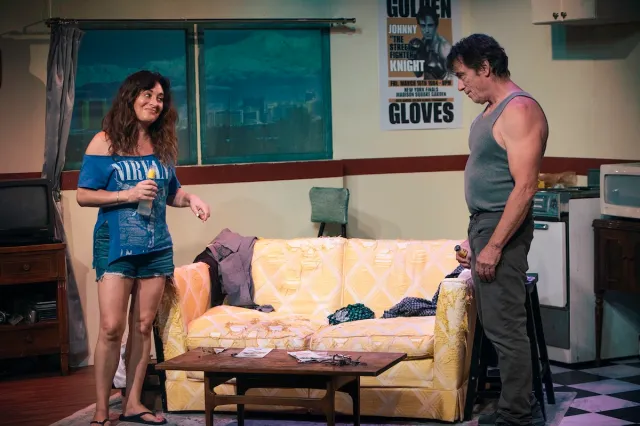
That will certainly be true for those who take in Eda Holmes’ searing production of Tennessee Williams’ Cat on a Hot Tin Roof at the Royal George Theatre. This highly physical production captures more precisely than any I’ve seen the characters’ sense of being trapped by their circumstances. Indeed, the members of the Pollock family barely seem held in by the 28,000-acre plantation on which they reside; it would be hardly surprising to see one of them jump of the balcony.
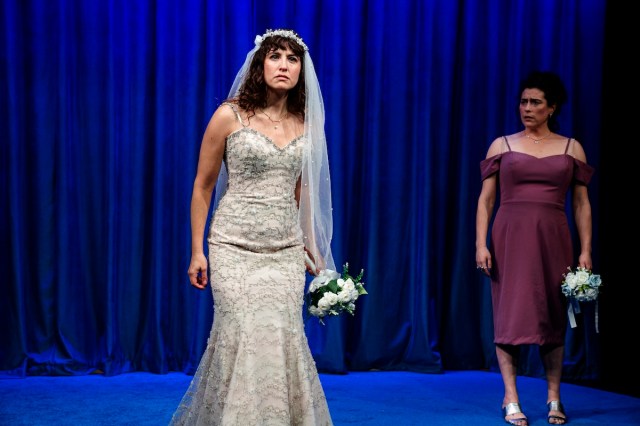
No one is more jittery than Maggie (the stunning Moya O’Connell), who is trying to maintain her balance on that hot tin roof — desperate to hold on to both her seemingly disgusted husband, Brick (Gray Powell), and her financial security in the wealthy family. Her lengthy first-act speeches are appropriately delivered with almost lightning-fast speed (which, combined with her drawl, does make a few of her words hard to understand), and as she lets forth her fears and plans, it feels as if time is literally about to run out on her.
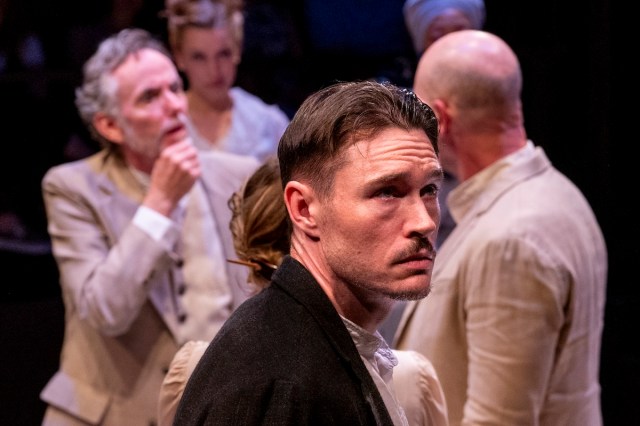
The appropriately buff Powell — believable as a former small-time football star — nicely charts Brick’s descent into drunkenness, going from tipsy to intoxicated to falling-down drunk with believability. Yet, while still relatively sober, his Brick proves to be a match for both Maggie and his father, Big Daddy (Jim Mezon), when he needs to be on an equal figurative footing with them.
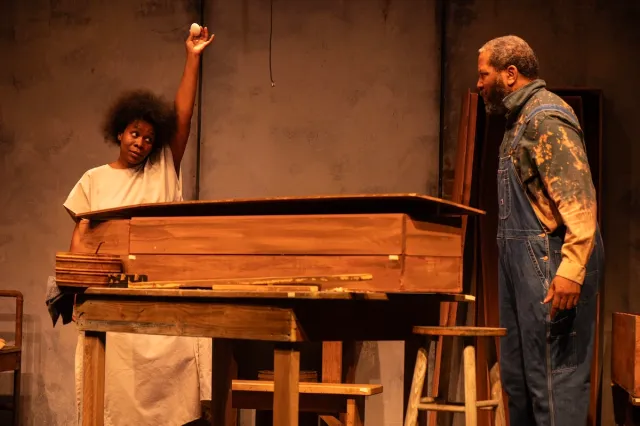
That’s no easy feat when he shares the stage with Mezon, who is incredibly imposing, both physically and verbally. He practically consumes all the air around him, and when he berates his long-suffering, smarter-than-she seems wife, Big Mama (an impressive Corrine Koslo), or briefly laces into his obnoxiously snide daughter-in-law, Mae (a fine Nicole Underhay), it’s almost terrifying to watch.
Audiences who have seen only early productions of the play (or the famed film version) may be surprised with the abundance of four-letter words here, as well as the forthright handling of the “friendship” between Brick and his late (and clearly homosexually-inclined) friend Skipper, both of which adds to the verisimilitude of this extraordinary production.