
How Kirk Lynn Discovered, Completed, and Made Sense of Thornton Wilder's Lost Play
The Emporium has its New York debut at Classic Stage Company.
 |
Off-Broadway
|
|
Off-Broadway
|
May 1, 2026
More than 75 years ago, Thornton Wilder began work on what would become a never-finished play. He called it The Emporium, and he intended for the play, about a young man who wants to work at a mysterious department store, to be a perfect circle, where you could drop in at any point and follow all the way around without losing the thread.
Announced for Broadway several times, Wilder worked on it for decades, before quietly shelving it. Until playwright Kirk Lynn found it several years ago, The Emporium lived inside a box at Yale’s Beinecke Rare Book & Manuscript Library. But what he discovered was more than 300 pages of drafts, and with the blessing of the Wilder estate, Lynn set out to complete it.
The Emporium received its world premiere in 2024 at the Alley Theatre in Houston, directed by Rob Melrose. Now, it arrives in New York for the first time. Classic Stage Company presents the drama’s off-Broadway premiere, running through June 7. We spoke with Lynn about his detective work and what it feels like to finish someone else’s undiscovered gem.
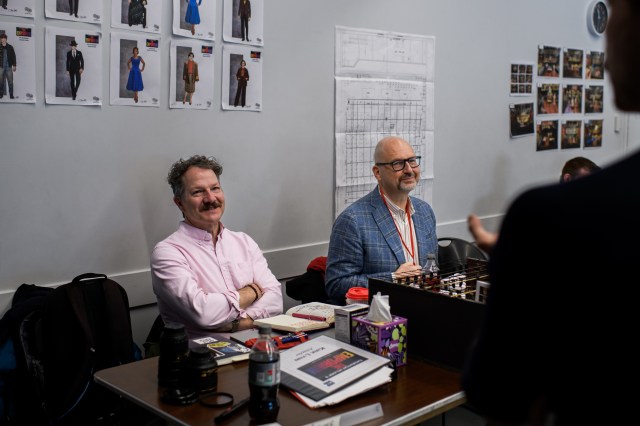
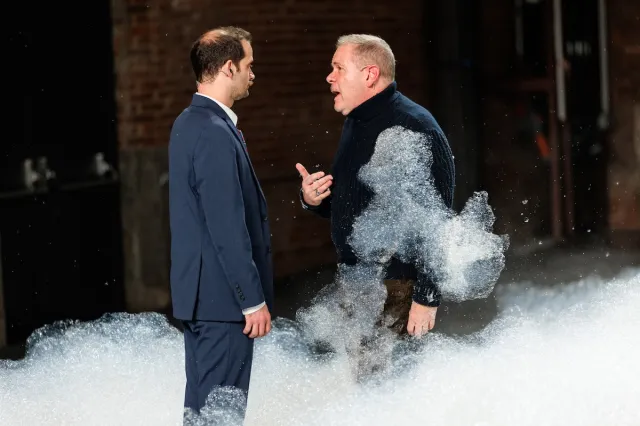
(© Allison Stock)
This conversation has been condensed and edited for clarity.
Was finding The Emporium initially a research nerd project for you?
It started with David Cromer’s production of Our Town at Barrow Street Theater in 2008. I’d read the play plenty of times before, but I left the theater and texted Cromer asking for the updated script because it felt so fresh and contemporary. He told me they hadn’t updated it at all; in fact, they’d used the rehearsal draft, which is actually a little darker and has fewer jokes. That stopped me cold. My parents had always thought of Wilder as someone who made well-made, nostalgic plays. But his experimentation was something that the whole of American theater hadn’t caught up to yet. How did he do both of those things at once? I decided that I should study Wilder. I read everything he ever wrote to try to think about how and why he composed the way he did. I read all the plays, all the novels, all the short plays, his letters, and his journals.
And it was the journals that led you to The Emporium?
In his journals, there are two scenes from The Emporium. More importantly, there were journal entries where he talks about reading it with friends. There was a whole draft of a Wilder play that I hadn’t read, somewhere in the world. At the time, I had a lectureship at Yale, so I had access to the Beinecke library [where Wilder’s archives are stored] and asked for some boxes. I think of it as an Antiques Roadshow moment, where I’m like “Oh, my God, there’s a whole play by Thornton Wilder here.”
Is there any inclination why he abandoned it?
I think he just couldn’t figure it out. It was scheduled for Broadway twice, directed by Jed Harris and starring Montgomery Clift. They were getting the team together. There’s lots of speculation. I wonder if he was anxious about how it compared to Our Town and Skin of Our Teeth. He won Pulitzer Prizes for his other original full-length plays; is it Pulitzer Prize-worthy? And he was a drinker. I don’t know how much that impacted his ability to pull it all together. There’s lots to wonder about. But he worked on it for decades. He didn’t just work on it a little bit.
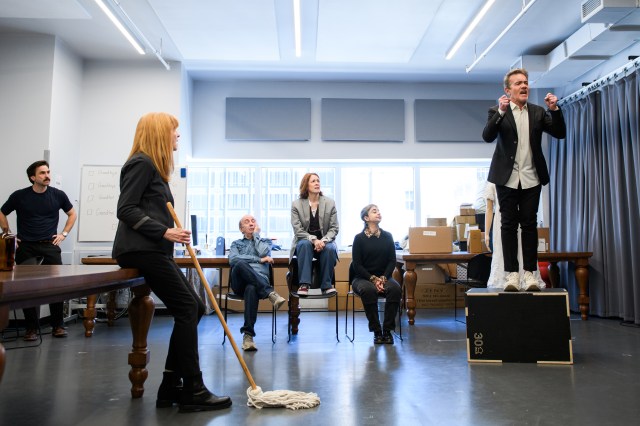
(© Allison Stock)
So, what kind of a state was it in?
There are nine scenes. Scenes one through four go together really well, and scenes five and six go with each other, but don’t go with the others. He needed to do a finishing pass on it, to say the least, but it’s all there.
There were to threads that inspired him. One, he wanted to write a very American, Horatio Alger, rags to riches story of an orphan finding his way. Two, he wanted to put some European polish on it. He loved Kafka’s The Castle and the idea that [the protagonist] K. has an appointment in the Castle but can’t ever get through the levels of bureaucracy to have that meeting.
So, those two things were combined to create a young man who’s an orphan who wants to make his way to the big city and work in a great department store. The Emporium is said to be the greatest department store of all. He gets there and he finds out there’s no way to turn in an application, there’s no interview process, and he’s totally baffled, because clearly, there are people working at the Emporium, but he can’t figure out how to become one of them.
The other thing that’s probably worth saying is that Wilder wanted to make it a perfect circle, so that the ending touched the beginning. He wanted to be able to start any scene and run it all the way around. It didn’t quite work that way, but the play does end back at the beginning.
In your process of excavating it, how did you decide what remains Wilder and what gets your intervention?
I sometimes thought of it as floating and spackling drywall. I had to line these edges up and make it so it feels seamless through the play. Once you do that, you have to do a lot of backwards work to make it all connect.
In the first version we did at the Alley, I’m a character in the play and I found it distasteful. The finding of the material is presented as part of the play, and I really didn’t care for it at all. It really removes it from Wilder. I didn’t like being a character. I convinced Rob [Melrose] and Jill [Rafson, of Classic Stage Company] that it would make the play better and make it more purely Wilder. Now, there’s a preface where, without ever mentioning me or my name, they talk about how these papers came to be found, and it dovetails with the first scene.
Sounds like Wilder was ahead of his time, even in this.
One of the games Wilder was very interested in was having a prologue after intermission. The audience, having seen the first half, demands to understand the play better, and the prologue obliges them. It’s a lovely, slightly absurdist idea. Fascinatingly, in all the pages where he outlines the play, he always notes prologue after intermission, but he never actually wrote the prologue. He was defying theatrical convention in the 1930s and ’40s while simultaneously telling a deeply human story. That combination is what makes him so hard to categorize and so easy to underestimate.




source on Google
Featured In This Story

Latest Reviews
See all








Latest Videos
Watch the Trailer for Elsinore Starring Andrew Scott
The film is based on the true story of Ian Charleson, who played Hamlet at London’s National Theatre after being diagnosed with AIDS.