
Roger Guenveur Smith on Jean-Michel Basquiat, Do the Right Thing, and Their Intuitive Connection
The actor and solo performer discusses his friendship with Basquiat, the artist’s influence on Smiley in Spike Lee’s Do the Right Thing, and the new stage work inspired by their relationship.
 |
Off-Broadway
|
September 17, 2026
Roger Guenveur Smith has spent decades transforming the lives of cultural figures into acclaimed solo performances. His Obie Award-winning A Huey P. Newton Story was adapted into a Peabody Award-winning telefilm that continues to stream on Hulu, while his Bessie Award-winning Rodney King is available on Netflix. Both Newton and King were scored by Marc Anthony Thompson and directed for the screen by Smith’s longtime collaborator Spike Lee.
Now Smith is turning his attention to his own history with the artist Jean-Michel Basquiat, whom he met in Los Angeles in the early 1980s. Their friendship brought Smith into the creative process behind some of Basquiat’s work. It also left an unexpected imprint on Smiley, the character Smith created for Lee’s Do the Right Thing.
As the New York Theatre Workshop production of Smith’s In Honor of Jean-Michel Basquiat gets into its run, Smith reflects on his past with the great artist, and his present moment, just blocks from where Basquiat lived, worked, and died.
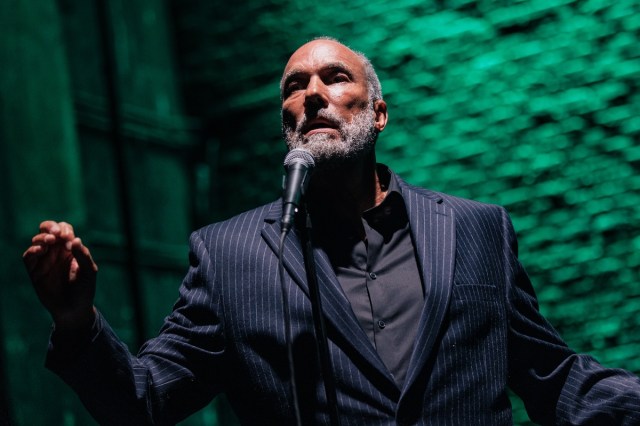
(© Marc J. Franklin)
This conversation has been condensed and edited for clarity.
When did you first decide you wanted to write a piece about Basquiat and your relationship with him?
I’ve told a lot of these stories over the years. There was a major retrospective of Jean’s work at the Brooklyn Museum, which was great because he was a junior member there—his mom signed him up when he was just a kid—and then there was the same retrospective in Los Angeles. Those two bookends gave me an opportunity to improvise storytelling about our relationship.
But then I realized, I think after doing memorial observations for what would have been his 50th birthday, that I had a responsibility of documenting these stories in a strategic way. I came up with a script and engaged Marc Anthony Thompson, my longtime collaborator, to score the show, and over a series of workshop presentations, we got to where we are now, which I think is a fully realized meditation on my relationship with Jean-Michel. It’s great to be on East Fourth Street, two blocks away from where Jean lived, worked, and tragically died.
Tell me about that relationship. You met him in 1982 in Los Angeles?
Absolutely. I was out there being Hollywatts, which was my rapping name, and Jean was in the club. He came up to me after he caught my performance and just said straight up “I really like your energy. You want to hang out with me?” I had no idea that he was an ascendent art star. That wasn’t really my world. He had already made his mark with a very well-reviewed show at Gagosian gallery and he was dating Madonna, but I didn’t know anything about that. I just thought he was a cool kid from New York. And he asked me if I wanted to go see King of Comedy with him, so I went. He stood up in front of the projectionist, and his dreads were projected onto the screen. That was really how we met. Then he invited me into his studio.
What was it like watching him make his art?
Not only did I watch him, I collaborated with him. When he was painting, I was doing raps, I was doing soliloquies, I was doing speeches. Then he would draw it. His painting was just as much about writing as it was about figurative work.
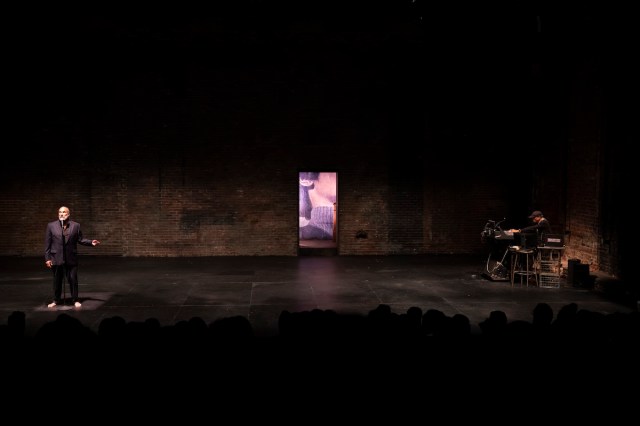
(© Marcus Middleton)
How did your relationship develop over the years, up until his death?
I think like many people, our relationship dissolved. He did not keep in contact with everyone who wanted to be in contact with him, and I think that I was one of those people. The loss of Andy Warhol was a seminal moment in Jean’s life. He had found a true comrade and friend, and to have lost Andy suddenly the way that he did was a difficult thing for him to bear. He did make efforts to kick his habit. He went to Maui; he went to the Ivory Coast. But it seems that New York was not the place to be for him, because it was full of temptation and full of ghosts.
You were filming Do the Right Thing in Brooklyn when he died. What was that experience like, knowing that your character is loosely inspired by Basquiat?
It was heavy to see the tabloids. Richard Edson [who played Vito], who was on the downtown scene as not just an actor, but also as a musician, and I were hit by it very hard because we both knew Jean.
I didn’t really think about how deeply Jean’s work had been influential on the creation of the Smiley character until way after. Smiley was created very quickly. It was not a scripted character, it was completely improvised. Two days before I was on set in Brooklyn, I was in the former Yugoslavia on a tour, and as I walked through places like Zagreb and Belgrade, I kept seeing these people coming at me and I said “That’s Smiley, that’s Smiley, that’s Smiley.”
After I did the film, I really started meditating on where it came from, and I realized that there were two men in particular who had influenced me as a child and as a teenager. One man sold the Los Angeles Sentinel newspaper every Thursday evening when I was a kid, and my father would patronize him. He would stutter his thanks and I think that that very much affected me. And it seemed like he was a giant, you know, looking up at him. And then when I was in high school, there was a guy who had been a great athlete but unfortunately was hit by a truck, and he talked like that as well when he became the locker room attendant, passing out the towels. I think that he also had an influence on the creation of Smiley.
And then I started thinking about the art? Where did that come from? I didn’t even know at that time that Jean-Michel had emerged by selling postcards in the Village. That seemed to be an interesting thing to do, and Spike Lee certainly thought so when I proposed that Smiley do that.
And then to appropriate the crown of Jean-Michel, to appropriate the X for Malcolm X. I don’t know. I think that there was a kind of intuitive, telepathic relationship between us. And as I said, I had been in his studio in Venice, California, so I was able to witness the guy at work firsthand and collaborate and communicate with him.
Do you still have one of his paintings?
He gave me one. And he said, “Buy a house with this one day.”
(© Marc J. Franklin)




source on Google
Featured In This Story
Related Articles
See all
Latest Reviews
See all




Latest Videos
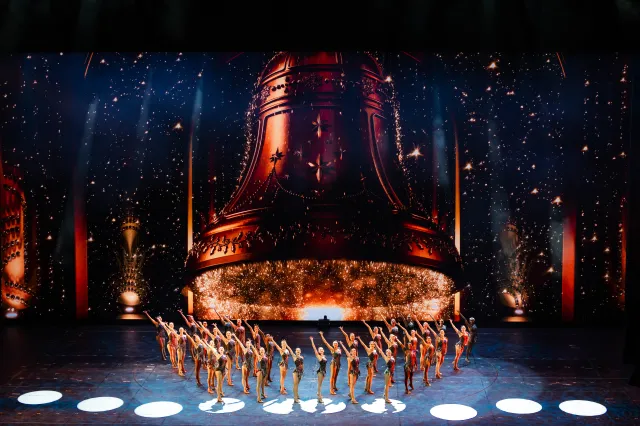
Watch the Radio City Rockettes in the New Christmas Spectacular Number "Ring"
The modern tap number is choreographed by Emmy Award nominee Chloé Arnold.