
Review: Roger Guenveur Smith's Impressionistic Tribute to Artist Jean-Michel Basquiat
In Honor of Jean-Michel Basquiat Returns to New York Theatre Workshop after a brief Under the Radar Festival run earlier this year.
 |
Off-Broadway
|
September 14, 2026

(© Marc J. Franklin)
Roger Guenveur Smith’s solo show In Honor of Jean-Michel Basquiat, which has returned to New York Theatre Workshop for a full run after a few performances at the Under the Radar Festival back in January, is hardly a typical biography of the great artist. Instead, Smith is attempting something much more impressionistic and personal in nature. To what level he succeeds will depend on your own interest in Basquiat, and to some extent Smith himself, going in.
Born in Brooklyn in 1960 to a Haitian father and a Latina mother, Basquiat started his artistic career in the late ’70s as one half of the graffiti duo SAMO, achieving notoriety for tagging satirical phrases with an ironically oversized copyright logo all over New York City. Eventually, though, with the help of Andy Warhol, among others, he would rise to fame in the early ’80s with works that dazzled viewers with their multifaceted aesthetics while commenting on the Black experience in America, class disparities, and colonialism. Alas, Basquiat, who struggled with drug addiction throughout his life, succumbed to a heroin overdose at age 27 on August 12, 1988.
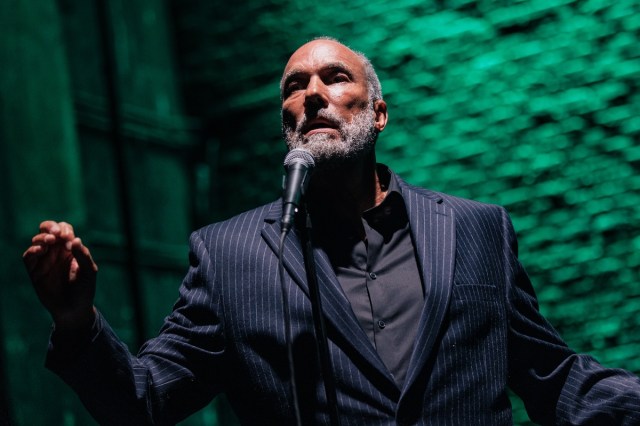
(© Marc J. Franklin)
Though Smith mentions some of those biographical facts, generally he assumes foreknowledge on the audience’s part—Basquiat’s drug abuse is barely mentioned, for instance. Instead, he seizes on specific details that he considers striking. A few days before Basquiat was born in 1960, a United Air Lines plane crash-landed in Park Slope after a deadly mid-air collision, causing a local church to burn down; on the day he died in 1988, the Empire State Building caught fire. “Jean’s life [was] inaugurated and extinguished in a crucible of flame” is how Smith ties these events to Basquiat’s life. At another point, Smith connects the car accident at age seven that left Basquiat without a spleen with Andy Warhol’s own brush with death after radical feminist writer Valerie Solanas’s assassination attempt in 1968, the juxtaposition suggesting the psychic bond that led them both to become friends after they formally met in 1982.
Smith himself met Basquiat while they were in Los Angeles in 1982, and they also subsequently became friends. In Honor of Jean-Michel Basquiat includes some of his own reminiscences, including, most memorably, the time at a club that he saw Basquiat angrily snatch a coat with a Confederate flag off a person and stomp on it.
Smith blends his own life story with Basquiat’s, seeing in him something of a kindred spirit. He opens the show by embodying his own father, who disapproved of his son’s decision to go into acting professionally but nevertheless encouraged him to be the best actor he could be. Just as Basquiat aimed to elevate African Americans in his art, Smith implies that he brings a similar uplifting impulse in his own stage and screen work. He drew on Basquiat for his performance as “artist-slash-arsonist” Smiley in Spike Lee’s 1989 masterpiece Do the Right Thing, which he discusses at some length in the show.
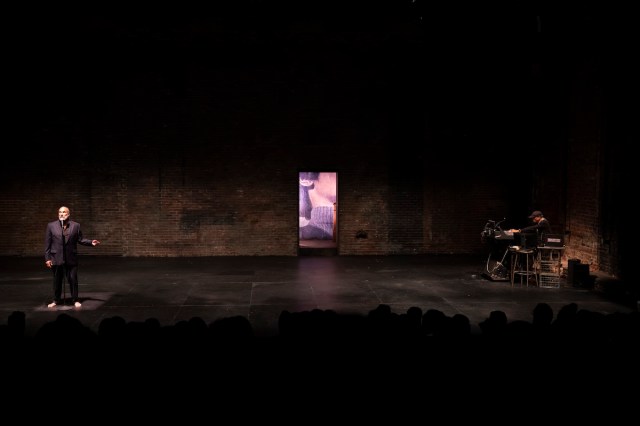
(© Marcus Middleton)
Smith presents this mix of biography and personal reflection in a stream-of-consciousness style in which he freely moves between characters and timelines, with Marc Anthony Thompson providing haunting live sound design. This unconventional approach could reflect Basquiat’s own artistry—like many of his subject’s canvases, Smith is neither afraid of mixing the directly confrontational with the poetically abstract, nor of mingling social commentary with surreal dream sequences. And yet, the material is made so diffuse as a result of its nonlinear style that frankly, one wouldn’t have been able to tell Smith and Basquiat had been close friends had Smith not basically said so a couple times. If one went into In Honor of Jean-Michel Basquiat knowing nothing about Basquiat, they might come away from the show still wondering, especially since none of his actual art is reproduced onstage. (No director is credited.)
Still, a little research never hurt anybody, especially if that means one could better appreciate the acting masterclass Smith offers. Raphael Mishler’s scenic design consists only of a doorway in the back of the stage with a glimpse of a self-portrait of Basquiat and the bottom of a staircase, while Arlo Sanders’ lighting design mostly holds a single overhead spotlight onto Smith himself.
That turns out to be all Smith needs to mesmerize us for 60 minutes. Even while mostly fixed in place speaking into a microphone, he keeps us rapt as his soothing voice weaves effortlessly between his and his friend’s lives, as if he was contemplating Basquiat’s influence on him out loud for our benefit. However much In Honor of Jean-Michel Basquiat may leave you feeling on the outside looking in, there’s no doubting the depth of feeling underpinning Smith’s virtuosity.




source on Google
Featured In This Story
Latest Reviews
See all





Latest Videos
Watch: Tom Hiddleston and Hayley Atwell Are Ready to Spar in Much Ado About Nothing
The longtime friends take on Shakespeare’s beloved Benedick and Beatrice in Jamie Lloyd’s confetti-filled production on Broadway.