
Review: Tartuffe, an Unexpected Romp from Serious Theater Artists
Lucas Hnath and Sarah Benson team up for a new take on Molière at New York Theatre Workshop.
 |
Off-Broadway
|
|
Off-Broadway
|
December 16, 2025
(© Marc J. Franklin)
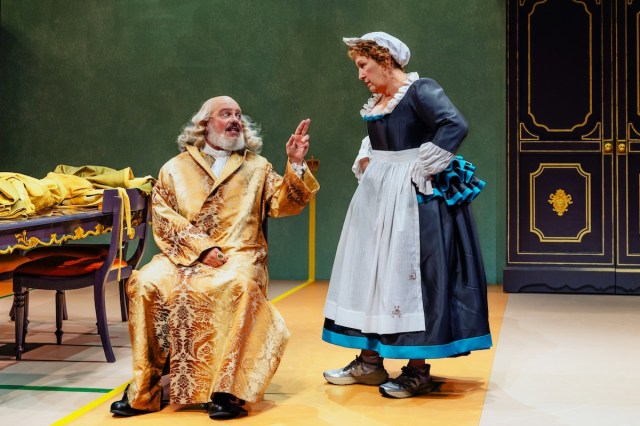
The most shocking thing about the new production of Molière’s Tartuffe at New York Theatre Workshop is how much it feels like a Molière play. Lucas Hnath’s adaptation of this 1664 French comedy is full of randy wordplay and rhyming couplets. Director Sarah Benson’s candy-colored production abounds with baroque frills and comedic thrills. These are two of the biggest names in downtown theater, responsible for award-winning hits and head-scratching failures, yet always relentlessly pushing against the boundaries of theatrical convention. But here they’ve delivered a Tartuffe that could easily be the shimmering jewel at the center of any regional theater’s season. It’s an unexpected delight, and absolutely the right call for a play that, all these centuries later, resists reinvention.
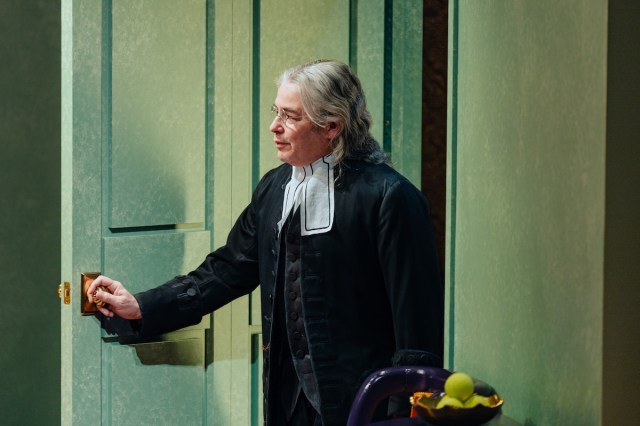
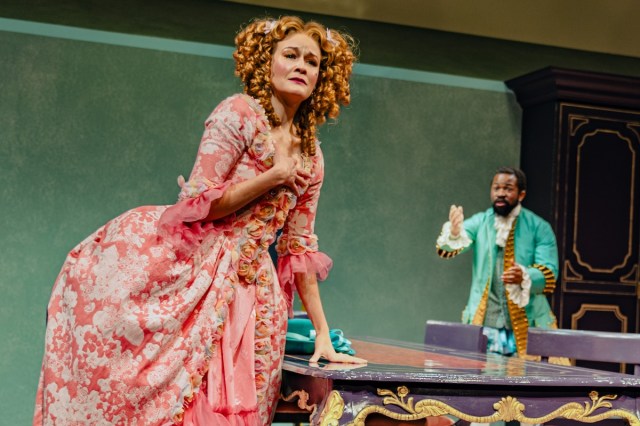
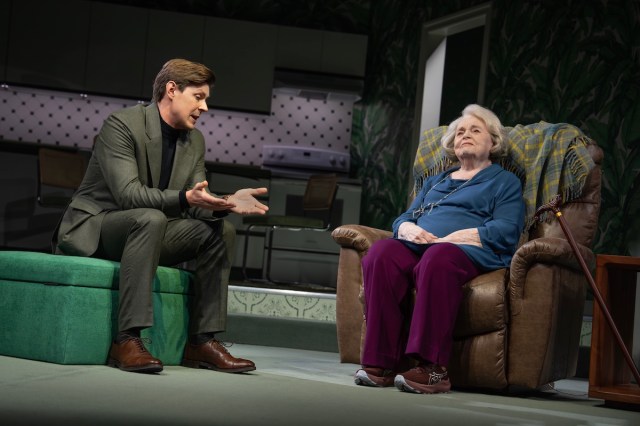
Perhaps that is because we are still so awash in sanctimony and fraud. Orgon (David Cross, a sassy Rembrandt portrait) is a rich man who obtained his money in ways that have left him feeling “scummy.” He has invited a self-styled holy man, Tartuffe (Matthew Broderick), into his home to assuage his guilt. He so values his guidance that he would like Tartuffe to wed his daughter, Mariane (Emily Davis, a scowling babydoll), even though she is in love with Valère (Ikechukwu Ufomadu, master of quick changes). Orgon not only wants Tartuffe in the family, he’s happy to sign over all his worldly possessions—even after Tartuffe openly admits to trying to sleep with Orgon’s wife, Elmire (Amber Gray with an unflappable dignity that makes the lunacy of her scenes even funnier).
“Now I only ask you give me what you’ve made me want—come on Elmire let’s not be a stingy cunt,” says Tartuffe in one of his more breathtaking lines, delivered in Broderick’s signature aggressively mild tone. It surprisingly works. Broderick looks like he just popped off an oatmeal box, and he sounds like every other role you’ve ever heard him play. But he makes sense as one of western drama’s great con artists. No one suspects the milquetoast.
(© Marc J. Franklin)
“Punish me beat me and give me no mercy,” Tartuffe instructs Orgon, “but just be warned that I’ll enjoy that as well on account of me being incredibly pervy.” Hnath clearly had a lot of fun crafting these rhymes, few of which are perfect but all of which achieve their intended goal, which is to make the audience laugh.
Tartuffe benefits from an exceptional supporting cast, the kind of actors who could sell snow boots in Tahiti. Bianca Del Rio warms up the audience as Mme Pernelle, Orgon’s judgmental mother, a role that fits the insult comic like an opera glove. Low-key exasperated, Francis Jue easily takes ownership of Cleante, Orgon’s brother and the voice of reason. Even wiser is the maid Dorine, whom Lisa Kron plays as a no-nonsense lesbian in sensible sneakers. Her line readings are as dry as a good white wine. On the other end of the spectrum is Orgon’s son Damis, played by Ryan J. Haddad with soap-operatic flair. I particularly enjoyed the relish with which he burst forth from the closet after catching Tartuffe in the act.
These big performances coexist on the same stage because Benson and the designers have created a cohesive world for them to inhabit. Enver Chakartash’s vibrant costumes drag-up baroque fashion (already over-the-top) for the most eye-popping looks of the fall season, topped by Robert Pickens’s sky-high wigs. The movement of every curl and tassel is visible under Stacey Derosier’s brilliant lighting. The scenery (by dots) evokes a storybook baroque manor with plenty of open space for broad physical comedy.
(© Marc J. Franklin)
Lines on the floor suggest a tennis court, with the actors performing tiny tennis-themed ballets between scenes (contemplative choreography by Raja Feather Kelly). These soothing intervals are interrupted by a harsh athletic buzzer (sound by Peter Mills Weiss), as if to say, play ball. It’s a not-so-subtle comment on the gamification of human behavior, how every word and action becomes strategic when so much money is at stake. We are meant to see the artifice, but it in no way detracts from our enjoyment of the game.
The production only becomes critical of Molière and his play at the end, when the actors perform a song (by Heather Christian) about how everything has been resolved by the gracious and wise King and no further interrogation into the nature of wealth, the law, and morality is necessary. “We all know and we agree, we’re the good ones obviously,” they sing, tongues firmly planted in cheeks. I think Hnath and Benson have earned this bit of Brechtian bitchery following an otherwise sparkling production, which still includes a bit of shameless Bourbon propaganda disguised as a deus ex machina. Honestly, it would be theatrical malpractice to let that pass without comment.
Ultimately, artists will always seek to flatter the people who pay for their work, and for Molière there was no patron more important than the king. This dynamic hasn’t changed in 2025, when Tartuffe still forcefully asks, Why are you looking to the theater for moral and spiritual instruction?




Featured In This Story
Latest Reviews
See all
Latest Videos
Watch the Trailer for Tovah, a Documentary About Tovah Feldshuh
The film includes appearances from Oscar Isaac, Dustin Hoffman, Kristen Bell, Patti LuPone, and more.