
Review: In The Ask, a Rich Old Liberal Faces Off with a Woke Young ACLU Rep
Matthew Freeman’s drama gets a remount at Theater 555.
 |
Off-Broadway
|
|
Off-Broadway
|
October 15, 2026
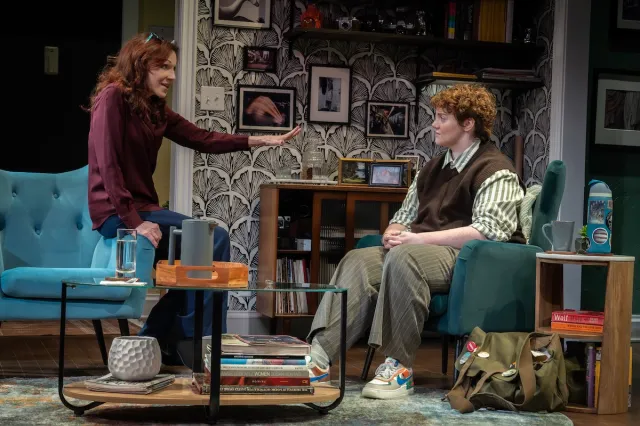
(© Joan Marcus)
In the coming decades, $110 trillion is expected to pass from Baby Boomers and the remaining members of the Silent Generation to their heirs—but they’re not dead yet! And since older Americans command most of the wealth of the nation, they still have an outsize say in the priorities of our government and America’s not-for-profits, provided those institutions are run by people interested in remaining solvent.
That’s the bind in which the American Civil Liberties Union finds itself, both in real life and in Matthew Freeman’s The Ask, now receiving a remount at Theater 555. The play depicts a 2022 meeting between longtime donor Greta (Marilu Henner) and ACLU representative Tanner (Shannon Purser), who has been sent by the organization to determine why Greta has stopped giving, and perhaps persuade her to reconsider.
But Greta is pissed. She feels like her money is being wasted on a wish list of niche progressive causes (rural broadband, student debt forgiveness) while the ACLU loses the big fights she really cares about, like nationwide abortion access. She doesn’t like the way her longtime contact, Carol, left the organization without even notifying her (she suspects Carol was let go as part of a wave of layoffs the executive director idiotically referred to as “right-sizing”). And she looks askance at the Orwellian language deployed in fundraising e-mails, and by Tanner across her coffee table—terms like “pregnant people.” Greta wonders if an organization that refuses to use the word “women” can ever vigorously defend their rights.
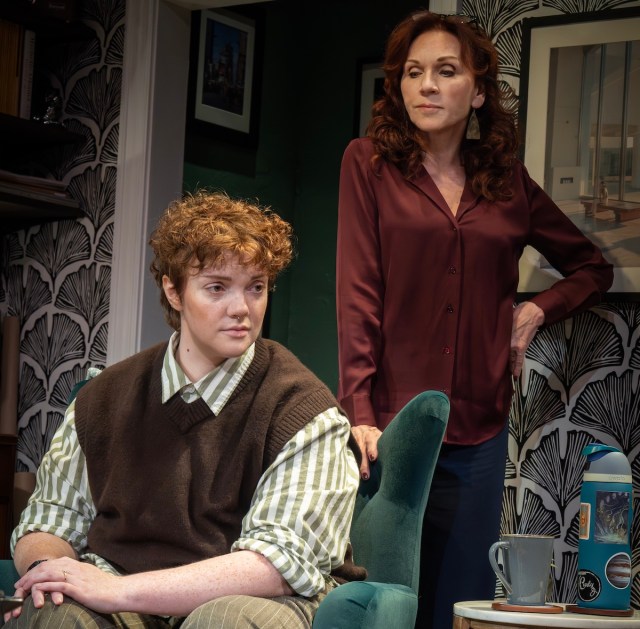
(© Joan Marcus)
Undergirding this tension is the fact that Tanner has outwardly disavowed the identity of “woman” in favor of they/them pronouns and somewhat professorial men’s clothing (the spot-on costumes are by Nicole Wee, who arms Henner with rich lady boots meant to convey the message, I was a creative in the 1970s). But because Tanner needs something from Greta, they cannot just dismiss her as a bigot and hit block. So the conversation stretches out for 75 agonizing (but also illuminating) minutes of intergenerational dialogue.
I really enjoyed The Ask in its 2024 world premiere at the Wild Project, and I was curious to see how a new venue, performers, and the passage of two years altered my perception of the play.
Director Jessi D. Hill’s staging remains straightforwardly realistic on D. Craig M. Napoliello’s set, which depicts the well-furnished drawing room of an Upper West Side pied-à-terre that Greta surely considers “cozy” (it only occupies the central third of the stage). New lighting designer Venus Gulbranson keeps the space illuminated so we can detect every minor facial twitch, though the pointed warming of the lights at key moments is a bit more noticeable than it ought to be. Sound designer Ben Scheff (also new to the production) deploys a suitably irritating cue for Greta’s constantly ringing iPhone, but he smartly only intrudes with city noises when the conversation approaches its end, suggesting an intense level of intimacy.
Not much has changed about Freeman’s script. However, “he’s never going to win again” is now a laugh line.
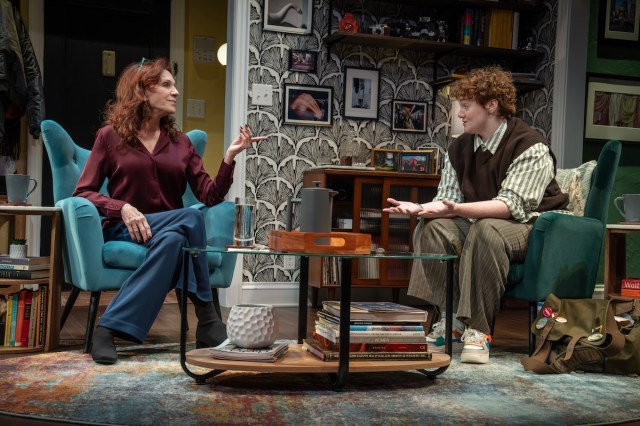
(© Joan Marcus)
That naïve reassurance is spoken by Tanner, the more challenging of the two roles because of how restrained they are by professionalism. We never learn about Tanner’s background or home life in Bushwick (and Greta notably never asks); but Purser conveys so much through her eyes, little distress signals flashing above a load-bearing smile. When Greta leaves the room for a phone call and Tanner is allowed to momentarily drop the façade, it feels like a dam bursting.
Greta, who catches them mid-sob, responds by offering Tanner a tissue and a glass of water. Then she continues talking about herself. Henner is in many ways less likable than Betsy Aidem was in the role, but also more believable. Her steamroller energy tells the story of a woman who has been waiting a long time to be heard, and her impassioned harangues are delivered as if to Chase Strangio himself, rather than a low-level emissary with no actual power. And she seems blithely unaware of just how remote her lifestyle is from most Americans when she ludicrously asks Tanner, “Do people still ski with climate change?” But the catch in her voice tells us that this is personal, that the ACLU has betrayed her and someone must pay. Henner’s pitch-perfect performance captures the unflappable narcissism of an entire generation.
The value of The Ask is still how it exposes the ideological rift between the highly educated people who staff legacy American institutions and their Boomer parents who play the bills. The theater knows this conflict well. It is the same cultural divide between the kind of people who make theater and those who pay full price for tickets. It’s a relevant story when so many not-for-profits still seem to be trapped in woke 1, but it feels less urgent with Slam Frank playing the Orpheum. And it’s not nearly as interesting as the larger gap between elites (be they liberal Boomers or hard-left Zoomers) and baseline American opinion. I suspect it’s in that chasm that many of this country’s great 20th century NGOs will go to die.




source on Google
Featured In This Story
Latest Reviews
See all





Latest Videos
Watch: Aaron Sorkin, Bradley Whitford, and the Cast of A Few Good Men Talk New Broadway Revival
The playwright reunites with his West Wing star for the first Broadway revival of the career-making drama.