
Review: Good Bones but a Shaky Foundation in James Ijames’s Wilderness Generation
Ijames aims for a big American play but falls short at Philadelphia Theatre Co.
 |
Philadelphia
|
|
Philadelphia
|
April 16, 2026

(© Mark Garvin)
Ask a playwright to define the building blocks of American drama and he’ll likely cite a house, a family, and a secret. James Ijames follows this familiar pattern in Wilderness Generation, receiving its world premiere through May 3 at Philadelphia Theatre Company. After collecting a Pulitzer Prize and Tony nomination for Fat Ham, which translated a Shakespearean epic to a contemporary Southern milieu, Ijames here tries his hand at the same general themes that have fascinated authors from O’Neill to Hansbury to Letts. Despite good bones, the results find him on a shakier foundation.
The action opens on a suburban Virginia home that seems suspended in time. (Matt Saunders designed the detailed, realistic set, with lighting by Thom Weaver.) As the unseen Grandma Bobbie lives her best life on vacation in Cancún, the task falls to her grandchildren to close up the family house, now that she’s moved to a senior-citizen apartment complex. Siblings Ramona (Heather Alicia Simms) and Smitty (Brenson Thomas) arrive with their cousin Nicole (Jessica Johnson), memories and grudges in tow. They are ultimately joined by Micah (Lindsay Smiling), another branch of the family tree who straddles the line between prodigal and black sheep.
Family plays rise and fall on the believability of relationships between the characters, but Ijames spends the first act largely spinning his wheels. The audience learns about each cousin’s career path—non-practicing lawyer, doctoral student, social media influencer—and about Nicole’s burgeoning relationship with Donovan (Abdul Sesay, who lacks the charisma the role requires), who seems genuine despite his proclivity for recording TikToks at the absolute worst times. Rifts are also vaguely suggested, but Ijames seems more intent on fleshing out the history among the principals. From a too-brief introduction, though, we come away with little sense of what the house means to each party, and why being together under this roof, after many passing years, unlocks both nostalgia and recrimination.
The connections among the characters feel unmoored partially due to Taibi Magar’s production, which seems halting and underrehearsed. The actors largely deliver their lines to the audience, not to each other, and they remain boxed into the stage apron, not taking advantage of the life-like dimensions of Saunders’s set. A family photo wall looms with a sense of importance over the cousins’ shoulders, yet when they brush past these snapshots of the past, you sense they’re communing with total strangers. With the exception of Simms—who finds nuance in Ramona, the most fully fleshed character—the performers often default to a broad, comedic tone, which tamps down a sense of intimacy that should be felt among people who have decades of shared history. Kara Harmon’s costumes do as much work to define individual personalities, if not more.
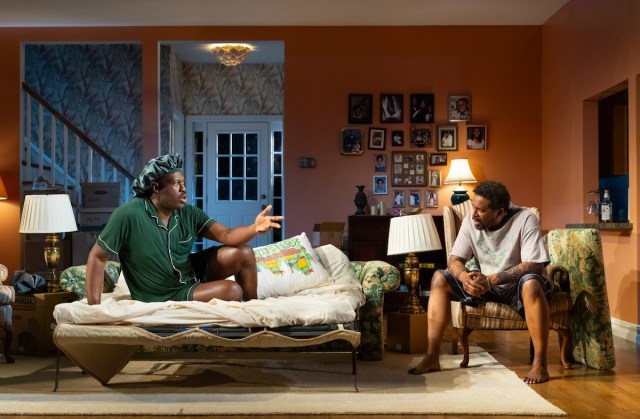
(© Mark Garvin).
The play’s second act kicks things into high gear, and a tender scene between Smitty and Micah dramatizes the sometimes-fraught dynamics between gay and straight male family members. (Thomas and Smiling, two of Philly’s finest actors, do their best work of the evening in this interaction.) Yet much of Ijames’s script still comes across as sketched rather than fully realized. An anticipated revelation of familial impropriety arrives with fury, is briskly dispatched, and the brood makes up before adverse consequences could even be considered. The drama ends with a muted redemptive flourish, expected and bland.
At its best, Wilderness Generation functions as a bright, broad comedy, with big laughs and low stakes. But Ijames seems after something grander that doesn’t coalesce in the final product. For a playwright whose strongest work comes across as startlingly original, it too often feels here as if he’s speaking with someone else’s voice, trying to slot his entry into the sweepstakes of important American family plays. It’s a noble goal, but here it’s frequently lost in the wilderness.




source on Google
Featured In This Story

Latest Reviews
See all







Latest Videos
Watch the Trailer for Elsinore Starring Andrew Scott
The film is based on the true story of Ian Charleson, who played Hamlet at London’s National Theatre after being diagnosed with AIDS.