
Review: America, Who Hurt You? and the United States of Sarah
Theatre for a New Audience and the National Black Theatre bring Sarah Jones back to the New York stage.
 |
Off-Broadway
|
|
Off-Broadway
|
September 17, 2026
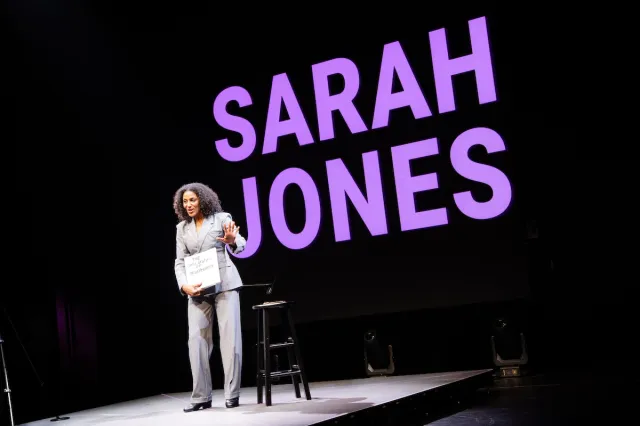
(© HanJie Chow)
I have seen well over 1,000 shows in my two decades as an observer of New York theater, so I am uncomfortably aware that my mind can play tricks on me as the sounds and images preserved in my memory blur and skip like an old VHS tape. But I was certain that the monologist Sarah Jones was American. So why was she speaking as herself from the stage of TFANA’s Polonsky Shakespeare Center, but with a posh London accent? I made a mental note to order some ginkgo biloba when I got home, hoping I wouldn’t forget that, too.
As most of us should be able to recall by now, it has been 250 years since America declared independence from Britain. But only 20 years have passed since Jones won a Tony Award for her remarkable show Bridge & Tunnel, which remains fresh in my mind as one of the best solo performances I’ve ever witnessed. Jones has a talent for mimicry and dialect—so much so that she fooled me with her British accent. Though once she switched back to Sarah from Queens, she humbly states, “If you’re a Brit and you fell for that, your gummies are working!”
Jones’s British accent gets a workout in her new solo show, America, Who Hurt You?, which is largely based around an intervention for America (portrayed as a bratty teenager with a California vocal fry and golden iPhone glued to her hand) presided over by dear old mum (the show was commissioned by Oxford University and the National Black Theatre, a co-producer of this New York run). Atrocities are highlighted on a timeline (sleek work by video designer Stefania Bulbarella), giving America an opportunity to defend and (mostly) deflect.
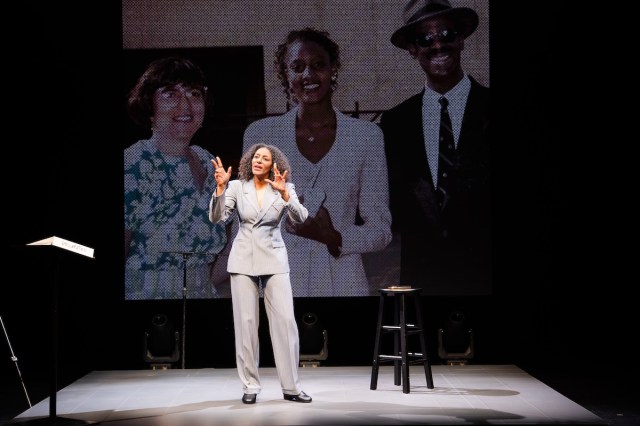
(© HanJie Chow)
As that reckoning with American history unfolds, other Jones creations emerge to have their say. Nereida, a fast-talking Dominirican woman, offers that we all must suffer under the reign of King Donald, “even if you’re a nice blanquito or whatever, and for you, the hardest thing you’ve had to live through was the pandemic.” Jones pitches down and crinkles her nose to become Rashid, a Black man, who reminds the audience that the situation as always been dire for his people. While Lorraine, an elderly Jewish woman conjured through pruned lips and a slight palsy in her right hand, counters that the microaggressions so many young Americans categorize as trauma pale in comparison to the pogroms her ancestors suffered in Eastern Europe.
While many of Jones’s characters are inspired by members of her extended multiracial family, some are not. Jones appears visibly nervous as she gently folds her arms to portray Habiba, a Jordanian woman who immigrated to America by way of Palestine, a word with the power to make everyone in the off-Broadway theater clench up.
Jones is up there with Anna Deavere Smith and Jefferson Mays as an actor who can instantly leap from character to character in a believable way using just her voice and a few specific physical gestures. Her power is undiminished from her one Broadway credit, and in many ways has matured.
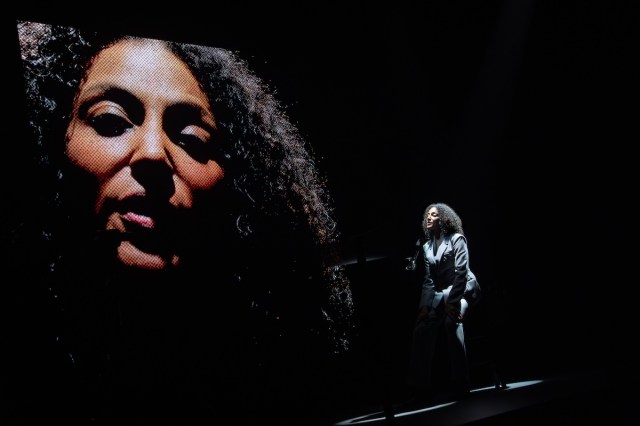
(© HanJie Chow)
Director Eric Ting wisely steps out of her way with a production that supports Jones’s performance-centric and highly portable style of theater. The neutral gray suit Toni-Leslie James costumes her in is the spiritual cousin of a hunky magician’s sleeveless shirt. Jiyoun Chang’s mostly bare set and simple-yet-effective lighting suggest a show that could easily fit into college auditoriums of all sizes. Sound designer Palmer Hefferan subtly ornaments Jones’s voice for a segment in which Britain administers a psychedelic to America so that it might hear voices from the past.
Jones gives Hank, the one straight white male in Jones’s menagerie of humanity, the most vulnerable monologues of the show, in which he recalls the violence of his alcoholic father, his son’s battle with addiction, and his fear about a precarious future. That’s something we all share in the audience, no matter our politics.
Jones’s characters feel so real because she approaches them all with deep and sincere empathy. That’s the key ingredient for great performances, but also a better America.




source on Google
Featured In This Story

Latest Reviews
See all








Latest Videos
Jocelyn Bioh, Whitney White, Jasmine Amy Rogers, and Patina Miller Talk School Girls
The playwright, director, and stars of School Girls; Or, the African Mean Girls Play discuss the comedy, sisterhood, and themes behind the new Broadway production.