
Prototype Review: Hildegard Presents a Portrait of a Divinely Inspired Girlboss
Sarah Kirkland Snider’s flawed but mesmerizing opera about Hildegard von Bingen makes its New York premiere.
 |
New York City
|
|
New York City
|
January 12, 2026
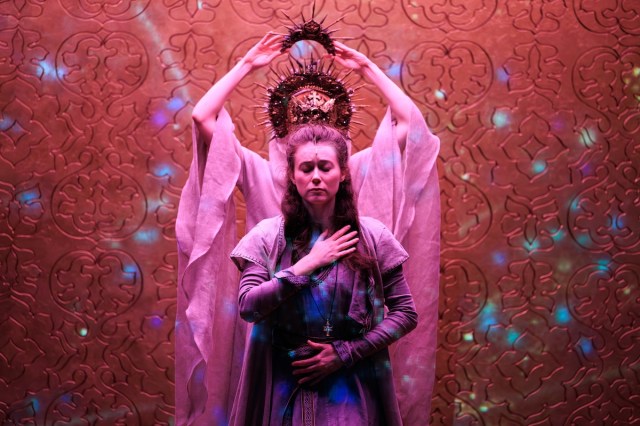
(© Angel Origgi)
Though German Benedictine abbess Hildegard von Bingen lived in the 12th century, fascination with her life and work remains strong today. Beyond her activity as a self-proclaimed mystic visionary, she was a Renaissance woman before the Renaissance, with pioneering efforts in literature, music, science, and philosophy. And aspects of her biography—her establishment of a couple of all-female monasteries, her maybe-romantic relationship with fellow nun Richardis von Stade—suggest she was something of a proto-feminist. Those interpersonal aspects are the starting point for Hildegard, a striking if flawed new opera from composer-librettist Sarah Kirkland Snider making its New York premiere at this year’s Prototype festival.
We see Hildegard (Nola Richardson), a mother superior at the Disibodenberg monastery in 1147, in the midst of one of her visions. Among the rest of her monastic group, only priest Volmar (Roy Hage) believes in the prophetic nature of those visions, which is why he decides to transcribe them. The process of putting these visions down on paper gains another dimension when Richardis (Mikaela Bennett) enters the monastery: Discovering she has a talent for painting, Hildegard enlists her to help illustrate them. Though the monastery’s abbot, Cuno (David Adam Moore), is skeptical of Hildegard’s visions, he allows these transcriptions to be sent to the Vatican for papal evaluation.
The heart of the opera lies in the relationship between Hildegard and Richardis. Unlike Richardis’s mother (Blythe Gaissert), who brings her daughter to Disibodenberg believing her seizures indicate diabolic possession, Hildegard diagnoses her condition as epilepsy. In Hildegard, Snider accepts speculation about the romantic nature of their relationship as truth and imagines the psychological and spiritual effects their forbidden desire has on both characters. In Hildegard’s case, the inner turmoil this queer awakening inspires in her mingles with both her confusion over the meaning of her visions and her frustration at being stymied by monastery higher-ups.
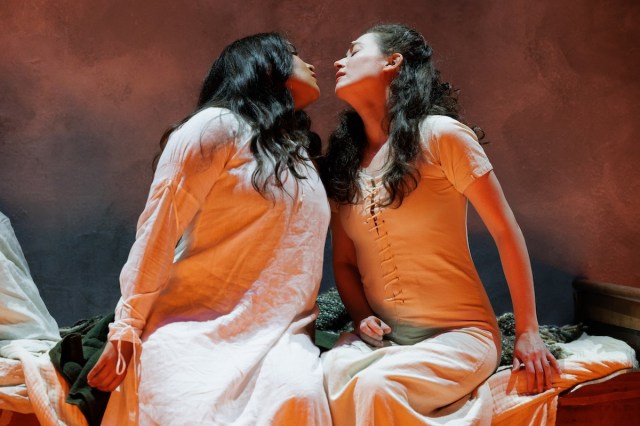
(© Angel Origgi)
Snider’s aim to go beyond Hildegard von Bingen’s sainthood and present her as achingly human is admirable. Alas, she hasn’t resisted the temptation to infuse these characters and their milieu with pointedly contemporary flavors. For all her vulnerability, her Hildegard ultimately comes off as something of a divinely inspired girlboss, transcending both Cuno’s patriarchal arrogance and the even more secular force of money—Richardis’s mother is a wealthy donor to Disibodenberg, a circumstance that puts the monastery in a perilous financial position when she objects to Hildegard’s treatment of her daughter. One might lament the more nuanced and challenging work Hildegard might have been had Snider worked harder to look past a presentist perspective.
It’s a good thing that her music is so gorgeous. Snider’s song cycles Penelope and Unremembered showed off her knack for eliciting lush textures with the sparest of instrumental means and her ability to switch between tonal minimalism and stark dissonance on a dime. In her 2020 Mass for the Endangered and now Hildegard, she brings out the inner spiritual core only hinted at in those earlier works, blending sacred harmonies with more modern touches in ways that are fresh and affecting. Even the discreet electronic enhancements that gives a halo-like effect to the sensitive playing of the chamber-sized Novus Ensemble under the direction of Gabriel Crouch adds to the score’s sense of contemplation even at its most dramatic.
The terrific cast aids immensely in putting the score across. Moore cuts an imposing figure with his brute-force baritone as Cuno, though not without hints of paternal warmth to offset the one-note villainy. Hage vividly projects his soaring tenor lines, oozing dedication as Volmar. And though Hildegard and Richardis are sung by sopranos, Bennett’s darker vocal hues as the tormented Richardis make for a sharp, earthy contrast to Richardson’s lighter, luminous tones as Hildegard. Snider has also given Hildegard a wider vocal range, with Richardson effortlessly nailing many moments of high-pitched coloratura.
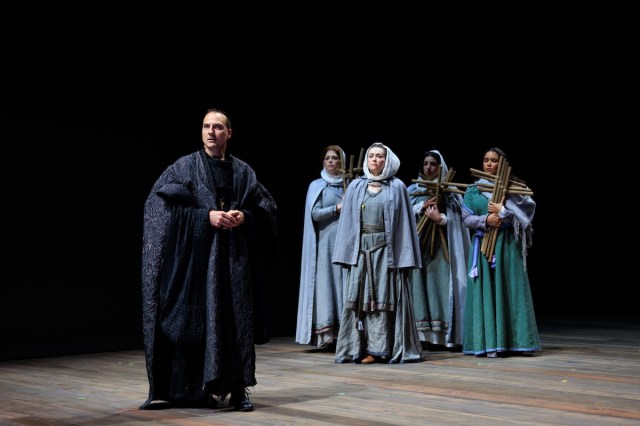
(© Angel Origgi)
Director Elkhanah Pulitzer matches Snider’s score with an appropriately spare production. Marsha Ginsberg’s production design consists mostly of a monolith-like slab and a movable cube representing different monastery settings, while Pablo Santiago’s lighting basks in basic chiaroscuro shadings. Deborah Johnson’s projections give Hildegard’s visions entrancing visual shapes. With the aid of Laurel Jenkins’s movement direction and Molly Irelan’s costume design, Pulitzer makes literal Hildegard’s conflict between worldly evil—represented by performers wearing crow masks—and the character’s divine will, represented by angels and a faceless woman (Chloë Engel) whom she sometimes emulates until she reaches a moment of physical connection toward the end.
It’s on such elemental levels that Hildegard works best. Snider’s work may not offer profound insights into the inner life of this remarkable medieval polymath, but musically speaking at least, it’s still one of the more remarkable new operas in quite some time.




Featured In This Story

Latest Reviews
See all
Latest Videos
West End vs Broadway: Oh, Mary!—From an Angry Inch to an Angry First Lady, With John Cameron Mitchell and Mason Alexander Park
Mitchell and Park celebrate a decade-long friendship in our latest installment.