
Interview: Talking About Fish, a Coming-of-Age Comedy Where Teen Girls and ISIS Meet on Twitter
Playwright Melis Aker chats with her stars Yasmin Ranz-Lind and Alyssa May Gold about their genre-bending world premiere at WP Theater.
 |
Off-Broadway
|
|
Off-Broadway
|
October 7, 2026
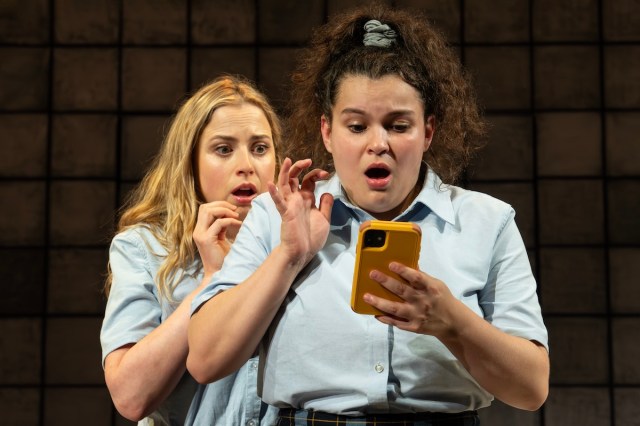
(© Joan Marcus)
In Fish, Melis Aker’s dark comedy now having its world premiere at WP Theater, 17-year-old best mates Karya (Yasmin Ranz-Lind) and Libby (Alyssa May Gold) stumble arm in arm through their adolescence in 2016 London. There are boy troubles, unwieldy periods, parental spats—the traditional horrors of teen girlhood. And then there’s the ISIS catfishing scam.
Coming of age is never a composed process, but Aker writes to the unique existential dread of 2016, a time when populism was just revving up, Twitter went from pithy playground to divisive hellscape, and proxies for the violent Islamic State seemed to be everywhere. Karya’s mother (Roxanna Hope Radja), a Turkish woman raising her family in the UK, is convinced her son’s disappearance is the result of an ISIS recruitment. And so, with the kind of brazenness only enjoyed by a partially developed brain, Karya and her boy-crazy bestie hatch a dumb plan with their smartphones.
Read TheaterMania’s conversation with Aker, Ranz-Lind, and Gold about this teen girl caper where the friendship politics have even higher stakes than the geopolitics.

(© Joan Marcus)
This conversation has been condensed and edited for clarity.
Melis, what was the original idea for this play? Was it always meant to revolve around the friendship between two teen girls?
Melis: There were two stories that I kind of plunked into my curiosities folder on my computer. One was called Mothers of ISIS, which is a pretty grim portrayal of mothers trying to look through footage online to find their missing sons. The other one was about four Chechen women who catfish scammed ISIS and then got prosecuted by the Chechen government (because clearly we hate women more than we hate terrorists). I really wanted to find a way to merge these two stories together and it took me 10 years to figure out the container for it. Yes, it’s dark, but I wanted this to be a comedy, ultimately. I wanted this to be absurd. So that’s sort of the journey it took to come to this.
It really is a teen girl romp that circles some dark topics. Yasmin and Alyssa, do you remember your first impressions of it?
Yasmin: I love dark comedy, and it was just one of the best-written new plays I had read in forever. It’s the kind of play that when you’re in drama school you’re like, “That’s the pinnacle of the work that there is to be doing in theater.” And the character Karya—we’re very different in a lot of ways but very similar in other ways. I really saw her codependent friendship. We don’t see a lot of that in media. We see a lot of toxic codependent romantic relationships, but personally, my experience was a string of toxic codependent friendships that shaped those years of my life. So that exploration was really meaningful to me.
Alyssa: I remember reading it and just feeling like I had never seen a friendship explored this way. Two girls get wrapped up in something small that becomes very big. One gets off scot-free and one has their life altered by it. I’ve never seen this sort of complexity of class and stakes explored in something that is also a comedy. And it was a page-turner. Even reading the first draft in 2024, I was like, “Wait. They’re gonna do what?!”
Karya being a first-generation British Turk makes her experience of girlhood in London significantly different than Libby’s. How do we see that cultural disparity play out between the two?
Yasmin: It’s not something that’s at the forefront of Libby’s mind at all. The reason it becomes important in the context of the play itself is because one of these girls has dire consequences and the other one does not. We explore why that is.
Alyssa: Libby has no awareness of the culture. Whenever you see Libby onstage, it’s never the most important thing that is happening in her day, because the most important thing that’s happening is George, her boyfriend. Everything she’s saying is sort of an afterthought while she’s waiting for this boy to text her. That’s the subtle sleight of hand Melis has done with watching these two girls. They don’t have a deep conversation about, “Well, because you’re blonde, you can do x, and that’s not fair because x.” We just watch someone who believes she is neutral and her culture is “girl” and her super-objective is “boyfriend.”
Melis: It’s also impossible to ask young people to know that there would be a difference in how they exist in the world until they experience the difference. That difference sometimes doesn’t come until an event happens and then you understand, “Oh, I’m affected differently. I guess we’re not the same.”
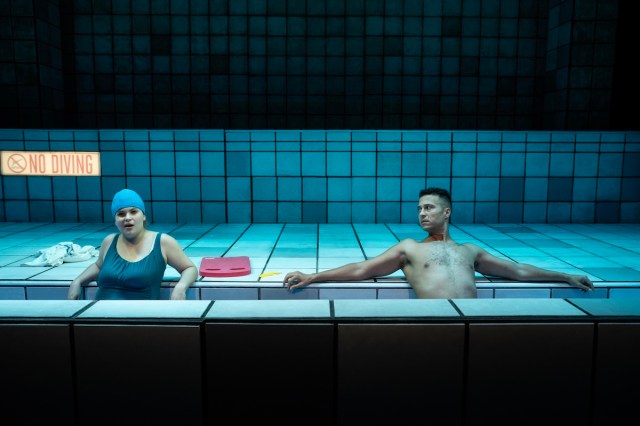
(© Joan Marcus)
At the same time, we’re seeing Karya test out a new persona through her catfishing scam—someone confident and seductive. What’s her objective, beyond digging for information about her missing brother?
Yasmin: Karya doesn’t know what kind of woman she wants to be. She has these three examples: Her mother, who is effortlessly elegant; [her brother’s ex-girlfriend] Isha [Sara Haider], who’s effortlessly confident, and then Libby, who Karya perceives to be this cool and effortlessly fun woman. Karya’s trying to put on all these different costumes of womanhood and none of them fit. That’s been one of my favorite things to explore with her because I connect to that.
Why is that the kind of character that interested you, Melis?
Melis: I think we have all forgotten what it’s like to be a teenager. I remember being at that age and feeling like nothing has consequences and everything has consequences. It’s such an extreme way of existing. In 2016, it felt like the world in a global sense was losing its innocence as well. I wanted to place a young girl coming of age in that time. She’s looking for anchors in the world, but the world doesn’t offer those anchors anymore.
Alyssa: But also, no matter what age you are, no matter what year it is, it’s a fiction that there is a way you can explore being a woman that doesn’t come with backlash. I don’t see anyone not receive backlash for whatever version of woman or girl they are trying to be. We still think there is one way that is the right way. For who? I don’t know. For a culture that doesn’t want us to be feral? That doesn’t want us to be many things at once? To take up space? To be confused?
Melis: It’s looking at a young person’s arc and seeing how they build from the outside in, because we don’t give them the tools to build from the inside out. Ultimately, for me, this is about trying to be seen. It’s about not being a replacement to a missing brother. It’s about [Karya’s] line: “I am here. I am the one who is still here.”




source on Google
Featured In This Story

Latest Reviews
See all







Latest Videos
Watch the Trailer for Elsinore Starring Andrew Scott
The film is based on the true story of Ian Charleson, who played Hamlet at London’s National Theatre after being diagnosed with AIDS.