
Interview: Susannah Flood on the Sanctity of Strange Theater and the Audacity of Liberation
Flood leads the Broadway cast of Bess Wohl’s latest work.
 |
Broadway
|
|
Broadway
|
October 29, 2025
(© Little Fang)
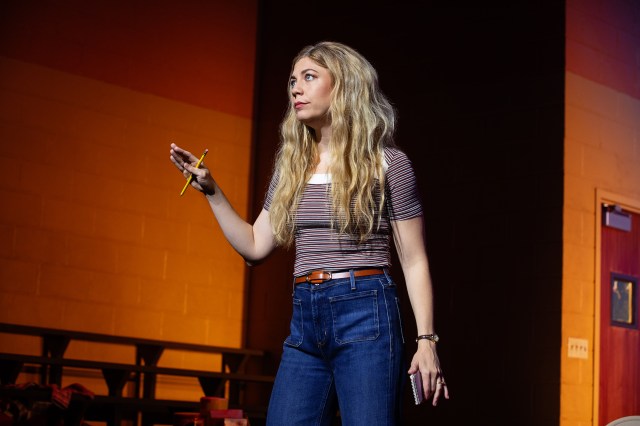
“In the words of Liberation, ‘This is family lore,’” says Susannah Flood, the star of Bess Wohl’s feminist memory play.
Sitting in a coffee shop a few blocks from her new Broadway home at the James Earl Jones Theatre, a hint of ‘70s flower child in her real-life mane of breezy blond hair, she exhumes a memory from her days as a Brown/Trinity MFA student. It’s in answer to a question about her taste in new plays, but you learn quickly that Flood’s responses come in story form.
“There was this exercise that essentially drove one of my classmates into a place of complete hysterical vulnerability,” she recounts. It was a class in physical theater. Flood remembers how the teacher leading the exercise embraced the student whose defenses had been shattered. Then he turned his attention back to the room, “complete fire in his eyes.” She delivers his words in character: “‘If this is not what you are doing, I do not want to pay money to see you. I do not…want to pay money…to see you.’”
A playwright couldn’t write drama school antics any better. But along with a choice anecdote for a cast party, she tiptoed out of that classroom with a mission statement. “If you’re going to do theater, and you are going to make no money,” she says, encapsulating the moral of the outburst, “you should not be wasting your own precious time on the planet by not giving yourself entirely to something.”
(© Joan Marcus)
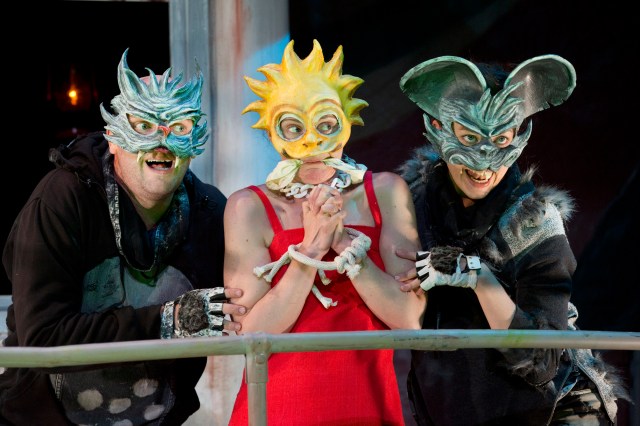
It gives context to a resume that’s become a portrait of off-Broadway theater’s wildest fancies where commitment is non-negotiable. One of her earliest jobs in New York was in Anne Washburn and Michael Friedman’s Mr. Burns at Playwrights Horizons. She played one of the apocalypse-surviving performers in a Brechtian theater troupe that traveled around reenacting the “Cape Feare” episode of The Simpsons. “My God,” says Flood. “Three acts. And there’s a musical canto at the end where we’re all in masks?” She laughs at the nerve of it. “I mean, it sounds just totally insane.”
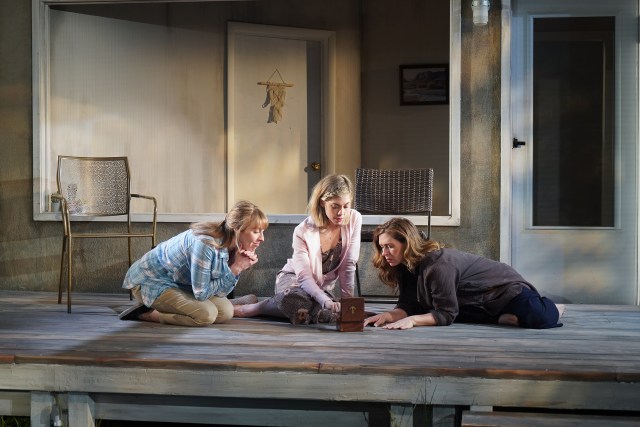
She also got in with the downtown theater company Clubbed Thumb, an incubator for burgeoning American playwrights that, just this fall, made her an honoree at its annual gala alongside Miriam Silverman and Flood’s longtime best friend and fellow Brown album Crystal Finn. The trio starred in Clubbed Thumb’s 2018 production of Plano, an inexplicable, time-warping Will Arbery play about three sisters in a world of nightmares and multiplying men.
Flood’s circle of up-and-coming artists had another notable member. “Branden Jacobs-Jenkins happened to be a young person who was kicking around at the same time,” she says. Jacobs-Jenkins, now a two-time Tony winner for his Broadway plays Appropriate and Purpose, cast her in his 2023 play The Comeuppance, about a high school reunion ominously attended by Death.
The Comeuppance was Flood’s first time back onstage after giving birth to her then-six-month-old son. It was also a last-minute switch-up in the Signature Theatre season that required a 10-year-old draft to transform into a fully realized play in just five weeks. “Nobody knew what that was gonna be when we started,” says Flood. “I was sleeping like three hours a night. And Branden was writing the play. The first preview, we put in 50—that’s not an exaggeration; five-zero—new pages that night. It was just like, ‘Well, I think Branden is one of the voices of this generation. So, whatever it’s gonna be, I’m on board for that.’”

(© Monique Carboni)
Before the exalted downtown theater artist image can crystalize, Flood light-heartedly interjects. “I haven’t made it a goal to just to be in strange new plays. If any TV producer out there reads this article and wants to put me in something, I will say yes.” She’s already done a handful of high-profile commercial projects, including the Shondaland legal series For the People and Amy Schumer’s semi-autobiographical Life & Beth. Liberation is also her third Broadway credit. She shared the stage with Diane Lane in Chekhov’s The Cherry Orchard in 2016 and joined Debra Messing in Noah Haidle’s Birthday Candles in 2022.
Her career does, however, reflect the core philosophy etched into her at Brown/Trinity. “Working with a playwright on a new piece of writing and meeting the challenge of that playwright’s imagination was exhilarating,” she says of her time there. “That, in some ways, gave you a way to work up an antidote to embarrassment.” By graduation, no imagination was too bizarre to meet. “New play development was the vehicle that could give American theater its next generation of block builders. That idea went in really deep.”
Or perhaps just deeper than it had already been impressed on her at home. “My parents were acting teachers, so it resonated with stuff I observed and heard as a child,” Flood says. She spent the first 10 years of her life in New York, the next four years in New Mexico where her mother taught acting at the College of Santa Fe, then moved in with her father and stepmother (also an actress) in Santa Monica.
“There was a constant conversation about acting going on in the background of my childhood almost at all times,” she says. It’s something she craves even now. “When my dad comes to see [Liberation], I am going to yearn for his conversation about it and his affirmation of it.” She continues, her storytelling instincts kicking in. “There’s this picture of us walking in Central Park with this tricycle. It’s my dad, who’s very tall, and four-year-old me. Part of me is always desiring that. That monopoly of his attention so we can talk about acting together.”
(© Elke Young)
Flood ended up an English major at UC Berkeley and considered a future in academia before an undergraduate acting class funnelled her to the role of Juliet in New Mexico. From that moment on, I was kind of like ‘Well, all these other things were just flirtations,’” she says. “That’s a hard role. I was young. There were some nights where I was not good. But I had a chance to put skin in the game by risking failure, and it felt right.”
It’s no coincidence she measures new plays by same benchmark. “I don’t want to be in something that doesn’t risk saying what it cares about,” she explains. “It has to put its own skin in the game.”
The sentiment has more than subtle echoes of Liberation, a play centered around a group of second-wave feminist activists who search for their way into the fight from a set of folding chairs in a basement gym in Ohio. Flood plays Lizzie, the group’s de facto leader, a woman with aspirations as a journalist who objects to the institution of marriage on principle. She also plays Lizzie’s daughter, who is piecing together this fabled history from the present day and wondering how her mother traded such staunch beliefs for classic American domesticity.
“Liberation is a complete high-water mark in my career and life because it does braid all of these pure artistic values with the audacity of a commercial run,” Flood says. “It’s a new play by a writer I respect, that challenges people, that is a huge swing structurally.”
That the play drew crowds for its previous run off-Broadway at Roundabout Theatre Company was meaningful, but “saying that it’s commercially viable is a more audacious claim,” she argues. “And I believe in it.” The fact that iPhones are safely locked away in Yondr pouch jail—owing to a 15-mintue scene that features six women scrutinizing, ridiculing, and celebrating various parts of their naked bodies— is a bonus. “Lowkey, that’s the reason we’re on Broadway,” she asides. “Because people are watching the play.”
![[0473r] Kim Fischer, Susannah Flood, Samantha Mathis, and Brad Heberlee in Make Believe, Photo by Joan Marcus](https://www.theatermania.com/wp-content/uploads/sites/4/2025/10/0473r-Kim-Fischer-Susannah-Flood-Samantha-Mathis-and-Brad-Heberlee-in-Make-Believe-Photo-by-Joan-Marcus-e1761579507312.jpg?w=640 "[0473r] Kim Fischer, Susannah Flood, Samantha Mathis, and Brad Heberlee in Make Believe, Photo by Joan Marcus")
(© Joan Marcus)
Of course, as vocations go, theater is among the more transient, offering little proof that it’s impacted anything or anyone. “I guess I have a radical faith in it,” says Flood. “The conversation around acting is a spiritual one for me. And that’s true generationally.”
She thinks back to that first preview of The Comeuppance. She remembers surrendering to the thought, “I know very little about what I am going to do tonight.” Whatever she did know had to be enough. “It turned out I could think a lot faster; I could be in a lot less control, I could accept way more vulnerability,” she says. “I would never have learned that if I hadn’t had a child. If I hadn’t challenged my own life by exploding it a little bit.” Lizzie and her daughter get to have that piece of lived wisdom floating in their shared bloodstream.
“I do think it’s a long game,” Flood says, breathing in the big picture of this fickle, weird, and sacred life as an actor. She points to Glenda Jackson and her 2018 Tony-winning performance in Edward Albee’s Three Tall Women. Jackson, then 82, hadn’t been on Broadway since 1988. “All of this intelligence and all of this life came on stage with her,” Flood remembers, moved by the memory of Jackson’s supremacy in that space. “That is the career that I want,” she says. “I want a big life with a great variety of experiences.”
Sounds like the definition of liberation.
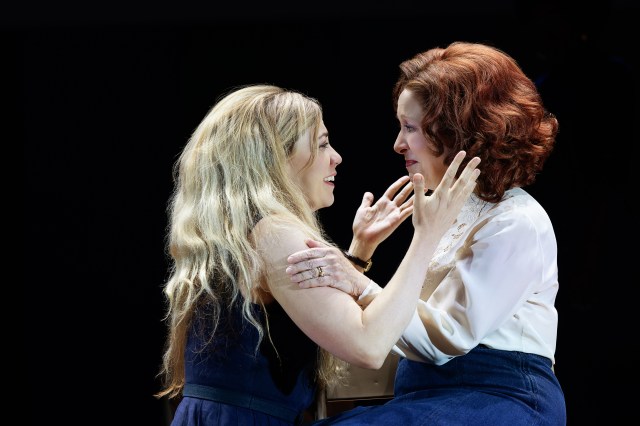
(© Little Fang)




source on Google
Featured In This Story
Latest Reviews
See all
Latest Videos
Watch Lindsey Kraft, Featuring Ben Folds, Sing "Beautiful Pain" From the Musical We've Been Here Before
We’ve Been Here Before starts performances on August 4 at SoHo Playhouse.