
Interview: Jonathan Spector on Birthright, Jewish Identity, and Theater After October 7
The Eureka Day playwright discusses his ambitious new off-Broadway drama.
 |
Off-Broadway
|
|
Off-Broadway
|
July 6, 2026
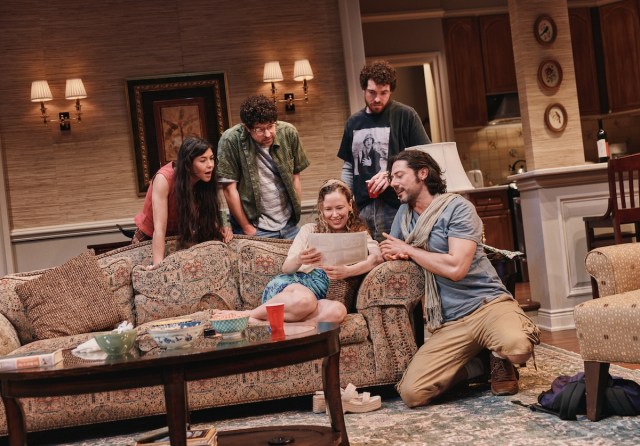
(© Emilio Madrid)
Jonathan Spector has built a reputation for tackling thorny subjects with sharp humor, compassion, and a keen ear for how people talk past one another. Best known for his Tony-winning play Eureka Day, his acclaimed comedy about consensus, vaccines, and progressive ideals together in a pressure cooker, Spector now turns to even more personal and politically charged territory with Birthright.
The play follows a group of young American Jews who meet on a Birthright trip to Israel in 2006, then reconnect over 18 years as friendship, faith, history, and identity are tested by a rapidly changing world and the aftermath of October 7.
TheaterMania.com spoke with Spector about why he initially resisted writing the play, how conversations with American Jews helped shape it, why the story spans nearly two decades, and how audiences are responding to a work that is both deeply serious and unexpectedly funny.

(© Tricia Baron)
This conversation has been condensed and edited for clarity.
You were initially asked to write something about the Jewish American experience after October 7, and you said no. What changed your mind?
[Michel Hausmann of Miami New Drama] asked me to write something about the tumultuous American Jewish experience in the moments after October 7th, and I did not want to, not just because of all the intense feelings about it, but also the scope and scale of it. It just felt too much to be able to take on and wrap your arms around. He was persistent, though, and as I tried to make sense of the moment personally, an idea started to take shape.
What eventually pulled you toward the project?
I started doing a series of interviews with other Jews … trying to get as wide a range as possible, not just political belief, but religious background and their relationship to Judaism. A thing that kept coming up in those interviews was just what a difficult time it was for everyone … and something else that kept coming up was people’s experience on Birthright. It felt like a good sort of centralizing idea to begin to explore a play around.
How long did it take to write?
Much less time than it should have. I think I said yes to writing the play in February of 2024 and Michel was like, great, we’re gonna do it next season, which I thought was insane, because I had not yet written it. The joke was on him, because he announced a play that wasn’t written yet, and it turned into a play that at that time was about 4.5 hours long, and needed a working hot tub onstage.
Audiences won’t have their phones during the show, which I found refreshing because everyone was focused and there were no accidental rings.
I love it so much. I’m thinking, how do I write this into every contract, every show from now on because you don’t have the experience I basically always have in the theater now, where somebody’s looking at their phone and someone behind them is yelling at them about it.
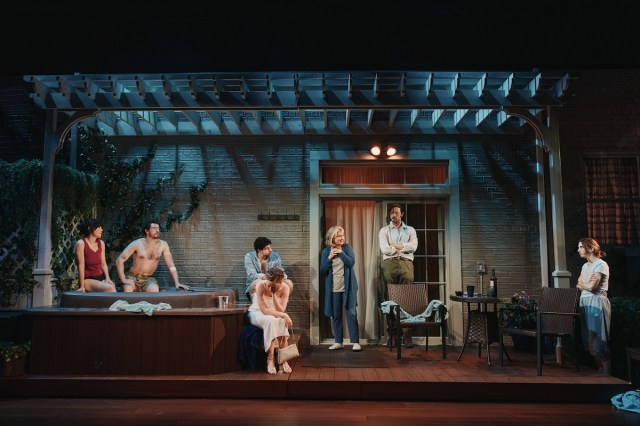
(© Emilio Madrid)
Were you thinking about how non-Jewish audience members might receive the play as you wrote it?
Certainly in the beginning of writing it, one of the things I did was give myself permission to really just be writing a play for the conversation within the Jewish community. I didn’t take on the obligation to explain everything. But I think the universal is found in the specific, often, and that some of these same things people are wrestling with are happening in many communities, in many parts of our world.
The play spans 18 years and returns often to the idea of history. Why structure it that way?
When you watch the way these conversations or debates play out, online or in person, around Israel and Palestine, people move very rapidly from talking about something that happened yesterday, to something that happened 80 years ago, to a thousand years ago. The notion of history is so wrapped up in how people engage with this. I set it on 18 years because eighteen is a number of special significance in Judaism. Once I started digging into 2006, I realized 2007 was the year the iPhone came out and Facebook went into wide availability so 2006 was really the last moment of the world before the one we live in now.
Now that it’s playing in New York, how has the reception been?
The overwhelming response has been super positive, and it’s been really gratifying. So far it’s been wonderful, and I am super happy the play is being so well received.
When I heard it was over 3 hours, I admit I was worried I might nod off but I was super engaged the whole time and the two intermissions helped break things up.
I think the idea of a three-plus-hour play about a heavy subject matter is daunting, but the experience of people watching the play is that it moves by. The other thing I want people to know is that it’s actually very funny too.




source on Google
Featured In This Story

Related Articles
See all

Latest Reviews
See all







Latest Videos
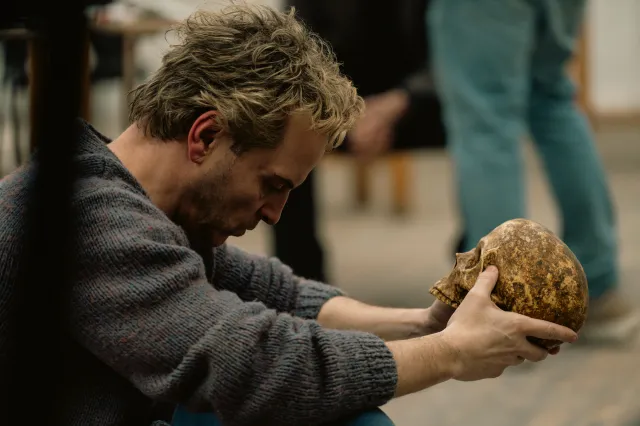
Watch the Trailer for Elsinore Starring Andrew Scott
The film is based on the true story of Ian Charleson, who played Hamlet at London’s National Theatre after being diagnosed with AIDS.