
Interview: Danielle Pinnock: "Whoopi Goldberg Was Essentially My First Uta Hagen"
Pinnock stars in the off-Broadway premiere of The Whoopi Monologues at Lincoln Center Theater.
 |
Off-Broadway
|
|
Off-Broadway
|
July 9, 2026
When she was just a kid, Danielle Pinnock would take the bus to Lincoln Center, walk to the New York Public Library for the Performing Arts, sit down in the darkened screening room of the Theatre on Film and Tape Archive, and obsessively pore over the archival recording of Whoopi Goldberg’s eponymous one-woman show. Teenage Danielle would obsessively study Goldberg’s body language and her timing of a joke. Those afternoons helped shape Pinnock’s artistic ambitions, convincing her that there was a place onstage for someone who looked and sounded like her.
Decades have passed and adult Danielle has garnered a level of TV fame: after a few seasons playing Young Sheldon’s math teacher, she got a series regular role on Ghosts as the Prohibition-era jazz singer Alberta. That’s all and well and good, but this summer, her life is officially coming full circle—she’s starring in the Lincoln Center Theater production of The Whoopi Monologues, a multi-actor adaptation of Goldberg’s original one-woman show, directed by Whitney White.
In this conversation with TheaterMania.com, Pinnock reflects on Goldberg’s enduring influence on her life and the responsibility of honoring an icon’s work while bringing her own lived experience to it.
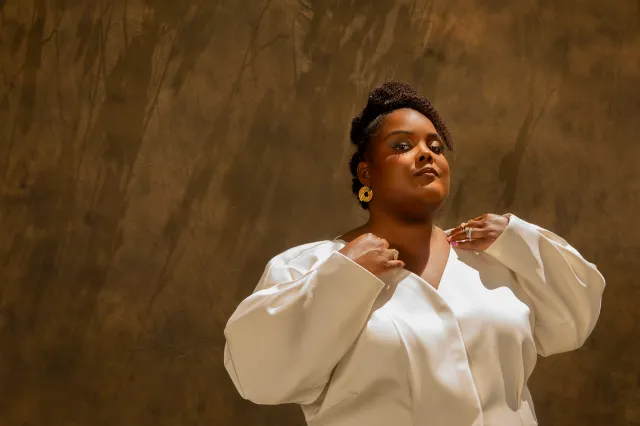
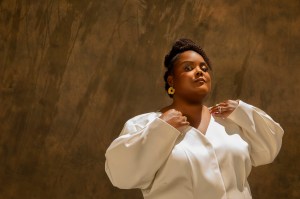
(© Kim Newmoney)
This conversation has been condensed and edited for clarity.
What was your first exposure to the work of Whoopi Goldberg?
The Color Purple, and I remember being so transfixed by her. I think I was maybe about 13. I couldn’t take my eyes off her. I was like, “Who is this woman?” And my mom was like, “That’s Whoopi Goldberg.” And I was like, “I need to learn more about her.”
I was a Black Matlida. I would go to the library because we didn’t have TV. I would take the 167Q bus to the Lincoln Center library and I asked them about Whoopi Goldberg, and they said, “She has a one-woman show, and you can watch it upstairs.” That was my first real introduction to her as a playwright and a multihyphenate.
I did not know she did theater, and that was something that I was thinking about at that time. I was in school plays, but I didn’t see many people that looked like me, that were unconventional in any way. Watching that one-woman show gave me the courage to pursue the arts, because I’m like, “If she can do it, maybe I can do it, too.” She is so integral to why I became an artist.
I feel like a lot of people see her on The View and either don’t realize or forget just how expansive her career has been.
Her impact goes so far and wide, through so many of us. Any time I see an actor on The View, they’re like “Whoopi Goldberg, you are the reason.” I want the younger generation to learn more about her. I think you’re right; a lot of people see she’s on The View, but if people just understood… She is such a titan in this industry. First Black person to host the Oscars. My God. She is a historical legend.
So, you’d go to the Performing Arts Library to watch her show.
Every single weekend. And my mom would be like, “Don’t you want to watch anything else? We could watch Gypsy!” And I’m like, “No!” I wanted to study the craft. I wanted to learn her nuances and comedic timing. I wanted to learn when audiences were laughing and what emotional beats she took. Whoopi Goldberg was essentially my first Uta Hagen. Any time that I get to be in her presence, I’m always asking questions.
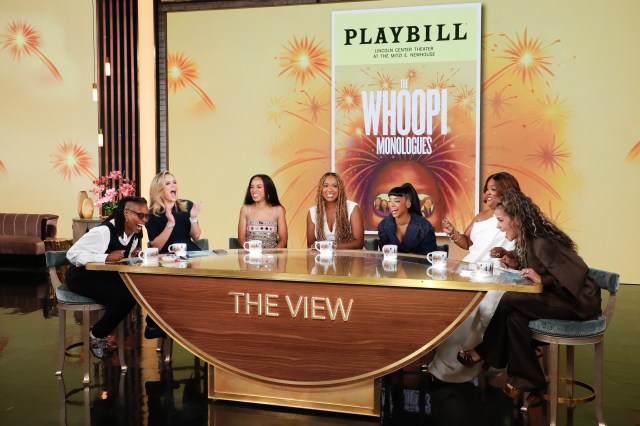
(© Lou Rocco/ABC)
When you started rehearsing for this production, did you have to sort of disregard your memory of her performance?
I’m never going to disregard Whoopi. She’s given us such a beautiful map of how to not only portray the character, but also to find our ways through the language. I’m not one of those actors that’s like “I’m just gonna do my own thing.” She’s given us a blueprint and I want to follow that. Even though this was done in the ’80s, a lot of these jokes still land, in the same places. There are certain beats in there for a reason.
The beautiful part about me being cast is that I am a first-generation Jamaican American, from Jamaica, so it feels special to be able to honor my culture this way on stage and make sure that I do it justice.
How are you preparing, in that regard?
I’ve been working with my mom on my patois accent. My husband, Jack Wallace, is an incredible dialect coach, and Oliver Samuels, who is one of the largest comedians in Jamaica—on the Mt. Rushmore of Jamaican legends, it’s like, Oliver Samuels, Bob Marley, Usain Bolt, and our adopted sister, Céline Dion, because we love her so much—has flown in to coach me on this to make sure I got all the nuances of the language.
I want to give this role my all, not only for the culture, but to give a human face to the immigrant experience. A lot of times, immigrant stories are reduced to politics and headlines, but this character is so funny when she’s talking about her adventure coming to the United States for the first time. Whitney White, our director who is truly a genius, has given me incredible notes on how to sell that journey.
You spent so many weekends studying Whoopi’s work, and now you’re performing just a few steps away, within the same complex. Has the full-circle nature of that journey sunk in yet?
It really hit me. Theater has always been my biggest dream. I worked in Chicago at the Goodman and Second City. I’ve done Shakespeare internationally. I’ve been doing documentary theater since I was 19 years old. Anna Deavere Smith was my mentor for a long time. She was very impactful in getting my one-woman show Body/Courage up in Chicago. I’ve put more than my 10,000 hours in.
I haven’t done theater in maybe 10 years, and it feels like a homecoming. [Cast member] Kerry Washington keeps saying “We are living in divine timing.” If you work hard enough and keep your head down and you’re a good Samaritan and you take the craft seriously, some of these things can come to fruition.
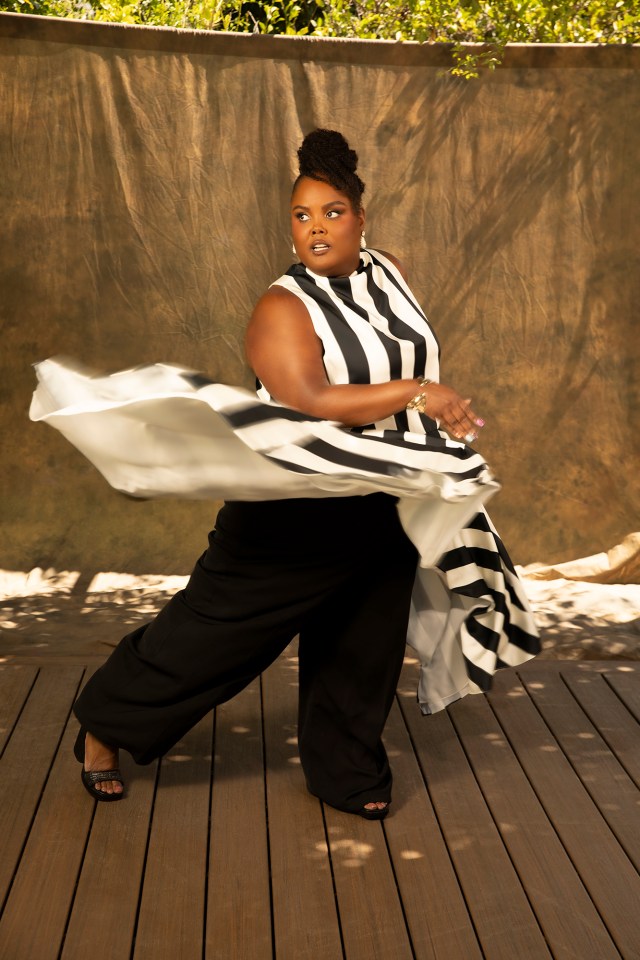
(© Kim Newmoney)




source on Google
Featured In This Story
Featured Artist
Latest Reviews
See all



Latest Videos
Watch: Aaron Sorkin, Bradley Whitford, and the Cast of A Few Good Men Talk New Broadway Revival
The playwright reunites with his West Wing star for the first Broadway revival of the career-making drama.