
Interviews
Interview: John Wilson Presents More of My Fair Lady Than You've Heard on Record
The British conductor’s new recording is the third in an important series of complete recordings of musicals.
 |
London
|
|
London
|
December 5, 2025
In September, a new recording of My Fair Lady was released on CD and streaming platforms. It wasn’t tied to a new production of the Lerner & Loewe classic, but was rather an in-studio production featuring a British orchestra and a mostly British cast, including Scarlet Strallen as Eliza Doolittle and Jamie Parker as Professor Henry Higgins.
Beyond the high quality of the vocal and orchestral performances, the most noteworthy aspect about the recording is its completeness. Whereas most cast recordings only include hit tunes and one or two instrumental numbers, this My Fair Lady recording includes reprises, scene-change underscoring and other such bits, all in Robert Russell Bennett’s original orchestrations for its 1956 Broadway premiere.
This recording is the third in a series of such exhaustive recordings led by British conductor John Wilson, with Rodgers & Hammerstein classics Oklahoma! and Carousel preceding it. Wilson isn’t a pioneer in this regard. Back in 1988, a complete recording of Show Boat, led by American maestro John McGlinn, blew the cobwebs off a work that had, through decades of revision, evolved into a mere vehicle for nostalgia. Theater fans may not know anything about Wilson’s recordings is because they were released by Chandos, a British label mostly devoted to classical music.
Wilson sat down with TheaterMania to discuss My Fair Lady, this important series of recordings, and his passion for “light” music.

(handout image)
This conversation has been condensed and edited for clarity.
Why do you believe complete recordings of musicals are worth making?
These pieces have stood the test of time, and whilst they’ve had many adaptations over the years, I think we’re in danger of losing sight of what it is that the composer and the authors intended. We live in an age of bold new imaginings and reinventions, which, on the one hand, I applaud, and I’ve even been involved in those kinds of productions. But I also think you have to be true to the spirit of the original composer/author when you do those things. And I just wanted to remind everybody how amazing these pieces are when you do them representing the final thoughts of the authors.
Why did you choose Oklahoma!, Carousel, and now My Fair Lady?
We decided early on we will do the big classics. So we’ve done Oklahoma!, Carousel, My Fair Lady, and we’ve just finished Guys and Dolls. If the series continues to do as well as it’s doing, then of course we will get into the territory of pieces which are perhaps less well-known. I would love to do complete She Loves Me. I would love to do a complete Camelot.
How did you come across the original orchestrations for My Fair Lady?
When Lincoln Center mounted their production back in 2018, a move was made to restore the original orchestrations from the original manuscripts just to make sure that everything really was as close as it could possibly be to what people heard in 1956. And a friend of mine, Bruce Pomahac, supervised the restoration of those orchestrations. It’s one of those rare instances of a piece where every single note of the original materials—sketches, Frederick Loewe manuscripts, Robert Russell Bennett manuscripts—everything survives and is preserved at the Library of Congress.
Was this also the case with Oklahoma! and Carousel, or was there more work involved in reconstruction?
Pomahac, who was head of music at Rodgers and Hammerstein Organization for decades, did those restorations in the 1990s and the 2000s. I remember Bruce telling me people have been playing “People Will Say We’re in Love” from Oklahoma! with the second violin part missing for decades. We’re now doing the kind of archeological work that people have been doing on Mozart and Haydn and Bach for centuries.
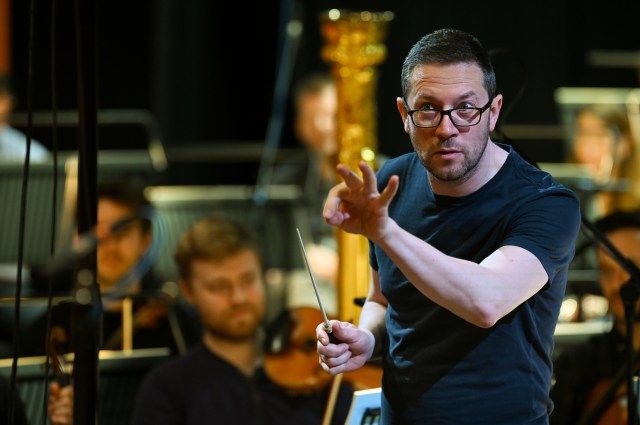
(handout image)
In addition to conducting classical music, you’ve conducted a lot of music by Rodgers & Hammerstein, Cole Porter, George Gershwin, and more with both the Sinfonia of London and your previous band, the John Wilson Orchestra. Was there anything in your childhood that led to this interest?
I would say it was just a part of my overall interest in music. I guess where I’m different from a lot of symphonic conductors is, I’ve never seen this music as a sort of an annex to what I do. I’ve always considered theater music as important to me as Puccini or Elgar or any of the big symphonic composers. It’s a different style, but I don’t take it any less or more seriously.
At the end of your My Fair Lady album, you include a handful of numbers cut from the Broadway production in an appendix section. Why did you feel a need to include those?
First of all, it’s good music. Also, Julie Andrews said that “Say a Prayer for Me Tonight” was one of her favorite numbers. And Rex Harrison’s “Come to the Ball,” that was his biggest number, and it was cut. So they weren’t insignificant. Then there’s a whole ballet choreographed by Trudi Rittman which must have taken weeks to work out. Then it was just dropped. It’s of a completely different character to all the music in the show. All those reasons conspired to make an interesting collection of things to put on the record.
How did you develop this interest in doing this kind of reconstruction work? As far as I can tell, you didn’t major in musicology.
Yeah, I did my degree in composition. Not that I ever wanted to be a composer, but I wanted the discipline of putting music down on paper. If you put on a musical, you’ve got three, four weeks to rehearse it, and it’s being orchestrated as it’s being written. So of course things were written at great haste, and then there’s quite a bit of tidying up that has to be done afterwards. And sometimes that tidying up never happened…until now. I didn’t want to have to spend 30 years of my life, say, reconstructing 300 lost numbers from MGM musicals because somebody destroyed them, but they were destroyed. And the music is too important to never be played in a concert ever again.




Latest Reviews
See all
Latest Videos
West End vs Broadway: Oh, Mary!—From an Angry Inch to an Angry First Lady, With John Cameron Mitchell and Mason Alexander Park
Mitchell and Park celebrate a decade-long friendship in our latest installment.