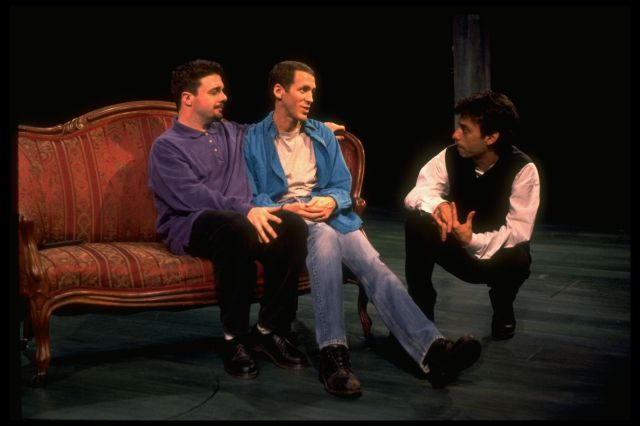
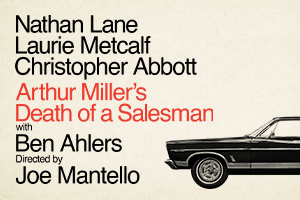
In 1995, as Joe Mantello stepped away from a successful acting career to focus on directing, he had a vision for one of the actors he had cast in Terrence McNally’s Love! Valour! Compassion!
Nathan Lane, already a Tony winner, was playing the flamboyant Buzz Hauser, and something about him made Mantello believe that one day they would tackle Arthur Miller’s Death of a Salesman together. Lane, by Mantello’s account, was as surprised by the idea as anyone. But Lane hadn’t done The Iceman Cometh or Angels in America or The Nance at that point, and Mantello hadn’t yet found his way into primal works like Blackbird and The Humans and The Boys in the Band.
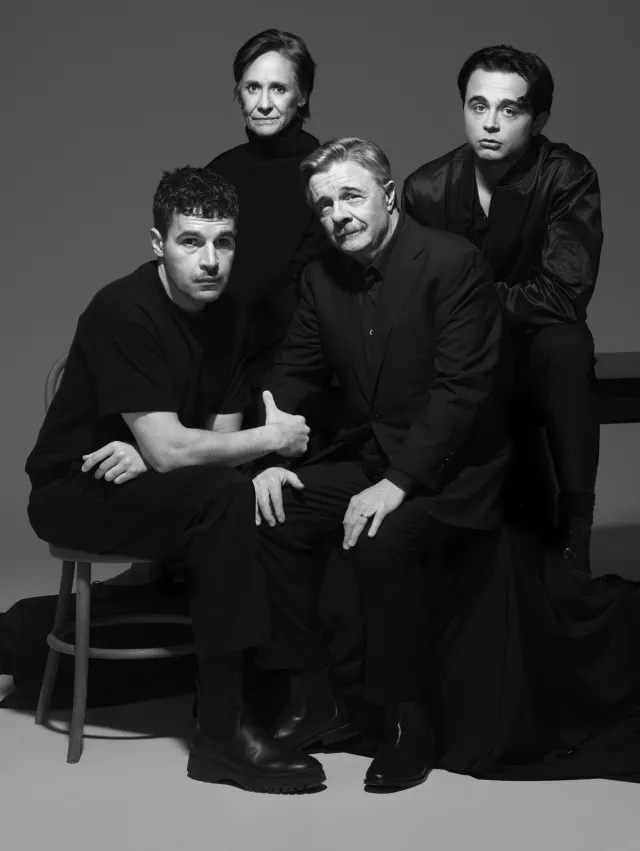
Given the depth both artists have plumbed in the decades since, the fact that they are indeed scailing Mt. Loman together, three decades after Mantello foretold it, seems less like a prophecy and more like an inevitability. That they’re joined by their longtime colleague Laurie Metcalf (as Linda to Lane’s Willy) is even less surprising. Being three great friends makes it easier for Mantello to do his work, but it’s still Death of a Salesman, and the pressure is still on, especially as Mantello looks for a different way to explore a classic.
This conversation has been condensed and edited for clarity.
I know you and Nathan have been dreaming of this production for a long time.
Over 30 years. The first time we worked together, at Love! Valour! Compassion!, I said to him “I’m going to direct you in Death of a Salesman someday.”
What was his reaction back then?
I think he was shocked. It seemed like such a projection into the future. It was just an instinct that I had watching him. We’ve talked about it on and off over the years, but more like a pipe dream than anything else.
When did Laurie come into the fold?
More than 10 years ago. She was doing All My Sons out in East Hampton, and the three of us went for drinks after the show, and I remember us sitting around this dark little bar, dreaming about it.
Nathan’s spoken of seeing Lee J. Cobb play Willy. What Salesman experiences have you had in your life?
I saw the Brian Dennehy version. I saw the Dustin Hoffman version on TV. And we did it my freshman year of drama school and I played Happy. Our Willy was played by my best friend, T. Scott Cunningham. He was very good. Laurie had never seen a production of Death of a Salesman. She had never seen Virginia Woolf either.
Fascinating.
She always felt like these are roles that she might play some day, so she did not want to have any preconceived notions of how one would play these two parts. It’s very Laurie, if you know her.
Is Nathan the Willy that you imagined he would be 30 years ago?
He definitely is. He’s one of our greats, and I’m glad he’s getting a crack at this.
This production extricates the play from the traditional vision of the Loman household and really seems to set it inside of a warehouse in Willie’s mind. Tell me about building the visual world of the production with Chloe Lamford, the scenic designer, and Jack Knowles, who did the lighting.
It really started accidentally. I was carrying around the acting edition, reading it, as I do, many, many times. I started to get frustrated by all the stage directions, so I reached out to them asking if there is a draft that exists without the stage directions, which I assume reflected the Kazan version. Julia Bolus, this wonderful woman who was Mr. Miller’s assistant and is kind of the archivist of the Miller estate, sent me a draft which was, I think, the draft before they went into rehearsal. It was his vision of the play before the Mielziner set, just sort of the pure instinct of the play on the page. It was remarkable as a document. He references the bedroom and the kitchen, but he describes it in terms of defining the space with light. It’s very abstract.
We knew that we were going to remove it from the physical space of the house. The way Chloe and I work is that we send images back and forth. There were photos of installations in art galleries in which the entire floor had been excavated, but the piece itself was open and very pristine. Jack comes at it from a dramaturgical point of view. He took his clues from the renderings that Chloe had done of the set, the scene-to-scene breakdown in which the lighting was really articulated. We translated that into a visual vocabulary for the production.
One of the questions I always have about Salesman is whether Willy is having flashbacks, or if he has some kind of dementia. It did seem to me that this production is set entirely within his head.
Miller said very clearly that they’re not flashbacks—Willie is not revisiting his past, but the past and the present absolutely exist simultaneously. He called them concurrences. I was interested in the notion of younger versions of Happy and Biff and Bernard and what that does to the play. When I got the version from the Miller estate, that is how he imagined it. When the characters are listed, it says Willie, Linda, Biff, Young Biff, Happy, Young Happy. There are even depictions of seeing the younger versions at different times in the play. That was one of the things that led me to having both younger Biff and Biff, and younger Happy, and Happy, all on stage simultaneously. It’s pretty early on, probably 10 or 15 minutes in, where you see that he’s activating all four of them at the same time in his mind. That became the north star for the production.
This is a cast that, beyond even Nathan and Laurie, is stacked with fantastic actors. K. Todd Freeman is doing some of his best work ever as Charley, the neighbor. There’s a scene between him and Nathan where you can tell everything you need to know about their relationship just by how they look at each other. When you have a play that’s this extraordinary, it makes the job of casting easier. Every production is a reflection of the people who work on it, and how you navigate your way through the play is a combination of all the minds and hearts of people in the room. Everybody has been incredibly generous and trusting and interested in trying to interrogate the play in a different way.
K. Todd and I went to drama school together, and then we did Angels in America in Los Angeles, so there is a deep history between the two of us. It’s a different take on Charley that’s effortless and minimal and deep and different. It’s complicated to explain because you obviously feel their history as characters, and yet there’s this gulf between them that they can never bridge, but there’s great affection. Charley is the one that steps forward, at least in our production, and eulogizes him. He has a profound understanding and acceptance of Willie, and he gives Willie a certain amount of grace, perhaps when he doesn’t even deserve it. They’re remarkable together.
Nathan and Laurie are so emotional together as Willie and Linda, but there’s nothing about their relationship or the production itself that feels overtly sentimental, which is fascinating.
That is exactly how we described it when we were working. What he’s going through is so harrowing. There’s a tendency to want to indicate to the audience, isn’t this awful? Look what he’s happening to this man: he’s being erased. I said, you must deliver emotional performances, but at no time can they be sentimental.
What is it like to tackle this mountain together?
I think I’m at that point in my life and in my career where I’m ready to tackle these mountains. Laurie and I did it with Virginia Woolf. They ask a lot of you, but they’re so sturdy and they really support you. They can take a lot of interrogation. Groups of artists have examined these plays for years and will continue to do so.
In some way, though, you go into a state of denial a bit, in the sense that while you understand the piece is a masterpiece, it’s hard to approach it like that. You want to be respectful, but not so reverential to what’s come before that you can only see one way in. There’s a lot of history and a lot of experience on that stage, and you need to get to a certain point in your life to take this on because it asks everything of you.