
Interviews
Interview: Japanese Filmmaker Ryusuke Hamaguchi on the Mysterious Power of Theater in Film
The Drive My Car director discusses his fascination with staging theatrical performances for the screen and how that impacts his latest film, All of a Sudden.
 |
New York City
|
November 24, 2026
The Japanese auteur Ryusuke Hamaguchi rose to international prominence in 2021 with his Oscar-winning drama Drive My Car. As a director, Hamaguchi is drawn to the power of conversation, crafting epic-length works about people searching for the truth in one another. His films are rich with complexities and humanity, their emotional weight often matching their formidable running times.
There is another hallmark of Hamaguchi’s filmmaking, one he shares with artists like John Cassavetes: the incorporation of theater and live performance as a means of deepening his storytelling. In Drive My Car, the protagonist is a theater director staging a multilingual production of Uncle Vanya while grieving his wife’s death. His 2018 film Asako I & II is a story of unrequited romance that draws on The Seagull. The first half of his four-hour 2013 film Intimacies takes the form of a documentary-style account of students rehearsing a stage production; the second half presents the full performance.
Hamaguchi’s latest film, All of a Sudden (opening in limited release November 25), turns its attention to illness and caregiving. Inspired by the epistolary work Suddenly Feeling Unwell, a collection of letters between philosopher Makiko Miyano and medical anthropologist Maho Isono written after Miyano was diagnosed with terminal breast cancer, the three-and-a-quarter-hour film explores an unexpected friendship between Marie-Lou (Virginie Efira), the director of a Parisian nursing home who champions Humanitude, a more humanistic approach to elder care, and Mari (Tao Okamoto), a theater director living with a cancer that will grow worse “all of a sudden.” Their relationship begins to blossom when Marie-Lou attends Mari’s new production and discovers that it is a solo play about Franco Basaglia, the Italian psychiatrist and disability rights advocate who campaigned against institutional psychiatric care in favor of more humane approaches to mental illness.
In the following conversation, Hamaguchi discusses his fascination with theater on screen, reflects on the influence of Cassavetes’s Opening Night on a pivotal scene in All of a Sudden, and discusses the creative challenges of writing plays intended to exist only within a film.
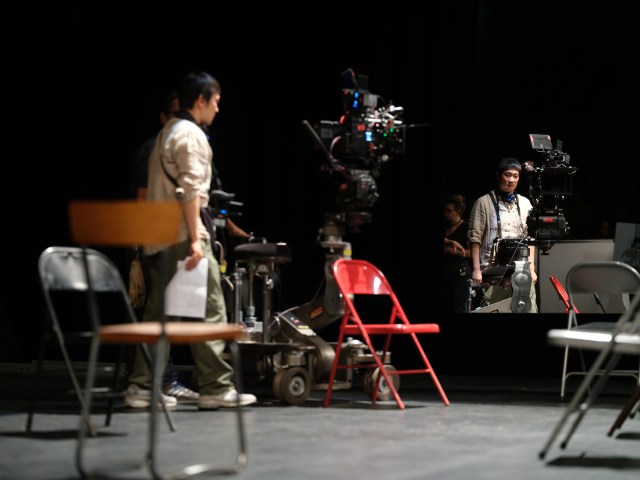
(© Julien Panié/Cinefrance Studios)
This interview has been adapted from Hamaguchi’s original Japanese responses and an in-the-moment translation by interpreter Monika Uchiyama. It has been edited and condensed for clarity.
One of the things I’m really interested in about your work is your use of theater within cinema, which I know goes back to early films of yours like Intimacies. So, are you a theater fan?
I would say I’m a fan of theater in film. I’ve really liked the depiction of theater appearing inside movies. If I were to refer to filmmakers of the past, John Cassavetes or Jacques Rivette are examples of people that have done this and it’s always made me wonder what the mysterious power is that depictions of theater within film carry. I don’t think that I have the same kind of passion or interest towards actual theater productions. When actors I have worked with appear on stage, I sometimes go to see them. Though I often think that encountering a good play is a difficult thing.
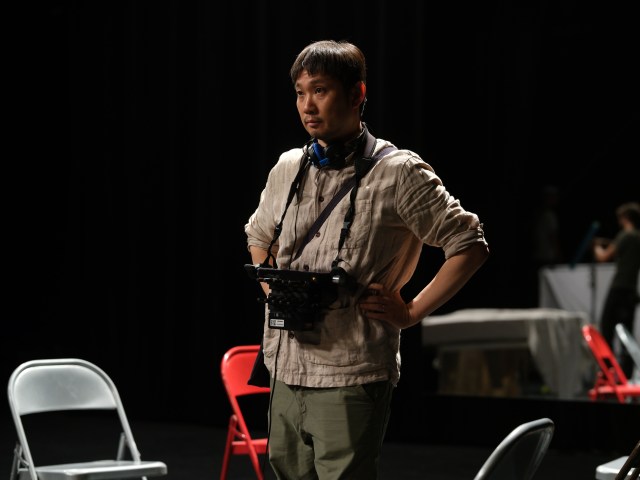
(© Julien Panié/Cinefrance Studios)
Do you find there to be a common ground between film and theater?
I think that the relationship between movies and theater is quite complicated. There’s a stark difference between theater acting and cinematic acting. There are many directors who have a harsh resistance against theater acting inside a film. An example of a person who really resisted this was Robert Bresson. I think he felt that it would bring us further from the idea of a cinematic truth, as if theater and film are rival siblings and never the twain shall meet. That could be true, but I want to see how bringing theater acting into a film is something that might not actually distance audiences and might add to the richness of the experience in cinema. In seeing films like those of John Cassavetes, Jacques Rivette, or Manoel de Oliveira, the Portuguese filmmaker, I knew there are cases where incorporating theater makes the film powerful.
(© Neon)
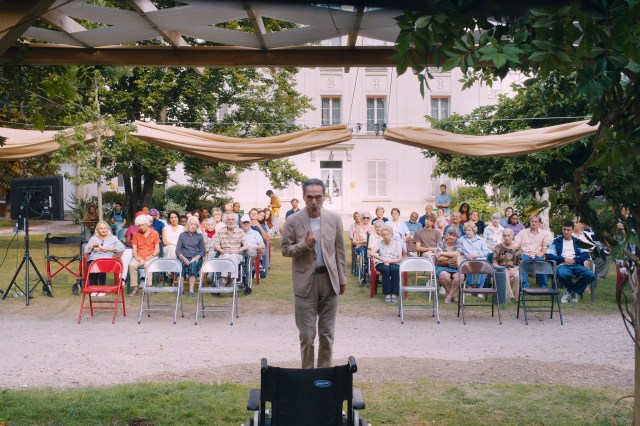
There’s a moment towards the end of All of a Sudden where a character is performing his one-person show, it’s interrupted by a different character, and then everyone in the audience joins in. Were you intending to show how theater can bridge the gap between generations and abilities and social standings?
Actually, that scene draws almost directly from the last scene of Opening Night. That was top of mind while I was creating that moment. Especially this idea of what happens when theater falls apart. And basically, it’s reliant on the attitude of the actors who are trying to retain what’s happening in the play. I really wanted to depict that. Of course, there’s the intermingling of people of various generations and nationalities, but I think what’s most important is this idea of not giving up. When something doesn’t go to plan, instead of quitting, finding what is beyond that moment of everything falling apart. That’s what I was interested in.
(© Julien Panié/Cinefrance Studios)
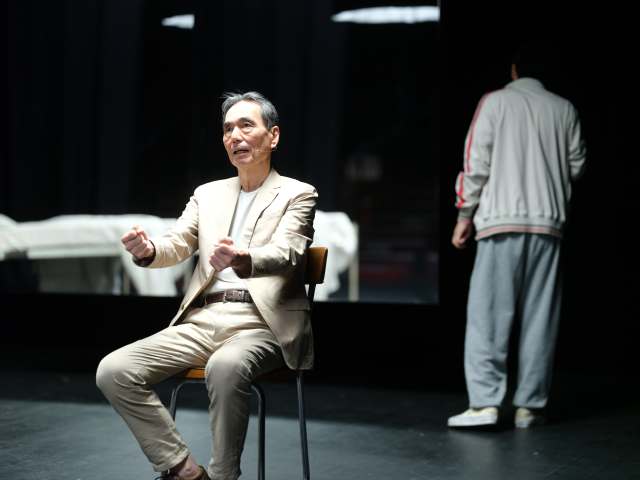
In your 2012 film Intimacies, a group of actors rehearse and perform an original play you wrote. In All of a Sudden, there is an character performing a solo show about Franco Basaglia. Tell me about writing a play that is designed expressly to be filmed, rather than performed live.
Something I realized through that process was that theater scripts have very different demands from a film script. Things like the degree of realism are completely different, and there is a big difference between lines that can be uttered on stage and lines that are ok to write in more everyday scenes.
There is a long play in Intimacies that’s actually something that I came up with while I was still a university student, but I thought it lacked a realism that would make it good for adapting into a movie. The actors in that film are acting majors at a film school and I feel like because the script was meant for a play for theater, it drew acting that moved me from the bottom of my heart. A theatrical text can possess a great power when it is transposed into film.
The idea [of a play about Basaglia for All of a Sudden came from] a book by a Japanese anthropologist named Takeshi Matsushima called Psico Nautica. In that book, there’s a Polish director named Grotowski whose followers do theater together with psychiatric patients. Through that, I read a detailed account of Basaglia, who was trying to abolish psychiatric institutions. Basaglia, the source material, and Humanitude are three ideas in the film, and they’re three disparate things I was interested in that I brought together. There had to be a connection [between them] and that’s what I was trying to discover.
In the book of correspondences, Isono is a person who is healthy and Miano is the person with cancer; they have various roles and gaps within them, but that they try to overcome in order to be two humans facing one another. When a person is going through a mental health condition, they’re put into a facility and basically stripped of their humanity. Rather than do that, Basaglia thought we should be trying to reintegrate these people into a society. The person who founded Humanitude encountered Basaglia’s practice very early in their career and was influenced by it. That’s how he became part of the play within the film.
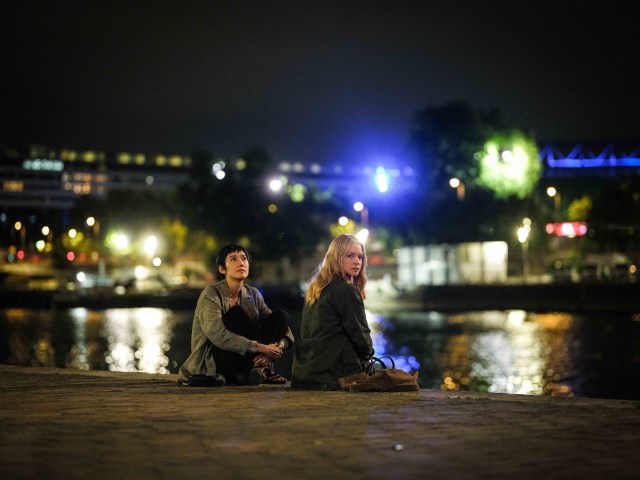
(© Julien Panié/Cinefrance Studios)
What are the practical considerations for you when you’re staging a play to be filmed, like the performance in All of a Sudden or Uncle Vanya in Drive My Car?
My focus is on how to film the play in a way that’s most effective for the film itself. That means that you need to place the camera in the position that can best capture what is intentional for the film; sometimes that’s backstage or even side stage. We’re filming from perspectives that you typically won’t watch theater from.
When you’re sitting as an audience member, you don’t have a new frame of view. Sometimes, you’re in the furthest seat and the actors are meant to be convey the intentions of the play to the person sitting in that seat, and they are projecting their voice and moving in a way that then becomes uncinematic. For the case of filming theater, I ask them to act in whatever way feels comfortable to them.
Specifically with this film, All of a Sudden, the DP that I worked with, Alan Guichaoua, was very deliberate in how to light the theater scenes to make sure there was some kind of uniformity.
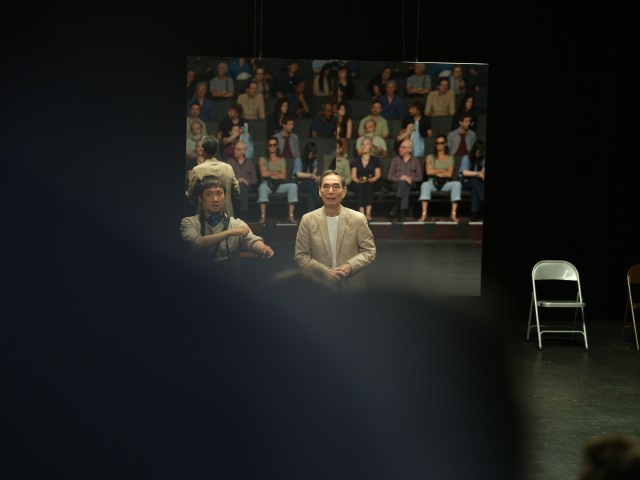
Ryusuke Hamaguchi and Kyozo Nagatsuka
(© Julien Panié/Cinefrance Studios)
Do you ever see yourself directing for the stage?
I would say that I don’t feel confident that I would be able to direct a play. I think specifically through the camera and the microphone. There are many times I’ve been asked to write or direct a play, and I’ve declined every offer because I simply think that I wouldn’t be able to do a good job.
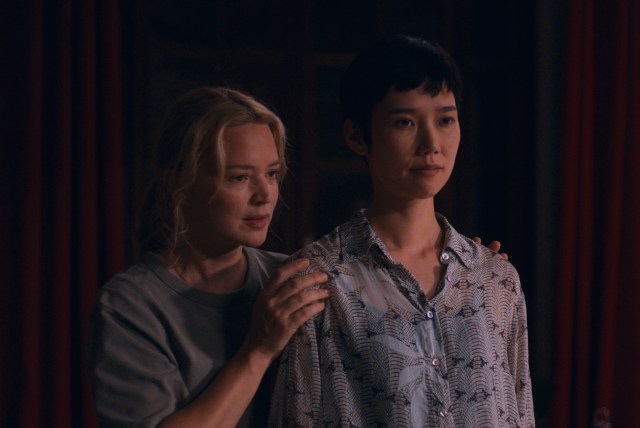
(© Julien Panié/Cinefrance Studios)




source on Google
Latest Reviews
See all





Latest Videos
Watch: Dolly Parton's Broadway Family Remembers Their Time With the Country Music Legend
Katie Rose Clarke, Carrie St. Louis, and more share memories of the days they spent in rehearsal with the icon before her passing.