
Interview: How Shakespeare Really Did Save Jacob Ming-Trent's Life
From drawing on his personal experiences to putting pen to paper backstage at Gypsy, one of New York’s great scene-stealers discusses his new solo play.
 |
Off-Broadway
|
|
Off-Broadway
|
September 14, 2026
At 12 years of age, Jacob Ming-Trent walked into the wrong classroom the morning after his father left the family, and his life changed even more than it had the night before: he discovered Shakespeare. The teacher gave him the St. Crispin’s Day speech from Henry V to read aloud, and it made the young Pittsburgh native realize that he had a purpose. That his voice mattered.
After decades on stage and screen, Ming-Trent has established himself as one of New York’s favorite classical and character actors (he was most recently seen as Uncle Jocko in the Audra McDonald Gypsy revival), and he’s turned his personal relationship with the Bard into How Shakespeare Saved My Life, now at the Public Theater, presented by Red Bull Theater. This solo work began almost accidentally, but over the course of its runs at Berkeley Rep and the Folger (who copresent of the New York run), it became something far more personal, a story about family, homelessness, forgiveness, and the ways that art can save us.
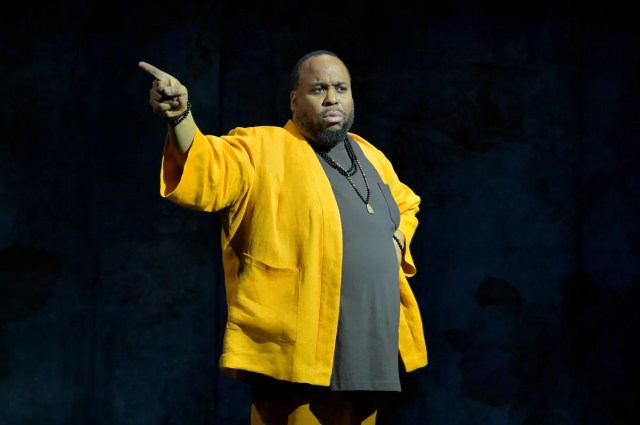
(© Kevin Berne)
This conversation has been condensed and edited for clarity.
Your show is called How Shakespeare Saved My Life. Do you actually view Shakespeare as having saved your life?
Yeah. When I walked into the classroom at 12 years old and a teacher made me read the St. Crispin’s Day speech [from Henry V], it felt like I had agency [for the first time]. I had purpose. I thought I was special, but then I realized my dad was a novelist, my mother is British and grew up studying Shakespeare, and my grandmother was an editor of the Pittsburgh Courier. I grew up in a house where language was important.
How did the play come about?
I was at Shakespeare & Company [in Lenox, MA] writing a cabaret for them, and these stories started coming out. Of course, Shakespeare & Company did not want that, they wanted Shakespeare. So, my friend said, “You should keep writing this.” I had 16 pages, literally just scraps of paper, and I sent it to Red Bull Theatre, because they’re part of my community. I said, “Should I continue?” and they were like, “We want to commission it.” And then I sent it to the Folger, and they wanted to commission it. I needed the money, so I took their money and then I had to write it.
Part of writing is that your subconscious is working. It was like my subconscious was leading me down a road and at the end of the tunnel was the forgiveness that I’d been working towards with my mother for so long. I’d already forgiven her, but I needed to make art out of the forgiveness, because I felt like making something beautiful out of it was better.
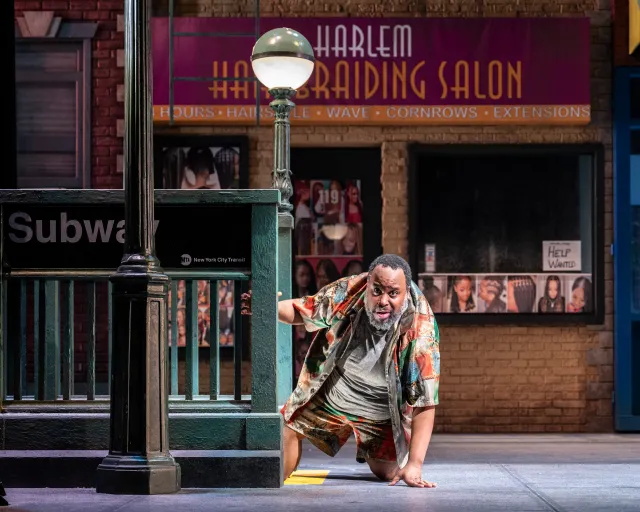
(© Teresa Castracane)
Do you consider yourself a writer, or do you see yourself as an actor who dabbles?
I’m in the writing space a lot now. I wrote another play and screenplay. But all my stuff is really low-key. Take away all the bells and whistles and it’s all about people and community. It’s about building things for community.
I was putting a lot of time into writing a story [during Father Comes Home from the Wars at the Public in 2014], but what if I’m terrible? I went to [playwright] Suzan-Lori Parks and I said “Read this, and you have to tell me if I should quit. You’re not gonna hurt my feelings. Save me from myself.” She actually surprised me. She said, “You can’t quit, you just need to go deeper.”
Is this show hard to perform for you?
It’s physically difficult. And then some nights, I have a moment with my father in the show that just gets me sometimes. I wasn’t a writer until my dad died. Crazy story. My dad died and he visited me. You’ll see this in the show. He checked on me. I went to his favorite coffee shop, and I sat in his seat and then a woman came over to me.
Oh, this is gonna get spooky, isn’t it?
Yeah. It is. And she was like “You don’t know me, but I knew your father.” She said, “your father gave me a message to give to you. His message was to continue the writing. I was like, what is he talking about? Then I realized that, when you come from a family of writers, part of what you’re doing is generationally telling the stories, and it was my turn. At night when I’m talking to him [in the show], it can be rough. Because I realized that he’s the reason I’m doing How Shakespeare Saved My Life. I’d never have written it if he didn’t give me that message.
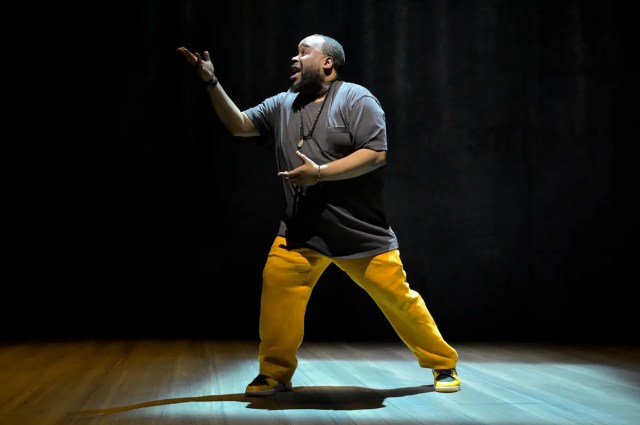
(© Kevin Berne)
Do you believe in signs like that?
I do now. When I was on PCP, my grandmother came to me, and I thought that was just the PCP, but she looked just like my dad when he came. It was really fuzzy, but you can tell it’s them. It was weird. So, I do believe it. I thought it was just the PCP. I thought my eyes were fucked up.
Back up.
I was a kid. I didn’t mean to smoke it. A joint was given to me. And…Yo. You know what was really crazy? Tony [Taccone], the director, when I was writing, he was like, “That happened to me once.” Literally, ambulances were called and I was rushed into the emergency room. It was really bad. Heart rate, seeing things, and then they shot stuff into me and I came down. It took me three days to get over it. I haven’t done drugs since.
The most recent big show you did was Gypsy with Audra McDonald and George C. Wolfe, and that show is obviously all about a fraught parent-child relationship. Did being in that show influence any of your storytelling here?
When we were negotiating to be in Gypsy, a workshop for this was scheduled. Me and George were going back and forth. But once he realized what I was writing about, he gave me a lot of wisdom about what was gonna happen. I was listening because I revere him. I didn’t think he was right, but he was right.
The thing about Gypsy is that the book is so good. It’s so taut. He [Arthur Laurents] got the book down to the essential, and it’s all complex ideas. It’s one of the greatest books to a musical ever. While the show was going, I’m writing this. I would go to the left side of the stage, I found a little cubby hole, and I’d sit there and write, listening to the show. That year in Gypsy, I was able to finish it. It gave me a place to do it, it was a good pay check, and I could focus on the writing.
What has surprised you most about How Shakespeare Saved My Life?
I was convinced older white people would say, this is not the show for me. But they love it. It’s crazy. It’s for everybody. And I’m surprised by that. I thought I created something that was so niche or whatever, and I wasn’t worried about it being commercial. I wanted to be in community with people. But people of all sorts have wrote me letters and have written me on social media. That’s been great. I remembered myself homeless at 15, 16. Not having a place to live and all that stuff, I thought “Man, that kid needs to hear this.”
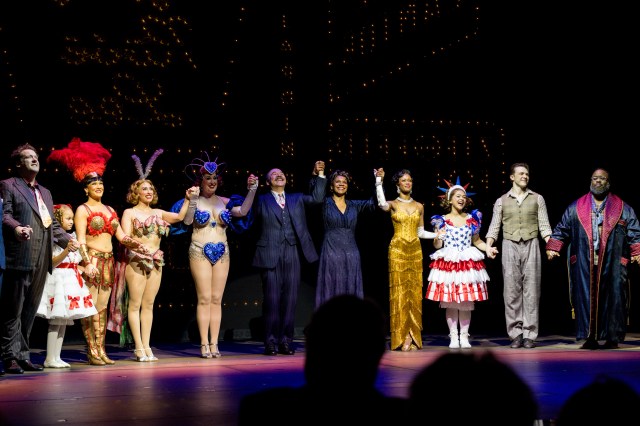
(© Tricia Baron)




source on Google
Featured In This Story
Latest Reviews
See all


Latest Videos
Jocelyn Bioh, Whitney White, Jasmine Amy Rogers, and Patina Miller Talk School Girls
The playwright, director, and stars of School Girls; Or, the African Mean Girls Play discuss the comedy, sisterhood, and themes behind the new Broadway production.