
Interview: Designer Soutra Gilmore Takes Us Inside a Confetti-Filled Much Ado on Broadway
Gilmore explains director Jamie Lloyd’s hot-pink palette, giant inflatable heart, and joyful minimalism.
 |
Broadway
|
November 11, 2026
(© Marc Brenner)
Jamie Lloyd productions often conjure images like the stark atmosphere of Sunset Blvd. or the somber single chair occupied by Jessica Chastain in A Doll’s House. But his take on Shakespeare’s Much Ado About Nothing, starring Hayley Atwell and Tom Hiddleston, paints his signature minimalism in a very different color. Pink!
Set and costume designer Soutra Gilmore has worked with Lloyd for over 20 years. For her, Much Ado’s vibrant palette is merely an extension of what she and Lloyd have been pursuing for two decades. “We’re doing it for the same reasons,” she says. “This feeling of trying to put something into the world that brings a discussion of hopefulness and connection and ways that we can draw people together. But this one feels like a real celebration of that idea.”
Lloyd is no stranger to reflecting the darker sides of humanity in his work, but Gilmore says they were both looking for a change of pace when they brought Much Ado to London’s West End in 2025. “We were trying to find something that had joy,” she says. “There felt like a real need for audiences to see something very life-affirming.”
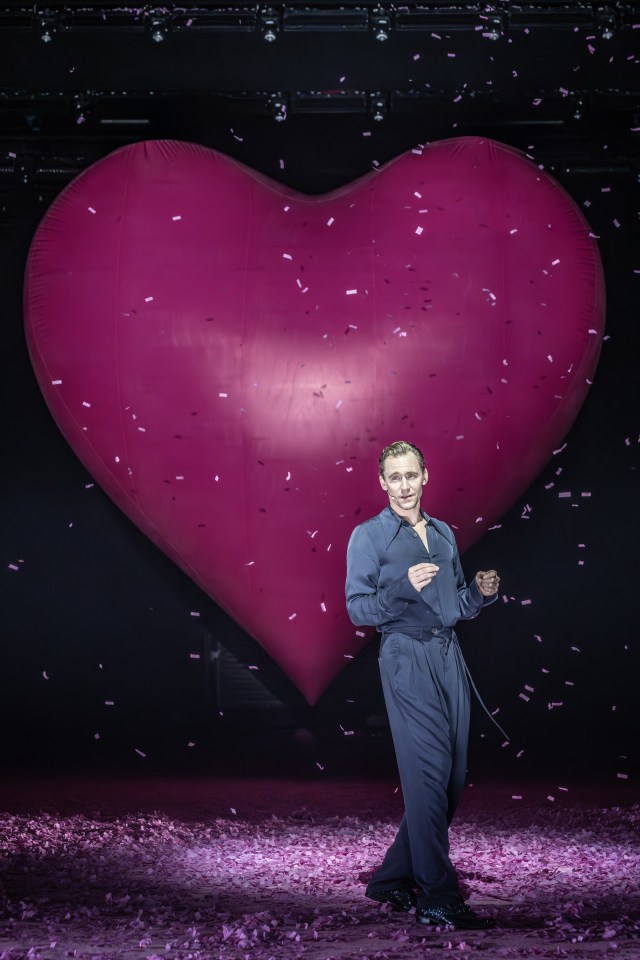
Hence the pink. But Gilmore didn’t start with that color. She and Lloyd began with the giant inflatable heart that provides the literal backdrop for the banter of Beatrice (Atwell) and Benedick (Hiddleston). “The real starting point for us was thinking about a space that had lightness and air in it,” she explains. “I’d been really interested in the idea of working with inflatables for quite a long time. There’s something intrinsically joyous about them. They’re a giant balloon, so they’re a celebratory form. That actually was the instigator of the tone of the project.”
(© Marc Brenner)
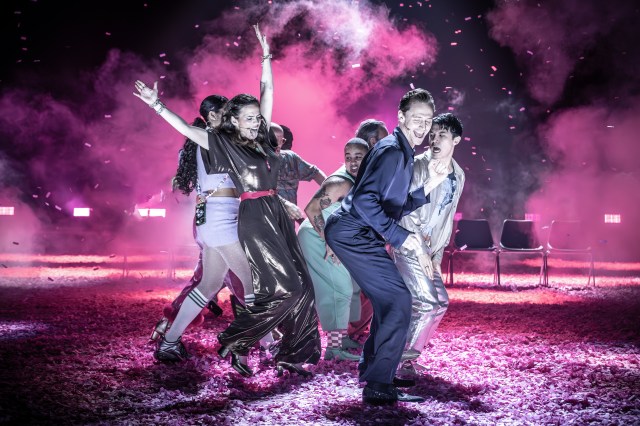
Gilmore and Lloyd were also both gravitating toward the exuberance of disco and the ways in which people express internal joy physically through dance and song. “There was a lot of looking at disco, glitter, inflatables, lightness, and air. And then the pink came via the fact that we chose a heart,” she adds.
For Gilmore, minimalism, even in a louder color, is its own form of maximalism. Fewer objects in the space force Gilmore and Lloyd to deeply consider every detail of the objects they do choose to include. “There aren’t walls, sofas, wallpaper, and all these other things that get in the way of the meaning of the few things that we’ve chosen.”
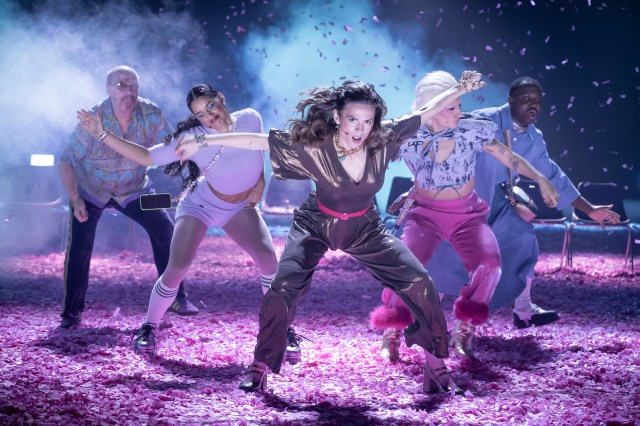
This production of Much Ado has two defining aspects of its design—the hot-pink confetti that covers the floor and rains down from the ceiling at various intervals, and the inflatable heart. Gilmore decided to use both as real-time metaphors for what the characters are experiencing.
“The heart is full of all of this air that sometimes deflates or comes down to ground and other times lifts up and is full of joy,” she says. “How big can your love be and how deflated can it feel and how painful is it when your heart is that big and out there? It’s the same with the confetti. Sometimes it’s very, very fine in the air. Sometimes it’s a ferocious blizzard. Sometimes it’s all over the floor and they’re playing, walking, and living in it.”
(© Marc Brenner)
The confetti dictated much of the design. With a limited number of glitter confetti colors available, Gilmore selected it before finding the right shade of pink to paint the inflatable heart. “You look at one and it’s too pastel-y,” she says. “Another is too murky. This [confetti color] has an almost fluorescent quality to it.”
Even more important were the actual shapes. “It’s the ticker tape shape,” Gilmore notes. “We tested the round ones and the petal ones. Different shapes and shades immediately tell different stories. The petals become “wedding” way too quickly. The round ones almost look like cherry blossoms.”
The confetti is the show’s main event, and the production uses about 44 pounds of it per show. “There was something about the ticker tape, which just feels celebratory,” she says. “That’s the one we all throw into the air when it’s a celebration.” Over the course of multiple performances, it builds a steady layer on the stage; Gilmore confesses they give the confetti a bit of a “haircut” with a vacuum cleaner every few days to keep things manageable.
Gilmore also designed the show’s costumes, and she was eager to find a way to complement the intense color saturation of the sets. While many of her initial references were ’70s-era disco, she decided to opt for a contemporary look that captures the funky, playful sensibility of the vintage styles. “It’s always about finding the balance about who’s got shine, who’s got glitter, who’s got patent, who’s got a bright color,” she says. “It’s all the detail of that so that you create this harmonious picture, but with individuality.”
Much of the wardrobe has remained the same in the transfer from London, except for Atwell’s costume, which is no longer a copper jumpsuit. Gilmore wanted Beatrice in warm colors to avoid any implication that her witty, barbed remarks make her cold or severe. She now wears blues and pinks that tie in with Hiddleston’s attire as well as with the set.
“She’s connected to the space, and then there’s this underlying, very subconscious connection into his costume,” Gilmore explains. “And then Tom’s got the glitter [belt] that is the same thing as the subconscious connection into her costume. They’ve got these subtle connections below the surface, even though they look like they’re very contrasting.”
Though the sets or costumes may look simple to audiences, every stitch and piece of confetti has been carefully considered. “It’s maximalism as much as it’s minimalism,” she says. “We try and create a stage that feels so full of emotion. There’s nothing minimal or slick or cold or empty about it. It’s filling it with as much room for the emotional engagement of the actors with the audience as possible.”

(© Marc Brenner)




source on Google
Featured In This Story

Latest Reviews
See all





Latest Videos
Find Out the Real Story Behind Broadway's Here There Are Blueberries
Writers Moisés Kaufman and Amanda Gronich discuss the new drama alongside their cast.