
Ethan Slater and Marshall Pailet on the Darkness, Light, and Life-Saving Silliness of Marcel on the Train
Slater stars as legendary mime Marcel Marceau, who smuggled Jewish children out of France during World War II.
 |
Off-Broadway
|
|
Off-Broadway
|
February 23, 2026
Marcel Marceau, the eminent mime who famously wrestled a shrinking cage as his white-faced alter ego Bip the Clown, delivered his earliest performances as Marcel Mangel—devoted member of the French Resistance. It was the early 1940s in Nazi-occupied France, and the young admirer of Charlie Chaplin used his nascent talents to entertain scared Jewish children on a train headed for salvation at the Swiss border.
It’s a lesser-known chapter of Marceau’s story, and writing partners Ethan Slater and Marshall Pailet saw in it the makings of a thriller: Four children, Marcel, and a single railway car. “The space is cramped, it’s dark, it’s scary, and Marcel has to be the bringer of light,” said Slater. “That was the immediate image.”
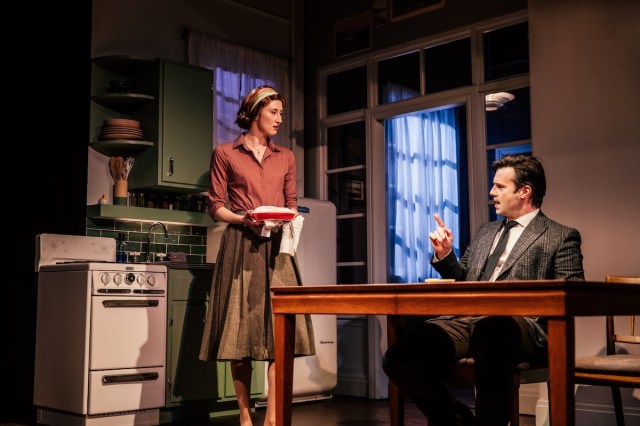
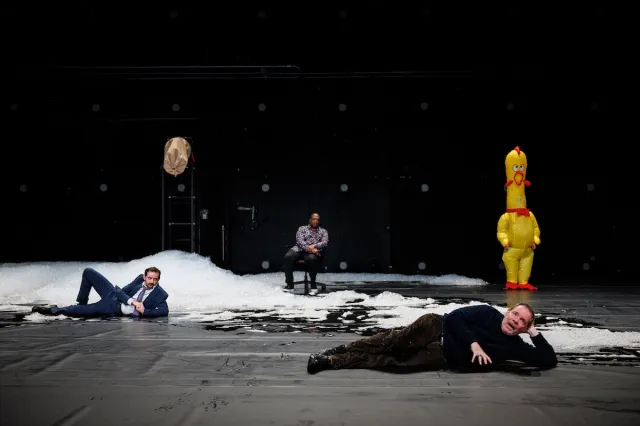
The idea grew into Marcel on the Train, a piece of historical fiction now running at Classic Stage Company. It’s a harrowing story syncopated with shadow puppets, imagination games, and classic clowning that indulges the simple delights of googly eyes and lolling tongues. Along with co-writing the play with Pailet (who also directs), Slater stars as Marceau, upping the ante in a career of physical performances.
“Ethan was in Wicked, and Ethan was in the SpongeBob musical, and people know him from that,” said Pailet, Slater bracing himself for his buddy’s impending compliments. “But people don’t realize what a good leader he is and how hard a worker he is. He’s just a marvel and I’m so excited for audiences to see what this man can do.” Pailet, a good friend, ended his encomium with a life raft of sarcasm: “Now your turn about me.”

(© Emilio Madrid)
This conversation has been condensed and edited for clarity.
Before we get to Marcel on the Train, tell me the origin story of your partnership. How did you two meet?
Marshall Pailet: We just met about 18 seconds ago. [Laughs] We met back in 2011, right?
Ethan Slater: 2010. We met in Washington, D.C., at the Capital Fringe Festival. I had just graduated high school and was in a play, and Marshall was directing a play he had written. I went to see his play and insanely he came to see mine as well. I said, “Hey, you’re this amazing writer and director, I would love to chat with you about what it’s like to make it in theater.”
Marshall: He asked me out to Cosi. So we had this sandwich date. It was lovely. And then maybe four years later…
Ethan: Three years later…
Marshall: I’m writing another show and my co-writer’s like, “Hey, I’m working on this SpongeBob SquarePants musical, and the guy who’s playing SpongeBob would be really good for this reading we’re working on.” So Ethan walks in and he’s like, “Hey, you probably don’t remember me, but we went to Cosi.” I’m like, “You’re SpongeBob SquarePants?!” So that’s how we got reconnected in New York.
Ethan then pitched you the idea for Marcel on the Train—literally right after your first child was born as I’ve heard you explain.
Ethan: We tell this story jokingly like I was so inconsiderate.
Marshall: He’s a very considerate man.
Ethan: What I said was, “I have an idea. Now is not the time.” And what you said, Marshall, was, “I’m not gonna remember what you tell me right now anyway so you might as well tell me what it is.”
Marshall: I have a funnier version of the story that’s not true. But that is the true version.
(© Andrew Patino)
Once you both committed to this project, what was the first stage picture you imagined?
Marshall: I think it was the shadow butterflies. It’s kind of the centerpiece moment of the show. And from a stage picture perspective you could just imagine these scared kids watching this butterfly float around on the wall. But from a metaphorical standpoint he is in the midst of this incredible darkness, and he is trying to be a bringer of light. The shadow is darkness on the light. There’s just something really beautiful in that metaphor.
Ethan, you came into this already an expert physical performer, but how much mime training did you have to do to prepare to play Marcel Marceau?
Ethan: I worked with some movement people who studied mime through the world of clowning, which is a world that I’m more comfortable with, so we spoke the same language. I’ve also studied with some disciples of Marceau, and they’ve been incredibly helpful in terms of giving me some tools from the grab bag and making sure that the mime that we’re doing is authentic to the moment that Marcel is in.
Is there a performer that inspires you like Chaplin inspired Marceau?
Ethan: Buster Keaton. Buster Keaton has been a deep obsession of mine. I’ve seen every movie of his a million times, I’ve read every biography. To be honest, he was my main source of inspiration for SpongeBob. As a storyteller, as a physical comedian, and as a filmmaker, he’s my Chaplin.
Marceau is at the center of the play, but the story really focuses on the kids he’s taking care of on this train car. What did you envision for those characters?
Marshall: This is being written while we’re having children and thinking about their place, our place, in the world, what it means to be the Jewish fathers of Jewish kids in a world where fascism is hot again. I think the thing about saving a child’s life is that you’re not just saving the child’s life right now, you’re saving the person that they’re going to become. For us, this play is as much about “do they live?” as “how do they live with it?”

(© Emilio Madrid)
Why was that important to you both that you cast all Jewish actors for these roles?
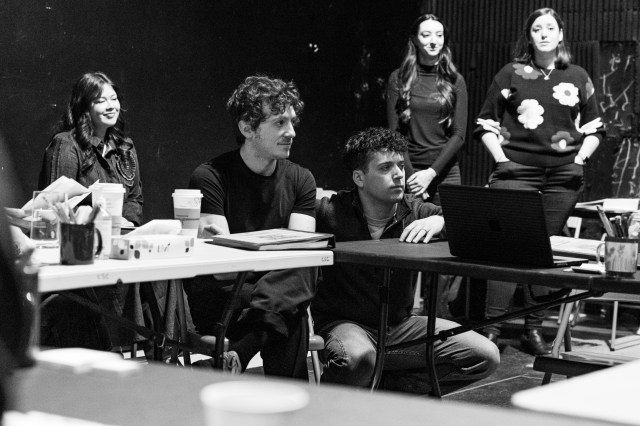
Marshall: I think that we knew pretty early on that we wanted to have an all-Jewish cast to play these Jewish roles. And then it wasn’t just the cast. We have a rehearsal room that is mostly Jewish. The stage managers, the designers, the creative team. We knew that we could have a vocal difference of opinion because everyone had a stake in it. It does add a layer of comfort. Me as a Jewish director talking to a Jewish actor who’s playing a Nazi—it’s actually not that hard for us to talk about heiling and swastikas.
Ethan: On a superficial level, we just all had to be able to make Holocaust jokes. There was a bit of a readjustment when we got into the theater because the audience isn’t gonna be comfortable laughing at those Holocaust jokes in the same way. But we have to be. Because that’s kind of what the play is about. It’s about the use of humor in these moments and how they can get us through.
In the spirit of Marcel on the Train, who is someone who managed to entertain you through a difficult or scary time?
Ethan: Jim Carrey. I always went to the clowns as a kid.
Marshall: Tom and Jerry, as silly as it is. While we were writing this, I spent a lot of time watching old-fashioned cartoons. I remember in the dark of Covid, [my son] was one and I was staying home with him while my wife was at work. Watching him enjoy these cartoons really reinvigorated me and kind of brought me back from a precipice.
There is something special about the delight of a child.
Ethan: Sometimes there’s a big resistance—especially of the age of the kids in our show, 12—there’s a resistance to giving in. But once they give in, there’s a real beauty in the imagined world. When the real world can be so hard, sometimes looking at the imagined beauty is a wonderful thing.




Featured In This Story

Latest Reviews
See all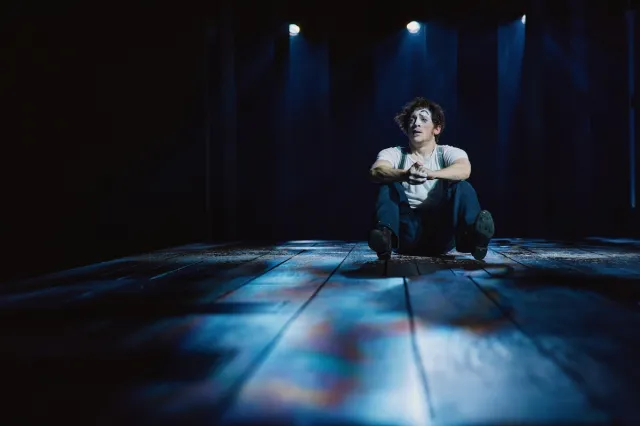

Latest Videos

Watch: Operation Mincemeat Stars Perform Live Concert in Honor of Final Performance
David Cumming, Claire-Marie Hall, Natasha Hodgson, Jak Malone, and Zoë Roberts played their final show on February 22.