
Review: The Visit, a Parable of Fascism Then and Now
Jefferson Mays stars in a new production of Friedrich Dürrenmatt’s 1956 play at Pasadena Playhouse.
 |
Pasadena
|
|
Pasadena
|
September 15, 2026
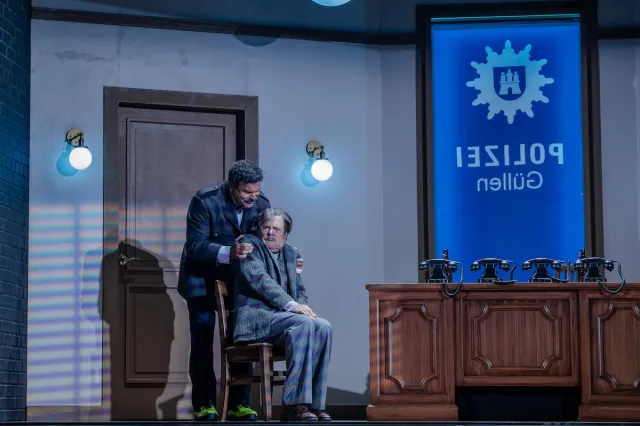
(© Jeff Lorch)
Fresh off last season’s scintillating Amadeus at Pasadena Playhouse, director Darko Tresnjak and his star Jefferson Mays return for another visually stunning, cunningly comic production of Friedrich Dürrenmatt’s The Visit. Filled with neon glare and a view of human cruelty that never lets up, The Visit is an absorbing and timely indictment of that oxymoron called humanity.
The Swiss playwright’s post-WWII play begins in a destitute mid-century European town. Most trains pass through Güllen, with only the local ones stopping, which depresses any possible tourism. The factories have closed, and though there are resources buried below, the town lacks the means to dig them up. But there is hope.
Claire Zachanassian (Melinda Page Hamilton), a former resident and current billionaire has granted donations all through Europe and she is returning to bestow a gift. The town gathers, along with Claire’s former lover, Anton Schill (Mays), to welcome her. Quirkily, she arrives like a hurricane and immediately honors the town with ONE BILLION. The play never specifies the currency, though it’s presumably Swiss francs. She only has one condition, but it’s a nasty one.
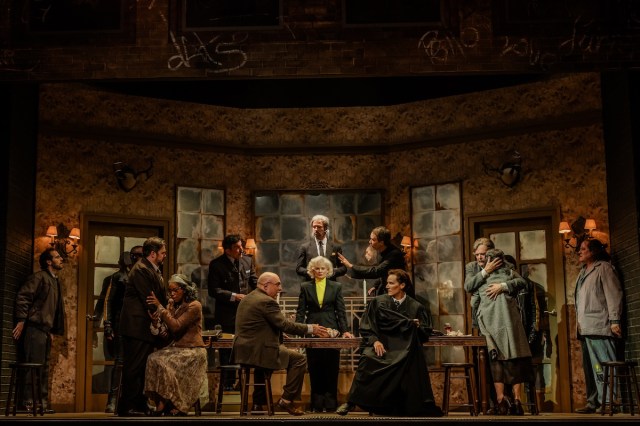
(© Jeff Lorch)
Tresnjak utilizes the condensed Maurice Valency translation that debuted on Broadway in the late fifties as opposed to Tony Kushner’s 2020 text. Running around 100 minutes, the play makes its point by assaulting the audience with its rage and then leaving them flabbergasted. The humor is satirical and often veers into pure farce. The characters are perverse yet recognizable. They kill with kindness, flattering their prey while stabbing them in the back—all except for Claire, who never minces words or hides behind hypocrisy.
Tresnjak visually charts the town’s corruption, as graffiti and broken glass clean magically, and bland clothing evolves into punchy neon reds, yellows, and blues. Tresnjak stages some scenes like a Kafkaesque nightmare—especially when Anton attempts to escape this newly fascistic town—and others like a parable: Claire announces her contract while at the Golden Apostle with a tableau recognizable as a mirror image of The Last Supper.
Hamilton exudes pure venom with confident, calm maleficence. She’s as sharp as a razor and just as deadly. Mays, required to embody many sides of the same character—hypocrisy, terror, resolve—is a wonder, making viewers understand his motives, if not forgive his misdeeds. John Lavelle brilliantly traces the Burgomeister’s transformation from hapless leader to rabble-rousing demagogue, drawing cringing laughs along the way. The rest of the townspeople perfectly channel the humor and nihilistic cruelty that fascism brings out in people. Ricardo Chavira, Matthew Patrick Davis, and Matthew Henerson have fun as the city councilmembers, but it’s Christian Barillas as the town’s last voice of humanity that stings in his final speech.
Alexander Dodge’s set, with its rotating rooms showcasing a deteriorating village becoming cleaner as the town gets wealthier, is a great visual representation of the town’s moral decay. Matthew Richards’s lighting reflects off the neon costumes, making them glow. It transforms the town from a decrepit wasteland into a frivolous dance club. Aaron Rhyne’s projections of trains zooming past without a stop, along with Jonathan A. Burke’s sound design, give the audience a visceral sense of the desperation.
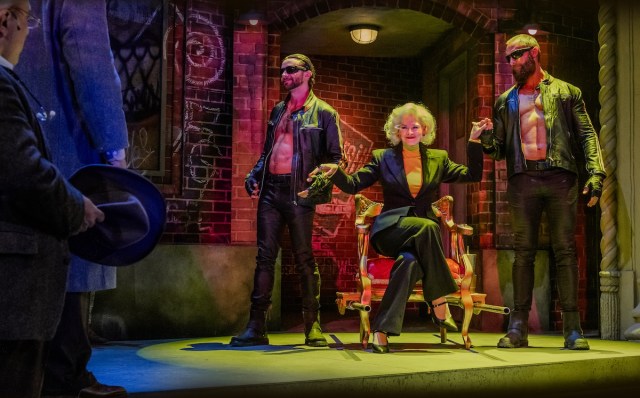
(© Jeff Lorch)
There are some interesting song cues. Playing Jerry Goldsmith’s haunting “The Boys From Brazil Waltz” during the curtain call ties the town directly to Nazism in a glaring way, but the motif of disco music during dance breaks seems a bit off message. The first time the ‘70s beat is played, it comically distances the crowd from Claire’s theatrics, particularly with the visual of muscle men carrying her on a throne like Cleopatra. But after a few more instances, that music just takes viewers out of the story.
Tresnjak keeps The Visit comically absurd with characters speaking in unison in a sing-song way, to remind the audience this is a fable, one we could have learned during WWII but are condemned to repeat endlessly, like unwitting victims in The Twilight Zone. At the climax, the play and its director orchestrate a murder so perverse that onlookers can point and laugh at the ridiculousness of townspeople who think they’re above a criminal when they should be judged just as harshly for their self-satisfaction. But once the audience walks away, it becomes uncomfortably clear that the death penalty in the US is just as hypocritical and cruel. The Visit indicts us all.




source on Google
Featured In This Story

Related Articles
See all
Latest Reviews
See all



Latest Videos

Jocelyn Bioh, Whitney White, Jasmine Amy Rogers, and Patina Miller Talk School Girls
The playwright, director, and stars of School Girls; Or, the African Mean Girls Play discuss the comedy, sisterhood, and themes behind the new Broadway production.