
Interview: Jefferson Mays and Darko Tresnjak's Artistic Partnership Meets Its Match in The Visit
The actor and director return to the Pasadena Playhouse with their take on Friedrich Dürrenmatt’s The Visit.
 |
Los Angeles
|
|
Los Angeles
|
September 8, 2026
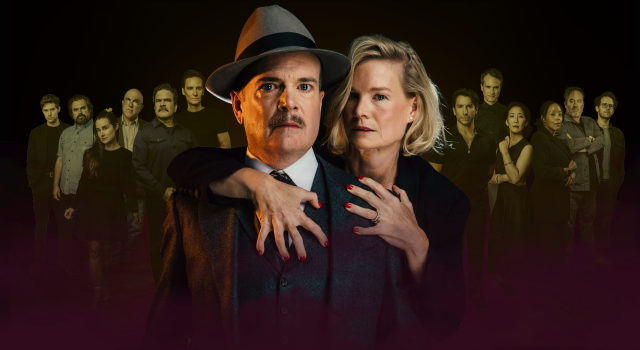
(© Jeff Lorch)
“We’re strange bedfellows,” says Jefferson Mays of his longtime partnership with director Darko Tresnjak, which extends back to the late 1990s. The creative duo most famously brought A Gentleman’s Guide to Love and Murder to Broadway, and this year, they’ve teamed up for two ambitious projects at Southern California’s Pasadena Playhouse: last spring’s mounting of Amadeus, in which Mays played Salieri, and this fall’s The Visit, which starts previews September 9 and runs through October 4.
The plays are bookends for Mays and Tresnjak: both long-simmering dreams come true. Mays hungered to play Salieri in Amadeus and came to Tresjnak with the idea. But The Visit is the result of serendipity. During tech rehearsals for Amadeus, Tresnjak discovered Pasadena Playhouse artistic director Danny Feldman was interested in doing Friedrich Dürrenmatt’s 1956 drama about a town on the way out and the billionaire who can save it, with one grim condition.
“I’ve been waiting to do this play professionally for 40 years,” says Tresnjak. “I read it as a teenager, directed it in college and found my voice as a director. I decided that this is what I wanted to do with my life because of this play.”
It was kismet considering how rarely the play is produced. “Nobody wants to do it,” quips Mays. “Because, number one, it’s a rather bleak picture of humanity. And number two, it’s a huge cast. We whittled it down to 17, which is still gigantic by modern regional theatrical standards, if it’s not a musical.”
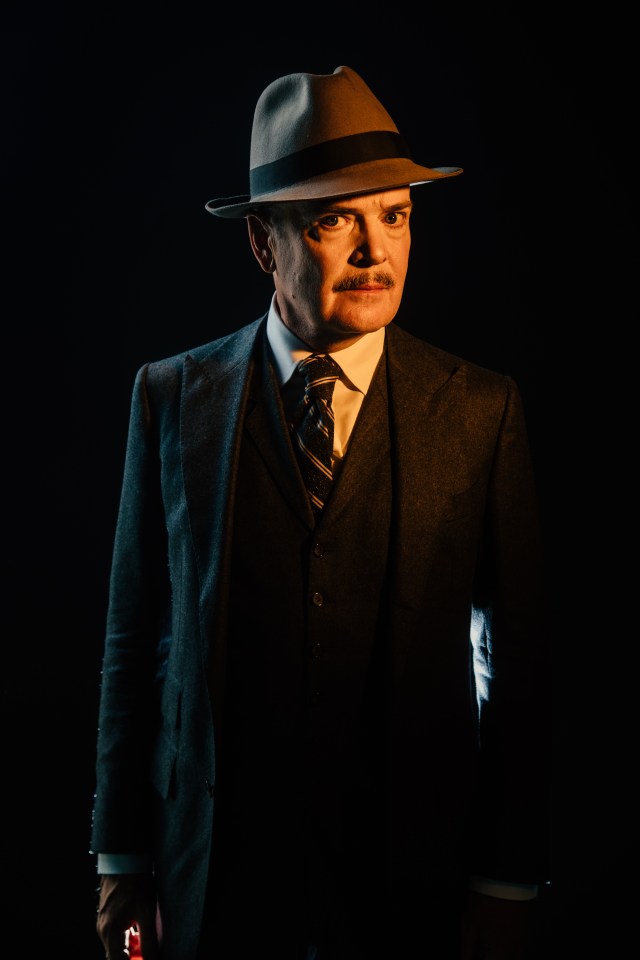
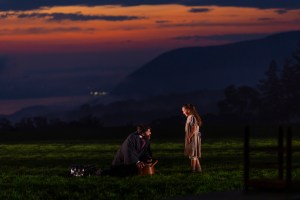
(© Jeff Lorch)
That speaks to the creative audacity of Pasadena Playhouse itself, which won the 2023 Regional Theatre Tony Award. Tresnjak is semi-retired and highly selective of the work he accepts, but he’s done two productions at the Playhouse this year. “It’s the healthiest theater I’ve ever worked at in my 40 years’ experience,” Mays gushes. “I told Danny Feldman, ‘You don’t run a theater, you run a high school drama club.’ It is a place that is infused with such joy, such pure love of the art form itself.”
Since both men were eager to continue working with the Playhouse team, Tresnjak knew he didn’t have to look far for his leading man. But while Tresnjak says he and Mays share similar values — namely a reverence for the text and an intense work ethic — Mays points to something more mysterious in the success of their partnership. “It’s always a rare and wonderful joy to work with him,” he explains. ‘We’re not alike, and I wouldn’t call us bosom friends, but there’s some strange alchemy that happens when we’re in the rehearsal hall together. He’s able to communicate with me very succinctly using a few words.”
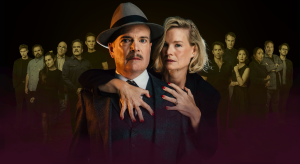
That’s fitting since Mays’s character, Anton Schill, is himself a man of few words. The Visit takes audiences to the fictional European town of Güllen. There, Schill is a respected man, tapped to be the next mayor of the town, until his teenage sweetheart and extremely wealthy widow Claire Zachanassian (Melinda Page Hamilton) breezes into town with an offer designed to expose the hypocrisy at this community’s center.
Tresjnak has opted to use Maurice Valency’s 1958 translation, which is the version he first read and locked onto as a teenager. For him, Valency’s translation lends Dürrenmatt’s story a timelessness many other adaptations lack as represented by one very specific detail. “Some of the adaptations put a denomination behind the money that Claire’s giving them,” Tresnjak explains. “The original play just says ‘billion’ because I think Dürrenmatt knew that he was writing the play for the ages, and Valency served him well.”
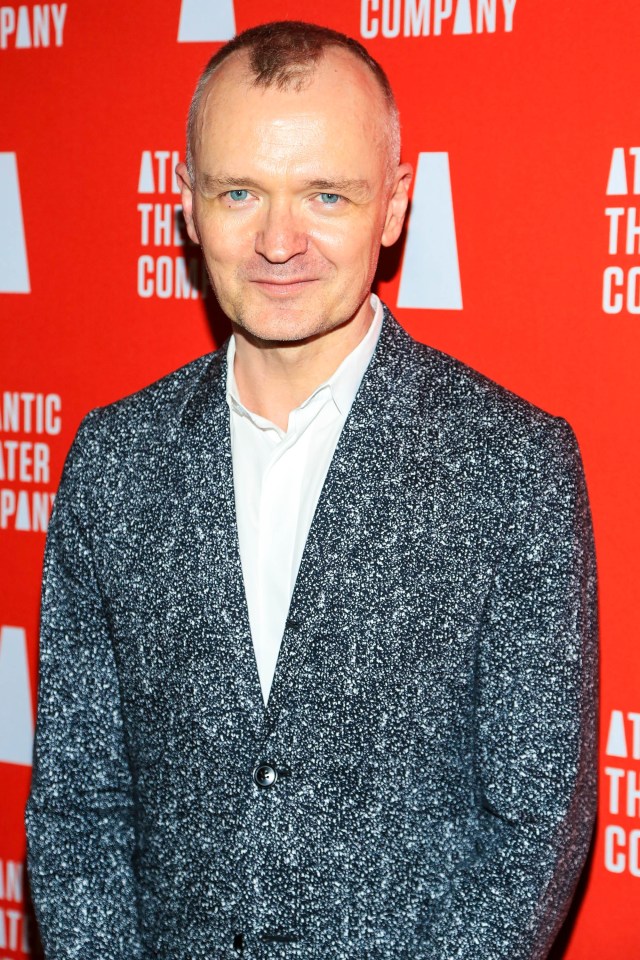
(© Tricia Baron)
Mays sees The Visit as an extremely personal text for Tresnjak. “This is his middle Europe,” Mays reflects. “He’s a son of the Austro-Hungarian Empire. His family endured World War II. He’s said, ‘This is a play about my mother.’ He’s returning to his boyhood in some ways.”
The Visit is both personal and universal in its appeal. The play, in its examination of complicity and what human beings will allow themselves to normalize, is as vitally relevant now as it was when it premiered in 1956. “I’ve been thinking a lot about the miraculous blessing that we have, which is simultaneously our curse as a species, to be able to rationalize and normalize almost anything,” says Mays.
“It’s a play that operates on many levels,” adds Tresnjak. “You can take it as a piece of entertainment or a work of art. You can think about it as a stage thriller, a feminist revenge comedy, a cautionary tale about democracy, an allegory of the Marshall Plan, and an inversion of a medieval mystery play. There are entertaining plays that are not necessarily great works of art. There are plays that are great works of art, but they work better on the page. This is both. It operates on many levels.”
Tresnjak’s upbringing draws him to strong female characters and The Visit‘s Claire Zachanassian is one of his favorites. “Directing a play, you have to have a strong point of view,” he notes. “I’m curious to see how the audience is going to respond to Claire right now in the wake of Me Too. She functions as a mirror. They’ve put a veil, as a community, over what they’re capable of doing and what they’ve done, and she’s going to remove the veil.”
However, personal though it may be, Tresnjak demurs at explicitly discussing the play’s relevance. “I have many reasons why I want to do it at this moment in American history,” he notes. “It’s a play with a global reach, but I promised myself that I would not talk about that. People need to see the play. The wonderful thing about being a director is occasionally you get to say exactly what you want to say about the world through the work of art.”
It’s this communion via theater-going that keeps Tresnjak and Mays coming back to each other. “If you sat us down and asked us what is most important in a theatrical experience,” reflects Mays, “it’s to encounter beauty and terror and to be shocked, in some way, out of ourselves. You may be rattled, you may be shaken up, your beliefs may be confronted, but you are ultimately safe to contemplate these things and to receive them.”
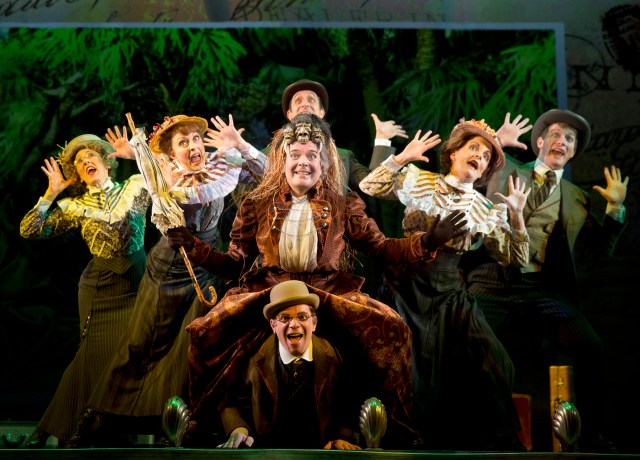
(© Joan Marcus)




source on Google
Featured In This Story
Latest Reviews
See all



Latest Videos
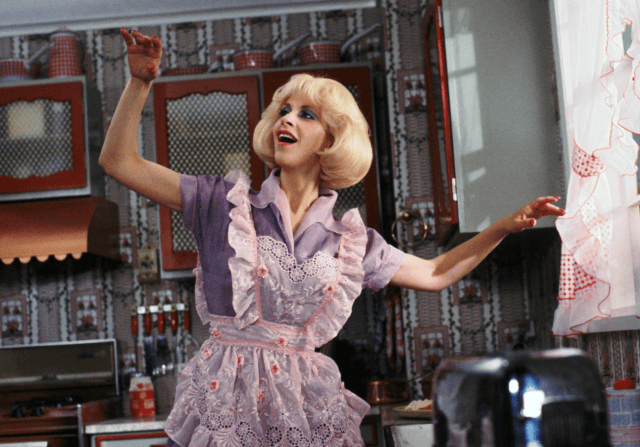
Watch: Ellen Greene Reflects on the Enduring Legacy of Little Shop of Horrors
Frank Oz’s cult classic movie-musical has gotten a new 4K restoration in celebration of its 40th anniversary.