
Reviews
Review: The Ford/Hill Project Gives Silenced Women the Final Word
REDCAT production revisits Anita Hill and Christine Blasey Ford’s testimony with searing urgency.
 |
Los Angeles
|
|
Los Angeles
|
September 21, 2026
(© Angel Origgi)
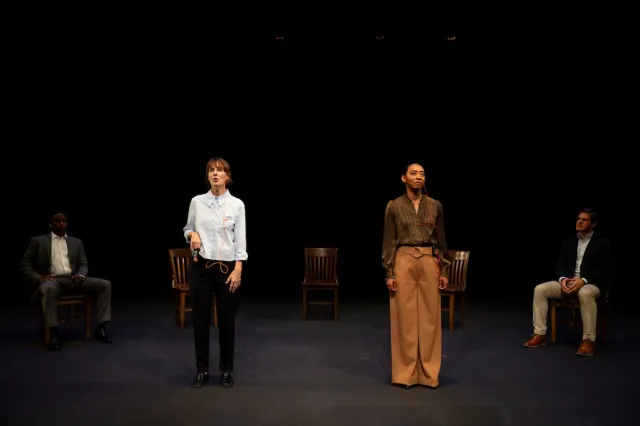
The audience enters to find a stage with nine chairs in a semi-circle. It could be anywhere, but because The Ford/Hill Project focuses on testimony that both Christine Blasey Ford and Anita Hill gave, respectively, at the hearings for eventual Supreme Court Justices Brett Kavanaugh and Clarence Thomas, we know what those seats represent.
Two women will bare their souls only for their words to be ignored, allowing two men to ascend to the highest court in the United States. In their own transcribed testimonies, these women still demand to be heard, even if the damage has already been done, in this engrossing production at Roy and Edna Disney CalArts Theater, known as REDCAT.
In September 1991, the George H.W. Bush appointment of Clarence Thomas (Dulé Hill) to the Supreme Court as a replacement for retiring esteemed Justice Thurgood Marshall hit a major obstacle. Most Senators who wanted a quick and easy advice and consent were caught off guard when former employee Anita Hill (Betty Gabriel) testified under oath, that while working for Thomas in the early ’80s, he repeatedly sexually harassed her. Forced before the news cameras to give graphic details of sexual jokes and innuendo she suffered, Anita Hill stood firm.
In 2018, during another contentious nomination, this time for President Trump’s nominee Brett Kavanaugh (Rich Sommer), Dr. Christine Blasey Ford (Rosemarie DeWitt) testified that at a high school party, Kavanaugh and another student sexually assaulted her, including covering her mouth to keep her quiet. Neither of the women’s testimonies led to the men stepping down. They both claimed their innocence and went on to their lifetime appointments.
(© Angel Origgi)
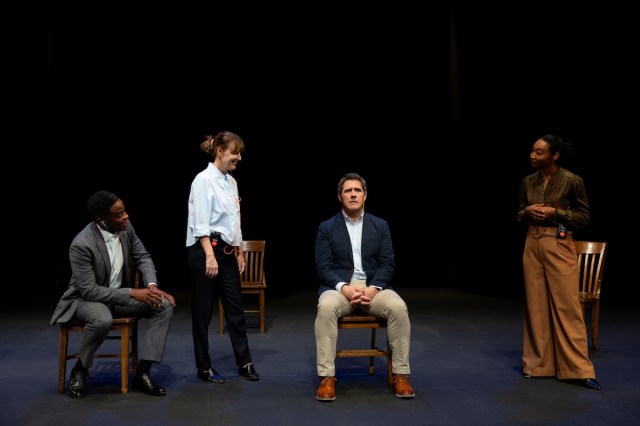
Elizabeth Marvel and director Lee Sunday Evans mold The Ford/Hill Project from the testimonies, crafting a harrowing portrait of two women deemed unworthy of belief. The actors take turns playing Senators and prosecutors as well as the four spotlighted characters. There are a few confusing moments, as when actors swap characters and genders, with Dulé Hill portraying Anita Hill and Sommer playing Dr. Ford, and Gabriel and DeWitt as the Senators. Because we’re not guided through the change, it’s initially unclear whether Dulé Hill and Sommer are playing Anita Hill and Dr. Ford or other accusers of the appointees. Only a glance at the script confirms that they indeed were playing the two women in the spotlight. Though it’s a fresh perspective to have the males placed in the roles of the disenfranchised women, and the women as powerful male Senators, the choice leaves us adrift.
All four actors listen by earpiece to the actual testimony as they speak, but this is not a reading in a traditional sense. Dulé Hill, angry and indignant, captures Thomas’s “high-tech lynching” speech with clarity and self-satisfaction, knowing those words will trigger the fear of the mostly white male panel who wanted this nomination to go quickly and quietly. Sommer finds the mocking humor in repeating “I love beer,” a reminder that the powerful are often shocked they when discover they cannot get away with everything.
As assorted Senators, Sommer also trips over words, particularly with Gabriel, illustrating how uncomfortable the Senators were in these proceedings. DeWitt projects frailty at reliving her traumatic experience. She also sinks her teeth into playing Senator John Kennedy, a big supporter of Kavanaugh’s appointment, who almost winks at the good-ole-boy antics of a younger Kavanaugh.
The Ford/Hill Project is not a snapshot of two slices of American history. These two hearings were circuses that lifted up the powerful, and hobbled powerless. But it’s not the two gloating men putting on their judge’s robes, taking their place at the chairs that sticks with the audience at the end; it’s the women who were castigated and mocked by the government and the press. They stood tall. Justice isn’t always immediate and the victors are not always history’s winners. As we watch the world unravel now, the hope those two women gave us may be all we have to cling to, but it may be enough.




source on Google
Latest Reviews
See all






Latest Videos
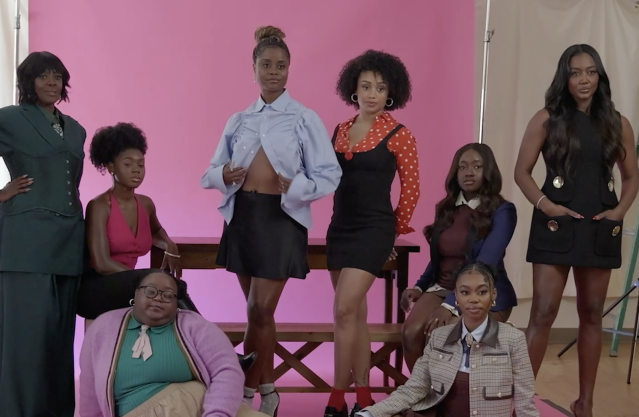
Jocelyn Bioh, Whitney White, Jasmine Amy Rogers, and Patina Miller Talk School Girls
The playwright, director, and stars of School Girls; Or, the African Mean Girls Play discuss the comedy, sisterhood, and themes behind the new Broadway production.