
Review: The Cherry Orchard, Reimagined by Simon Stone as a K-Drama
Park Avenue Armory presents a contemporary Korean-language take on Chekhov.
 |
New York City
|
|
New York City
|
September 17, 2026
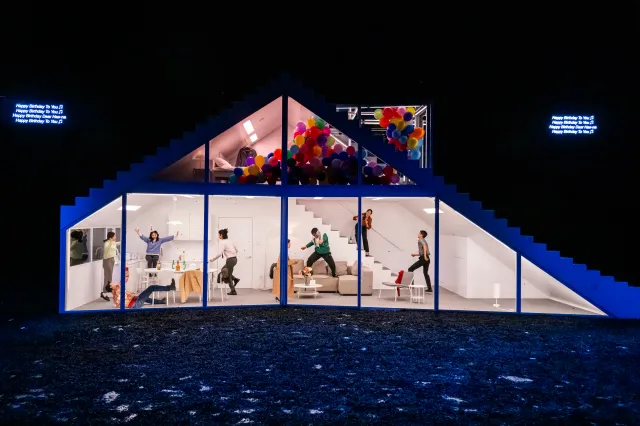
(© Stephanie Berger)
If there’s any remaining question about how interconnected our global society has become, just head to the Park Avenue Armory, the former American military drill hall turned performing arts venue, which is presenting a contemporary Korean adaptation of a classic Russian tragicomedy created by a Swiss-born Australian who resides in Austria. That’s 벚꽃동산 in a nutshell: Anton Chekhov’s The Cherry Orchard reimagined by iconoclastic theatermaker Simon Stone as a K-drama, transforming the 1904 work into a contemporary examination of inherited wealth and the ruthlessness of corporate power.
In transplanting Chekhov’s fading gentry to present-day Seoul, Stone turns the hapless Gayevs into a chaebol, a family-run business conglomerate of extraordinary power. Think Samsung, Hyundai, or LG, whose world-class performing arts center in Seoul debuted this production in 2024. Founded two generations ago by the grandfather of capricious alcoholic Song Do-young (Jeon Do-yeon) and her oblivious older brother, Song Jae-young (Son Sang-kyu), the industrial firm, which deals in “cars, tech, hospitality, medical supplies, what have you,” is on the verge of bankruptcy. Its stock price is tanking, while thousands of workers protest for job security at the gates.
But the Song family would rather dance their way to the end of their world than heed the advice of self-made industrialist Hwang Doo-sik (Park Hae-soo). He tells them to essentially sell the company for parts while preserving its name. But Do-young and Jae-young would never take advice from the formerly poor son of their father’s alcoholic chauffeur. They can see that their skyline view is rapidly changing, but they cannot imagine a future that doesn’t have them in it.
Of course, we all know who ends up buying the business, the land, and the prized 벚꽃동산 out from under them. But Stone and his magnetic central actors keep us guessing until the climactic moments, their motives in constant flux. As the Korean Ranevskaya, Jeon veers from recklessness to circumspection within a few words, almost without us even realizing. Son is eminently huggable as her beaten-down brother, whose only passion is vinyl records. And Park sheds his initial tenderness quickly, his fierce, demanding authority emerging with thrilling force. Who knows what lengths they’d go to so they can save themselves, or if they’re even capable?
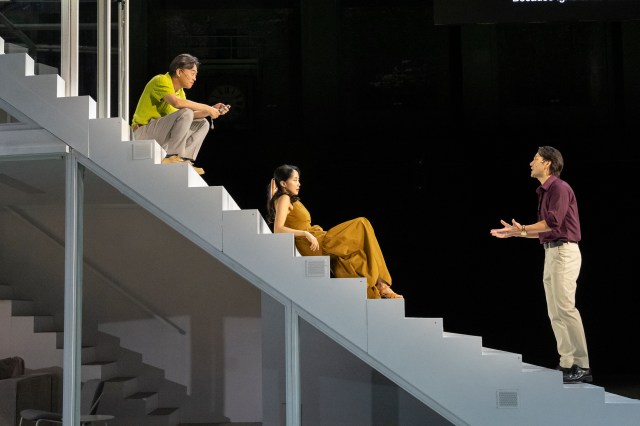
(© Stephanie Berger)
Stone’s fleet and funny dialogue (performed in Korean, with English supertitles) follows the Chekhov pretty reliably, down to the tangential love triangle between the servants (Park Hee-jung, Lee Ju-won, and Lee Se-jun, all excellent). It does peter out by the end (an issue I have with the original play, too), and the railing against Big Tech by family tutor Byun Dong-lim (the simultaneously passionate and mopey Nam Yun-ho) isn’t an especially original take on Trofimov. And there was at least one character adaptation—a hedonistic combination of the elderly servant Firs and the old aristocrat Simeonov-Pishchik—that didn’t land for me, despite a scene-stealing turn from Yoo Byung-hoon.
Taken as a whole, Stone’s script underscores just how timeless this 122-year-old play really is. The specifics might be a little different, but the inability to recognize that the world has moved on and isn’t waiting for you to catch up is as vivid as ever.
As in Stone’s other projects, like Yerma, which played the Armory, and his recent Oresteia at London’s Bridge Theatre, much of The Cherry Orchard takes place inside a glass terrarium. The enclosure, within an architectural marvel of a multilevel set by Saul Kim, functions as a pressure cooker, sealed off from the world and creating an environment where the simmering tensions and competing personalities intensify until they finally erupt (most evident in the performances of Moon Choi and Lee Ji-hye as Do-young’s vastly different daughters).
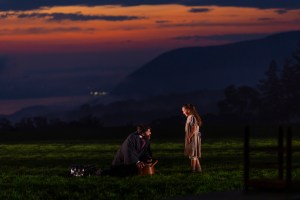
Kim and lighting designer James Farncombe paint gorgeous imagery—the sun rises and sets in frightening reds and soothing blues; a blizzard of pitch-black snow envelopes the crisply white Song home—but Stone’s staging is reaching for a level of intimacy that’s difficult to achieve in a 55,000-square-foot building. The projected supertitles hang on the sides of the stage, making it difficult for us to reconcile the translation with the actor speaking the words aloud (Jang Young Gu’s heavy amplification ricocheting off the 80-foot-high vaulted ceiling doesn’t help either). A building of this scale is simply not the ideal setting for what is, ultimately, a small family drama.
The present-day setting is what ultimately makes this Cherry Orchard so tragic. Surely, we think, the Songs will find a way to save themselves. The rich always do. Stone’s insight, however, is that the Songs mistake their history of power for a guaranteed future. Like many modern scions of inherited wealth, they cannot see the peons waiting to take their place. In this world, there are more Tom Wambsgans‘ waiting in the wings than there are Shiv Roys.
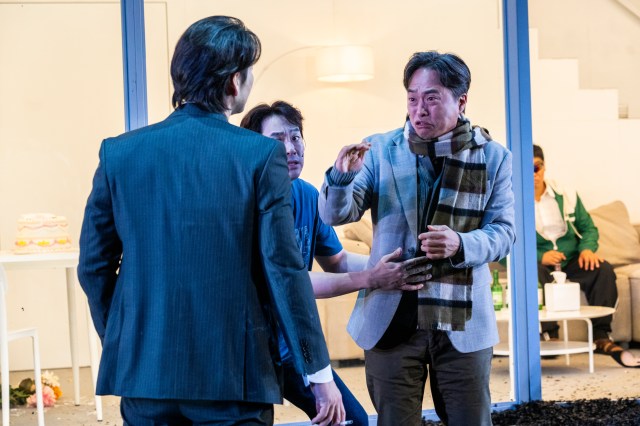
(© Stephanie Berger)




source on Google
Featured In This Story

Latest Reviews
See all




Latest Videos

Jocelyn Bioh, Whitney White, Jasmine Amy Rogers, and Patina Miller Talk School Girls
The playwright, director, and stars of School Girls; Or, the African Mean Girls Play discuss the comedy, sisterhood, and themes behind the new Broadway production.