
Review: Show Trial, a Czechoslovakian Communist Spectacular
Laura Zlatos’s courtroom farce makes its world premiere at the Tank.
 |
Off-Off-Broadway
|
October 19, 2026
(© Morgan McDowell)
Courtroom dramas are perennially popular, but what about a courtroom farce? That’s what Laura Zlatos has written with Show Trial, now having its world premiere at the Tank. Based on real but long-suppressed audio recordings of the 1950 prosecution of Milada Horákova, the play makes a well-earned mockery of justice in Communist Czechoslovakia by emphasizing the show.
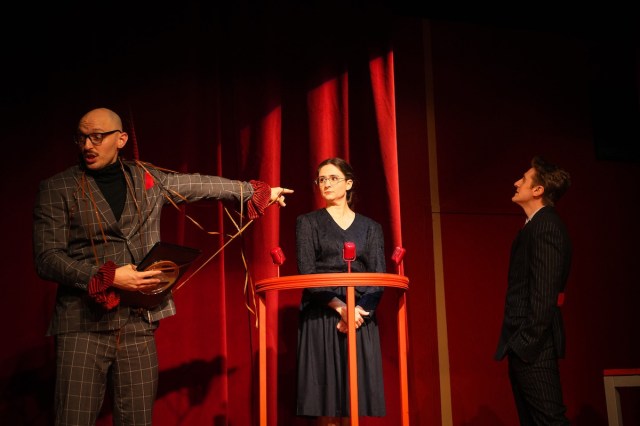
Horákova (Jessica Frey) was a moderate socialist and member of the Czech resistance who served time in a Nazi concentration camp. But that doesn’t stop prosecutor Ludmila Brožová (Jessie Cannizzaro, all deranged Peggy Sawyer energy) from accusing her of being a secret Nazi herself. Lead prosecutor Josef Urválek (Alex J. Gould, ready for his meeting with Armando Iannucci) describes her as “a professional agent of Western imperialism and veganism.” And just in case that spaghetti doesn’t stick, judicial chairman Karel Trudák (Brian Bock, a Luciferian Leninist) has assigned two more prosecutors to the case: sadistic war hero Juraj Vieska (Tom Mezger) and blithering idiot Antonín Havelka (Justin Ahdoot), the fall guy in case the trial collapses.
“Every line, each pas de bourrée must be performed exactly as written, or else the second act falls apart and Comrade Stalin kills us all,” says Trudák the impresario. And it’s a real possibility, since Horákova refuses to follow the script and repeatedly calls-out the illegitimacy of the trial (this is why the audio recordings were shelved until they were discovered in the national archives in 2005). When Trudák informs his cast that Stalin himself (Ema Zivkovic, hilarious outfitted in a ballgown, bushy mustache, and Ann Miller wig) will be in attendance, a wave of terror and excitement washes over them.
(© Morgan McDowell)
Zlatos’s script gives the immediate impression of a playwright deeply immersed in both Eastern European history and the Adult Swim block of programming on Cartoon Network. Her treatment of this very serious history is quippy, absurd, and inoffensive from the perspective of 2026, when all but a few keyboard warriors would agree that Stalinist show trials were a flimsy excuse to eliminate political opposition and instill fear in those who might join them.
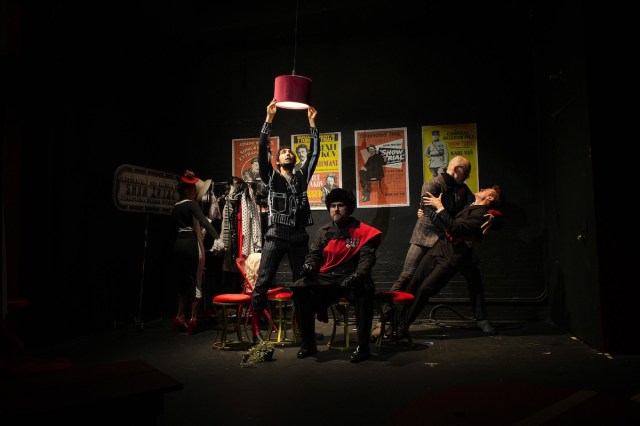
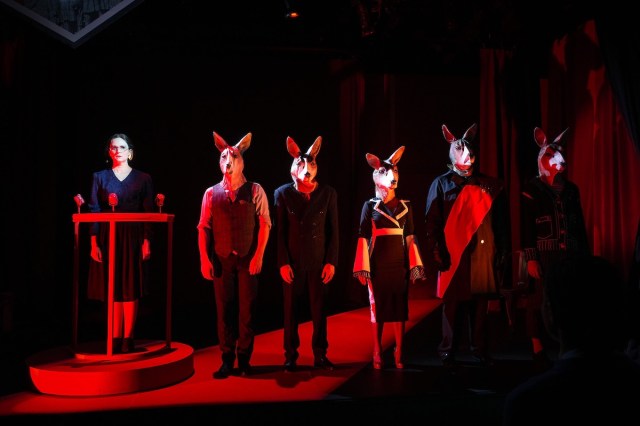
Director Tom Costello gets the tone right, with 100 minutes of well-choreographed chaos. The production is certainly the most spectacular I’ve witnessed at the Tank, with the diagonal lines and muted colors of Cat Raynor’s set aping Soviet constructivism, while a series of backstage posters commemorating previous show trials (“Trotsky!”) constitute the funniest sight gag in the show. Patricia Marjorie’s costumes smartly lean into archetype (a furry hat and sash of medals for Vieska, a closely tailored pinstripe suit for Urválek) so it’s easy to remember who is playing what role. Sharp and sudden lighting cues (by Sawyer Smith) and perfectly timed sound design (by Nicholas Webster) undergird the manic pacing. It keeps the proceedings light, bright, and fast, but also portrays justice as a kind of terrifying machine that is very difficult to stop once it is in motion.
As Horákova, Frey feels like a librarian who has wandered into clown college, the calm at the center of this hurricane of pandemonium. Her lips pursed and firsts clenched, she straightforwardly answers questions from the stand knowing full well that her words will be twisted by the state in pursuit of a predetermined guilty verdict.
“We’re nearing the end of the second quarter and the prosecution leads 20,000 to zilch,” reports radio commentor Martin Martinek (Alex Mandell, serving old-timey sports broadcaster). It’s a satire of the nakedly partisan propaganda of state media, but just barely.
(© Morgan McDowell)
There’s a lot to like about Show Trial. Everyone in this cast is giving their all, the staging is solid, and the concept is clever. I really wanted to laugh harder than I did, but something (the barrage of historical information, the channel-flipping shortness of the scenes, the mildly amusing but never deliriously funny jokes) kept me from fully abandoning myself to Zlatos’s zany world. Show Trial is the kind of comedy that elicits knowing guffaws, but never uncontrollable belly laughs.
Still, Zlatos is a writer with a unique perspective and admirably playful sensibility. I have no doubt that, if she found the right collaborators, she could write a series of well-regarded animated shorts that exhausted high school history teachers would be delighted to stream for class the Wednesday before Thanksgiving.




source on Google
Featured In This Story
Latest Reviews
See all



Latest Videos
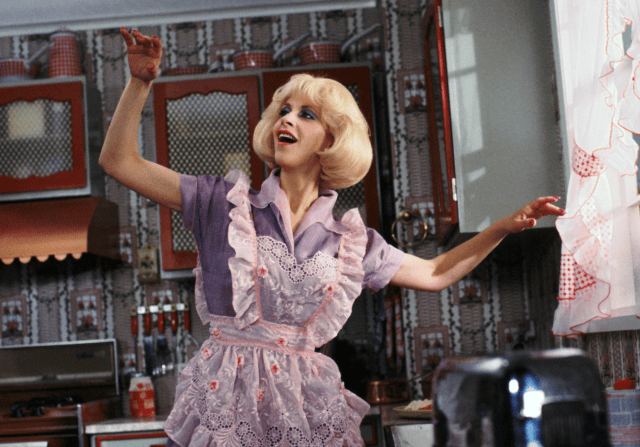
Watch: Ellen Greene Reflects on the Enduring Legacy of Little Shop of Horrors
Frank Oz’s cult classic movie-musical has gotten a new 4K restoration in celebration of its 40th anniversary.