
Interview: Danny Robins on How 2:22—A Ghost Story Escaped Dear Evan Hansen's Theater and Took Over the World
The unexpected Covid-era hit makes its New York debut in time for Halloween.
 |
Off-Broadway
|
October 19, 2026
Danny Robins was a new kid on the block when his play 2:22—A Ghost Story unexpectedly took over the West End home of Dear Evan Hansen while that show was shut down during the pandemic. It was the first play he had ever written (his background is in comedy and journalism), it was being produced by relatively new producers, and it starred pop singer Lily Allen, making her stage debut. No one quite knew what to expect. Suffice it to say, Robins was surprised when the play not only took off, but grew into an international hit.
Now, 2:22—about a dinner party hosted by a woman convinced her house is haunted and her husband, who insists it isn’t—is making its New York premiere beginning October 20 at the Lucille Lortel Theatre, in a production led by Anna Camp and Jasmine Cephas Jones. They join a growing list of high-profile actors who have taken on the play, including Allen, Stephanie Beatriz, Tom Felton, Constance Wu, Finn Wittrock, Ruby Rose, and others. For all its supernatural trappings, Robins says, 2:22 is ultimately a decidedly human story…Which may be exactly what makes it so scary.
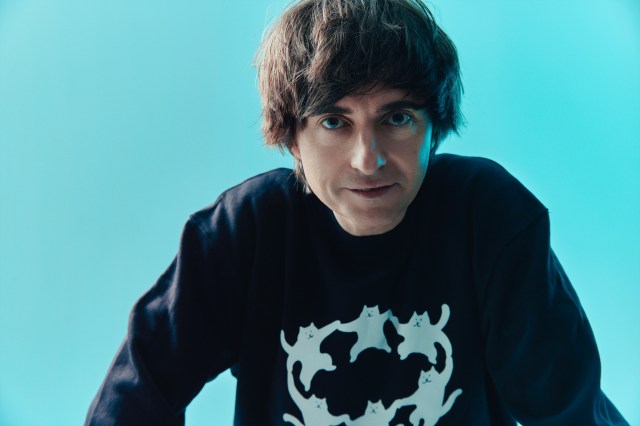
(© Rich Lakos)
This interview has been condensed and edited for clarity.
Is genre the kind of thing you’ve always gravitated towards?
I was a teenage Agatha Christie fan. I’ve always been a big consumer of detective stories. I love true crime podcasts. And actually, the podcasts I’ve made about ghosts are in that mold to a degree. I took the true crime format and applied it to a ghost story. 2:22 is very much a detective story, a supernatural mystery that unfolds over a night.
I read that you were inspired to write 2:22—A Ghost Story because your firend told you they saw a ghost.
Yeah, it was a kind of seminal, life-changing conversation. I was talking to a very old friend of mine who told me this story about having seen what they thought was a ghost. And it was just a story that grabbed me like no other, really. It felt like hearing somebody describe being in a traffic accident or witnessing a crime. I remember thinking that all of our friendship group would react to her in very different ways. Some people would be irritated by her. Some people would mock her. Some people would think she was going crazy, and some people would believe her. And I thought if you could distill that incredible spectrum of reactions into a couple, it felt like a very exciting Molotov cocktail to throw into a relationship. How can you love me if you don’t believe me, essentially? That was the starting point: one person believing their house is haunted and one person fundamentally refusing to believe in ghosts and waiting until the moment that one of them is proved right or wrong.
How did you settle on 2:22 as the particular time?
I wish I could tell you that it was some sort of complex, brilliant set of references. There’s plenty of people out there who believe I chose it because of references to angelic numbers or Bible passages. But it really was just a time that I felt had a nice ring to it. I liked the idea of counting down to this number, the clock ticking down over the night. One of the early producers said, “This will never be a success if you call it 2:22.” And I was like, “It’s got to be called 2:22. The whole thing the play is about is counting down to that time.” So, I added hyphen “A Ghost Story.” And it hasn’t done that badly. It’s been across five continents and had several seasons in the West End.
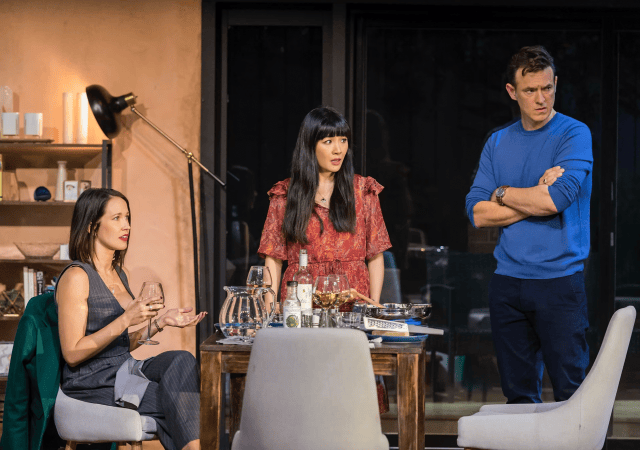
(© Craig Schwartz Photography)
You’ve referred to this as a supernatural mystery. Do you consider it horror?
I would consider the work I do to be horror for people who think they don’t like horror. I think that horror can sometimes seem like an off-putting genre to certain audiences. You can feel like it caters to a younger audience. And certainly, I know so many people within my social circle who have kids and lose their threshold for scares completely.
So, I was interested in doing something that was very emotionally driven. I didn’t want something that felt like a play. I wanted it to feel like real life on stage. I think it’s a useful and powerful thing to have lots of real-world, mundane threats. The noise of foxes in the garden. The rustle of the baby monitor. Can you trust each other? Is my husband keeping secrets? That sustains the tension and peril across the evening.
You were essentially a new kid on the block when the show first started in the West End, and now you’ve played around the world. Were you surprised by how much it has resonated?
We put this play on in the West End just as we emerged from COVID lockdown. It was pretty much the first show in a theater where you didn’t have to socially distance. It was a theater that was normally occupied by Dear Evan Hansen, but they decided to close until it was safe, in inverted commas, and we filled that gap from August to October. We were this incredibly presumptuous act of new producers who hadn’t really done much in the West End, a new playwright who’d never done anything in the West End, and a leading lady who was a pop star who had never acted before in Lily Allen. I could almost literally hear critics sharpening their knives in the background going, “What is this ghost play?”
In the wake of 2:22 in the UK, there’s been a boom in writing about the supernatural. It could have gone horribly wrong, but thankfully, it was so well received. It kept coming back for more West End runs and now it’s worked its way around the world. And I think there’s something about the subject that resonates. You could go anywhere and start a conversation around the question, “Do ghosts exist?”

(© Helen Murray)




source on Google
Featured In This Story

Related Articles
See all
Latest Reviews
See all


Latest Videos
Watch: Ellen Greene Reflects on the Enduring Legacy of Little Shop of Horrors
Frank Oz’s cult classic movie-musical has gotten a new 4K restoration in celebration of its 40th anniversary.