
Review: New Musical Begin Again Needs to Start Over
Passion ignites once Pat Monahan and Train hack their way out of the first act.
 |
San Diego
|
|
San Diego
|
September 24, 2026
(© Jeff Lorch)
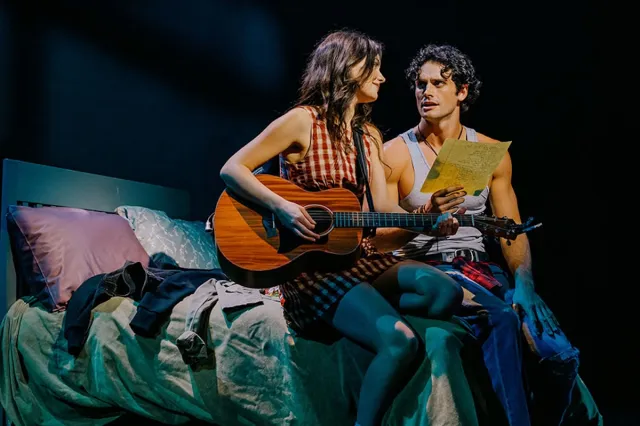
Two scores are at war in the Old Globe’s world premiere of Begin Again, the stage adaptation of the John Carney’s 2013 film. Pat Monahan and the band Train split the music between generic book songs, which convey the characters’ longings and frustrations, and spontaneous, passionate source songs, sung by the artists at open mic or while recording an album.
The story revolves around Gretta (Emma Busse), a talented, unknown songwriter who invests all her energy in her sexy but shallow boyfriend, Max (Kevin William Paul). His striking looks and adept singing land him a major record contract, but only if he’s listed as the sole songwriter.
Desperate for his love, Gretta relinquishes all her rights to the music and sends him on his way to fame and fortune. Unsurprisingly, the new superstar gets himself a shiny new girlfriend, leaving Gretta without a muse, a boyfriend, or direction. Encouraged by her friend Stevie (Casey Whyland), she performs her freshly written “Song I Used to Know” at open mic night and blows away down-on-his-luck record producer Dan (Patrick Heusinger). He convinces Gretta to perform all her new songs as the lead artist, using the ambient noise of New York’s streets to bring the recordings to life. Gretta falls in love with her own talent through this exploration.
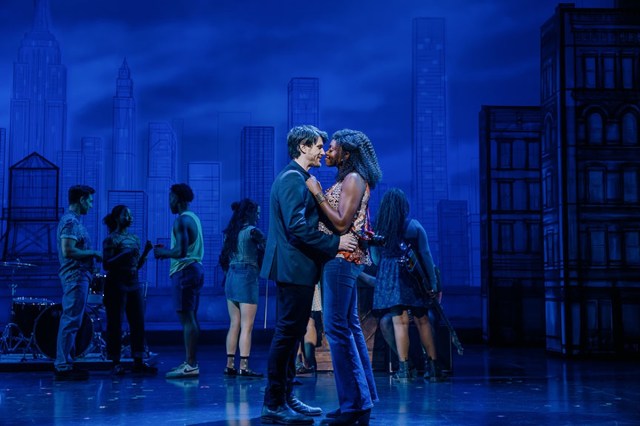
John Carney’s films, which also include Once and Sing Street, captivate with their authenticity. This musical channels similar moments in its source songs. Librettists Jenna Clark Embrey and Molly Beach Murph excel at showing us Gretta’s creative process as she struggles to write her music.
(© Jeff Lorch)
But in Act 1, Gretta displays no drive or forward momentum. She gets back in the game only because Dan begs her to. And in Act 2, when she gives up again after a setback, we’re not sure exactly why, with an 11th-hour conflict needed to get her to act. These plot points come from the original film, but they’re more pronounced in this adaptation, making Gretta less compelling.
The book songs come up short too, telling us little specific about the characters; the songs could been sung interchangeably by any of them. Dan’s are the most egregious, sounding like whining instead of reflection. One song he shares with his business partner, Saul (Nik Walker), “Made of Gold,” is the most unpleasant. Some of the source songs on the other hand are quite good, like “Half a Heart” and “I Hope You See What I See,” but none stands out like the film’s Oscar-nominated song, “Lost Stars,” by Gregg Alexander and Danielle Brisebois.
Of the cast, Whyland and Paul bring the most charisma. Paul makes it obvious that Max will be a star, not only for his dashing looks but also for his electric stage presence, and Whyland is a ball of wild energy. Heusinger is saddled with songs that don’t work, so it’s hard to care about Dan. His relationships with Charlotte MacLeod, who plays his daughter Violet, and Adrienne Walker, who plays his separated wife Miriam, are equally underdeveloped. We learn how his marriage to Miriam ended in Act 2, and the circumstances don’t square with Walker’s antipathy toward him.
The biggest issue is Busse’s performance. A semi-finalist on the 21st season of American Idol, she has a soulful voice, but director Lorin Latarro guides her toward a stiff and unconvincing performance, with unnatural hand movements and an unmodulated voice.
(© Jeff Lorch)
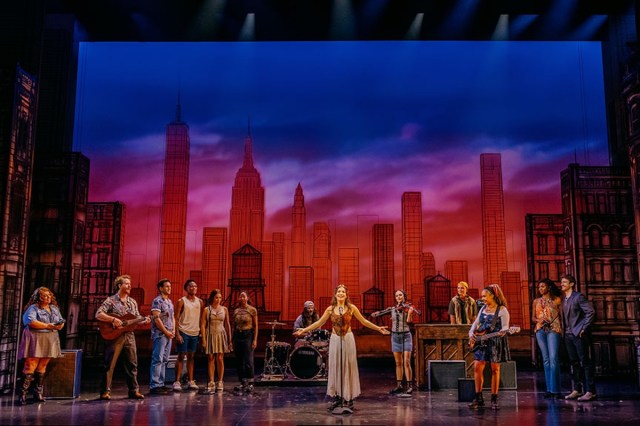
Latarro does an excellent job telling much of the story visually, through illusions courtesy of Skylar Fox. Basketballs and pieces of paper magically bounce from person to person; crumpled notes float to the sky; instruments invisibly glide into the hands of musicians. The effect works well the first few times—especially when Dan imagines a nervous Gretta singing “Song I Used to Know” with a full band forming behind her—but after one too many repetitions, it just seems like Heusinger packed along the poltergeists from his performance in Paranormal Activity. Similarly, Latarro stages Max’s studio recording of “Meteor” with all the suffocation of ending a relationship while money men breathe down his neck.
David Neumann’s rudimentary choreography, with people walking and doing a few step-touches, adds little to the production. Derek McLane’s and David Bengali’s projections effectively evoke Manhattan like the cover of The New Yorker.
Begin Again needs some work in its first half, and if it gets it, this musical could come together. Act 1 is little more than cliched exposition, but once the two characters begin collaborating in Act 2, Begin Again gets a fresh start and delivers invigorating moments.




source on Google
Featured In This Story
Latest Reviews
See all


Latest Videos
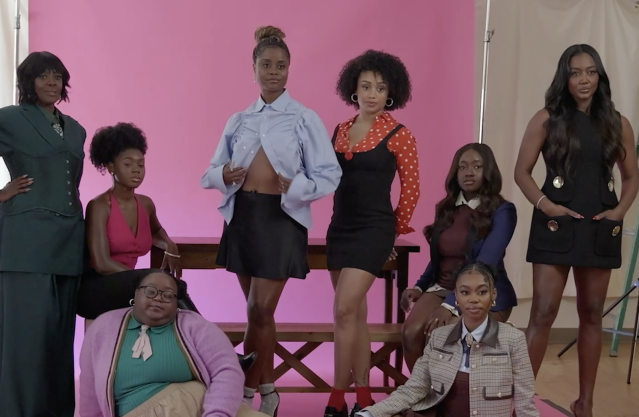
Jocelyn Bioh, Whitney White, Jasmine Amy Rogers, and Patina Miller Talk School Girls
The playwright, director, and stars of School Girls; Or, the African Mean Girls Play discuss the comedy, sisterhood, and themes behind the new Broadway production.