
Review: Mrs. Stern Wanders the Prussian State Library, an Ambling Nazi Drama
Jenny Lyn Bader’s historical play about Hannah Arendt plays a return engagement at 59E59.
 |
Off-Broadway
|
|
Off-Broadway
|
September 18, 2026
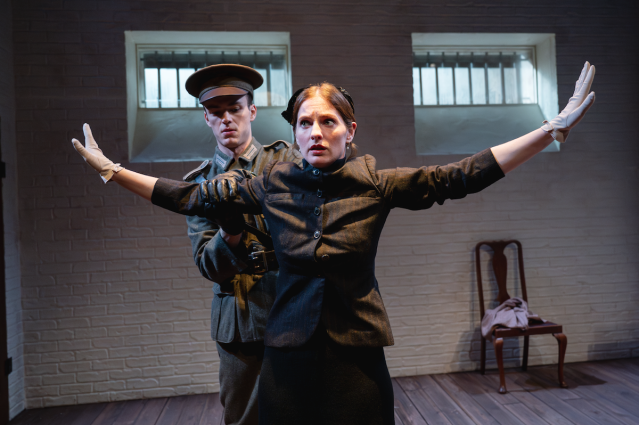
(© Valerie Terranova)
A drama about a Jewish woman under Nazi scrutiny in 1930s Germany has the potential to be a lot of things. Challenging. Timely. Chilling. Thought-provoking. Jenny Lyn Bader’s Mrs. Stern Wanders the Prussian State Library, onstage at 59E59, is none of these things. It’s the dullest imaginable version of the true story of Hannah Arendt, the philosopher famous for coining the phrase “the banality of evil.” The couple of sentences from Arendt’s Wikipedia page detailing the events of the play are more riveting than this production.
Objectively, the stakes are sky high. Hannah (Ella Kaille), a philosophy graduate student, is imprisoned and interrogated by Karl (Brett Temple), a baby-faced Nazi officer who, in the chaos of martial law, has been promoted beyond his experience. He must determine if Hannah has collected antisemitic materials from the titular library to publicize outside of Germany. She claims she was just looking for dessert recipes. If she’s found guilty, she could be executed.
The premise is solid, but the play falters from the start. Karl’s interrogation treads into Hannah’s lofty ideas about philosophy, Jewish identity, and Zionism, but doesn’t generate tangible jeopardy. The only suspense comes from the question of whether Hannah will be released from jail. For those who know what happened to one of the most prominent political theorists of the 20th century, there’s no tension. But those unfamiliar with this history are also out of luck. Karl never seems particularly threatening, and the play doesn’t make it clear that Hannah is an activist, undercutting the real danger she is in.
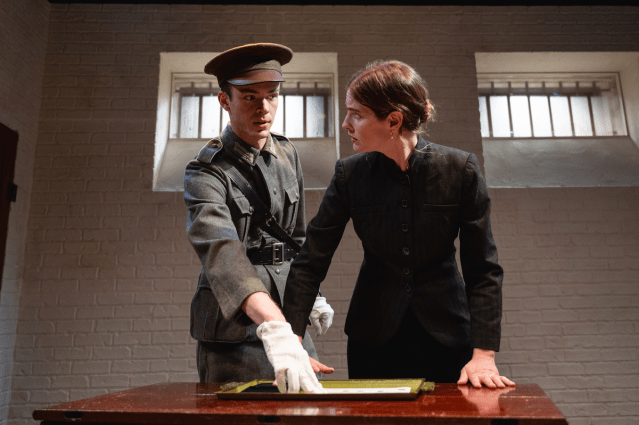
(© Valerie Terranova)
Later, a lawyer for a Zionist organization, Erich (Daniel Adam Cantor), unexpectedly arrives to help Hannah. At first, I was relieved at his appearance, hoping that Hannah’s real motivations would be revealed (or at least something interesting would happen). Unfortunately, this also went nowhere: Hannah pretends she is innocent and has never met a Zionist or Communist in her life, flattening possible rising conflict into a smooth, textureless plateau.
The actors do little to liven up the drama. Kaille makes the same emotional and physical choices over and over, playing dumb and constantly motioning for Karl to stay calm. She doesn’t indicate deeper layers of her character, despite hints at her deception. Is Hannah charmingly earnest, cleverly manipulating Karl into feeling compassion for her, or both? It doesn’t matter. Kaille’s one-note performance erases any nuance or intrigue. She doesn’t even bother to act like she’s been imprisoned for increasingly longer periods of time. Her behavior on day eight of questioning is the same as when she first walks into the jail cell.
As Karl, Temple does better. Some of his delivery is stilted and he dives in and out of a German accent, putting him at odds with his costars who avoid it. But he is attempting to fully embody his character and gets some laughs, which I cannot say about his costars. Plus, Karl is written flatly, remaining an unsure, tentative young man throughout. There’s little opportunity for Temple to create subtext, so his effort to do so is appreciated. Meanwhile, Cantor takes a character with no discernible personality and does nothing to make him more dynamic.
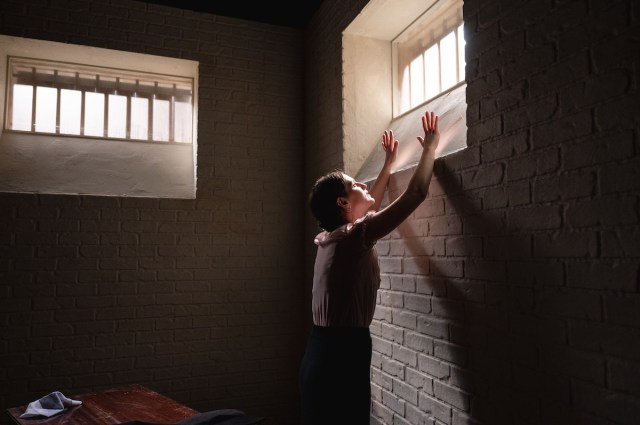
(© Valerie Terranova)
Ari Laura Kreith’s direction is uninspired, giving characters little to do except circle each other around the room. At times, her staging even seemed to go against the basic tenets of direction. At one point, Hannah approaches Karl as he angrily questions her, when logic dictates that the opposite would happen.
Not all production elements were bland, however. The set (Lauren Helpern) and lighting (Zachary Connell) worked well, and the costumes (Deborah Caney) were period-appropriate and suited the characters. These strong elements add to the letdown that the play itself is not compelling.
Just when something new starts to build, Mrs. Stern Wanders the Prussian State Library abruptly stops. It’s an underwhelming ending to a story rife with dramatic potential, which sums up this disappointing production.




source on Google
Featured In This Story

Latest Reviews
See all








Latest Videos

Jocelyn Bioh, Whitney White, Jasmine Amy Rogers, and Patina Miller Talk School Girls
The playwright, director, and stars of School Girls; Or, the African Mean Girls Play discuss the comedy, sisterhood, and themes behind the new Broadway production.