
Review: Macbeth, a Tale of Halting Ambition at the Metropolitan Opera
Quinn Kelsey and Lise Davidsen star in a new production of Verdi’s Scottish opera.
 |
New York City
|
September 23, 2026
(© Marty Sohl / Met Opera)
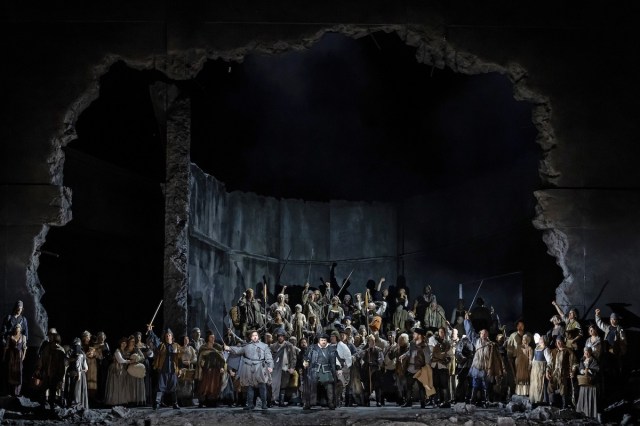
A giant hole in the wall serves as the proscenium of the new production of Giuseppe Verdi’s Macbeth, which last night opened the 141st season of the Metropolitan Opera. It is la bocca d’inferno, the mouth of hell opened to devour all creation. It also presents an opportunity, for those who would seize it, to build a new world from the rubble of the old. That seems to be what director Louisa Proske is attempting in a dazzling Met debut which reinvents grand opera for a new generation. Of course, great ambition can be dangerous.
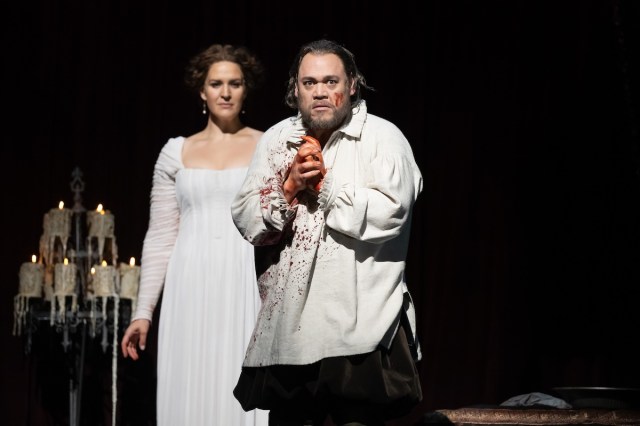
Shakespeare understood that when he wrote Macbeth, the English tragedy that serves as the basis of this Italian opera. It’s the story of a Scottish lord (Quinn Kelsey) who encounters a coven of witches in the aftermath of victory against the traitorous Thane of Cawdor. They tell him that not only will he receive Cawdor’s title and lands, but he will become King hereafter. His impatient wife (Lise Davidsen) schemes to make hereafter now by ordering her husband to murder King Duncan in his sleep. They ascend the throne in the subsequent power vacuum, with Macbeth ever wary of the final part of the prophecy: that the descendants of his friend, Banquo (Ryan Speedo Green), will eventually become kings too.
(© Marty Sohl / Met Opera)
In a letter to Francesco Maria Piave (who co-wrote the libretto with Andrea Maffei) the year before the opera’s 1847 debut, Verdi was perhaps mindful of his own ambition when he wrote, “If we can’t make something great out of it, let us at least try to do something out of the ordinary.” For those of us accustomed to the shrinking casts and thinning orchestras of Broadway, that is exactly what the Met does best.
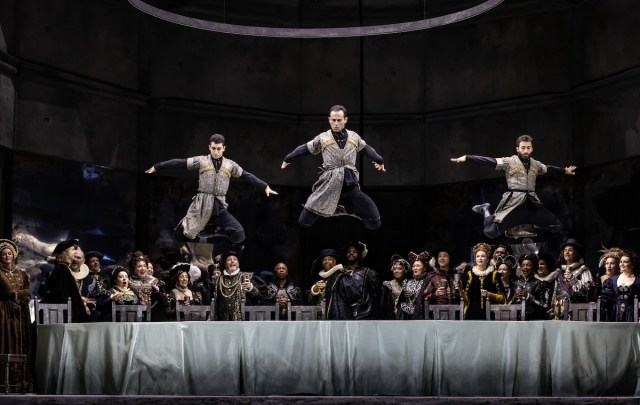
Proske, co-founder of the scrappy Heartbeat Opera, marshals the resources of the Met to create a production that ranks with the greatest triumphs of Franco Zeffirelli. The curtain rises with steel clashing and sparks flying in a tense battle scene (the action director is Ran Arthur Braun). Jon Bausor’s rotating set matches the dynamism of Verdi’s score, creating sweeping panoramic scenes, with Adam Silverman’s lighting casting horrifying shadows upstage. Daredevil choreographer Jorrell Lawyer-Jefferson has dancers performing rotating knee drops atop a banquet table (I witnessed several elderly patrons vicariously wince).
(© Marty Sohl / Met Opera)
That dance takes place during the second act banquet scene, surrounded by the enormous Met chorus, each member intricately adorned in Montana Levi Blanco’s sumptuous 16th-century costumes. Lord and Lady Macbeth look like Henry VIII and Queen Elizabeth, respectively. Ruffs and long strings of pearls abound, making the stage look like a Francken painting. According to the designer, much of it was salvaged from the Met’s costume storage—a new world built from the scraps of the old.
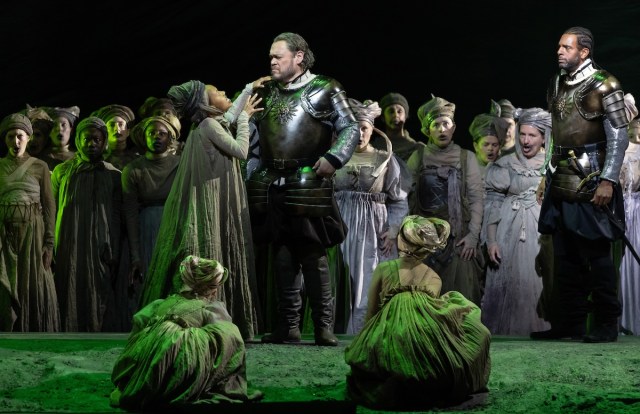
Hungry scavengers, the witches play a vital role throughout. They urge Macbeth forward, penetrate the walls of Lady Macbeth’s chamber and her mind, and revel in the destruction they have wrought. Who needs AI when you have these ladies imparting psychotic delusions of grandeur with a bloody smile?
(© Marty Sohl / Met Opera)
We get the sense that this Macbeth would easily be led astray by ChatGPT. Kelsey is vocally unimpeachable, with a lush baritone that never tires throughout a difficult two-and-a-half-hour score, and which beautifully illustrates Macbeth’s emotional life and what drives him. Unfortunately, Kelsey’s character study only goes so far. His Macbeth’s default emotional state seems to be a retiring reluctance, and his primary motivation is fear of his domineering wife, who towers over him by a head.
It is certainly not sex. Kelsey and Davidsen have the chemistry of a dim student and an icy substitute teacher, each keenly aware that their engagement will be brief (their final performance is October 20). A third act embrace at arm’s length seems to confirm this as a marriage of inconvenience, mostly held together by the lady’s lust for power—not that great partnerships cannot derive from that.
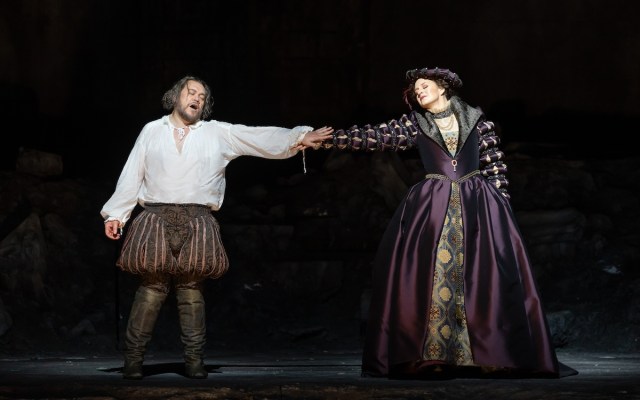
(© Marty Sohl / Met Opera)
Disappointingly, Davidsen is unable to summon the irresistible force of will that makes the best villains so watchable. Her vocals are textbook perfect, with darkly flirtatious coloratura during “Vieni! t’affretta!,” diabolical heft on “La luce langue,” and cat-like agility in “Si colmi il calice.” Yet there is something hesitant in her expression, like a terrified Olympic figure skater landing a triple axel. Davidsen is a world-class vocal talent, but she is not yet commanding the stage like a diva.
The Met has a colorful history with the role of Lady Macbeth. General manager Rudolf Bing famously fired Maria Callas from the 1959 Met debut, replacing her with Leonie Rysanek. I’m sure current general manager Peter Gelb is eager to bury all thoughts of Anna Netrebko, who memorably played Lady Mac in a previous Met production in 2014, long before falling out with Gelb over Russia’s invasion of Ukraine. Yet like Banquo’s ghost, her unapologetically brazen specter keeps returning to the feast.
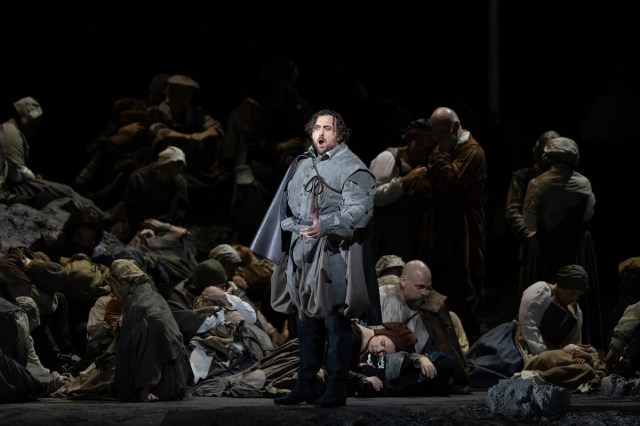
(© Marty Sohl / Met Opera)
The supporting players are solid. Green’s Banquo is both emotionally and aurally resonant. Jonathan Burton’s Malcolm might just make you feel patriotic again, in a death-to-the-Habsburgs kind of way. And Freddie De Tommaso’s Macduff, an emo strand of hair hanging down the right side of his face and a song of aching remorse in his throat, turns out to be the most delightful surprise of the night. They all sound great, when we can hear them.
Conductor Yannick Nézet-Séguin powerfully conjures Verdi’s brass of doom and drums of fate, but this frequently resulted in drowned voices the night I attended. A little restraint goes a long way, both in music and statecraft.
Performance issues aside, Proske’s magnificent new production of Macbeth is a rare and happy tale of successful ambition, heralding the arrival of an exciting new directorial voice on the Met’s grand stage. It is sure to astound and terrify audiences for seasons to come.




source on Google
Featured In This Story
Latest Reviews
See all



Latest Videos

Find Out the Real Story Behind Broadway's Here There Are Blueberries
Writers Moisés Kaufman and Amanda Gronich discuss the new drama alongside their cast.