
Review: Katie Holmes Stars in Ibsen’s Comedy Hedda Gabler. Wait, Comedy?
Barry Edelstein directs the new production at the Old Globe.
 |
San Diego
|
|
San Diego
|
February 25, 2026
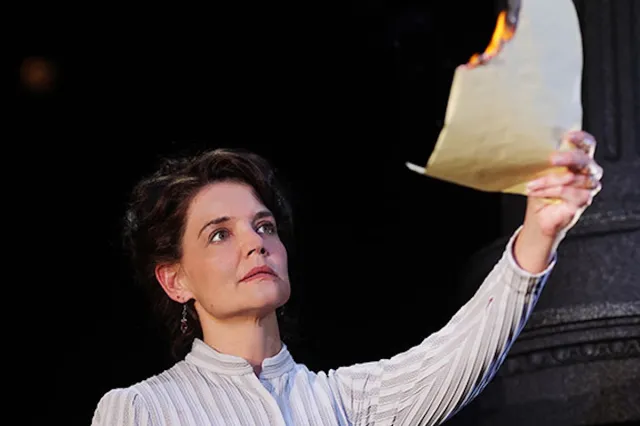
(© Rich Soublet II)
Is the Old Globe’s new production of Hedda Gabler intended as a comedy? This isn’t a glib question, but a legitimate concern after leaving Erin Cressida Wilson’s slimmed-down adaptation of Henrik Ibsen’s classic, headed by movie star Katie Holmes. This very watchable production feels like a spoof of daytime soap operas. At the performance I attended, the audience laughed often and seemed to be having a good time.
Hedda Gabler follows Hedda (Holmes), newly returned from her honeymoon with her milquetoast husband, George (Charlie Barnett). Already bored and restless, she finds herself trapped in an extravagant home she never wanted and under the constant scrutiny of his Aunt Julie (Saidah Arrika) and Julie’s loyal maid (Katie MacNichol), who now works for the couple.
Complicating matters further, Hedda’s former flame (Alexander Hurt) arrives in town and becomes a direct rival to George for an important job. His innocent wife, Thea (Celeste Arias), is both fragile and yet wise enough to survive the machinations of Hedda, who had tortured her through their boarding school days. As frustrations mount, Hedda begins manipulating those around her in a desperate attempt to claim the wealth and power she believes she deserves—only to discover that it may have long since slipped from her grasp.
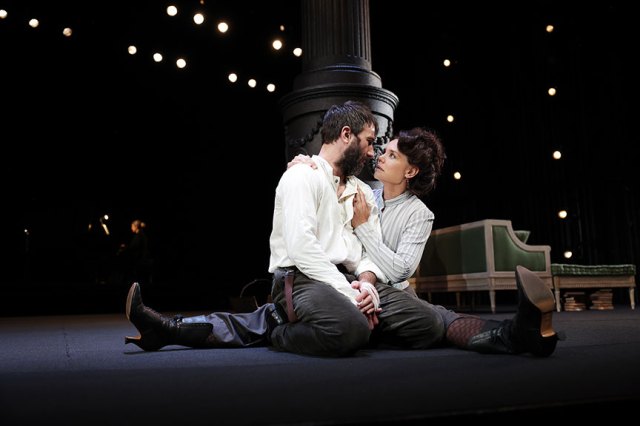
(© Rich Soublet II)
Wilson, who wrote the sly Maggie Gyllenhaal film Secretary about a BDSM work relationship, brings bold, provocative sensibility to Ibsen’s work. Her Hedda comes off as a volatile adolescent—part mischievous child, part menace. The old‑fashioned 19th‑century formalities are gone, replaced with a more modern bluntness and a willingness to push right up against the line.
Holmes revels in her character’s atrocities, practically salivating when a past lover destroys himself. Barnett brings charm to the oblivious man who believes his wife to be a beautiful butterfly, unaware she’s a wasp. Arrika is warm and comforting as Aunt Julie. As the writer, Hurt is a ticking time bomb—passionate, volatile, and instable. As the “friendly neighborhood” judge, Alfredo Narciso shrewdly makes a meal out of powerful white-man stereotypes.
Director Barry Edelstein heightens the performances to an absurd level, which is what makes Ibsen’s dialogue hilarious. A pianist (Korrie Yamaoka) plucks out original tunes that sound like the theme from The Young and the Restless throughout the evening.
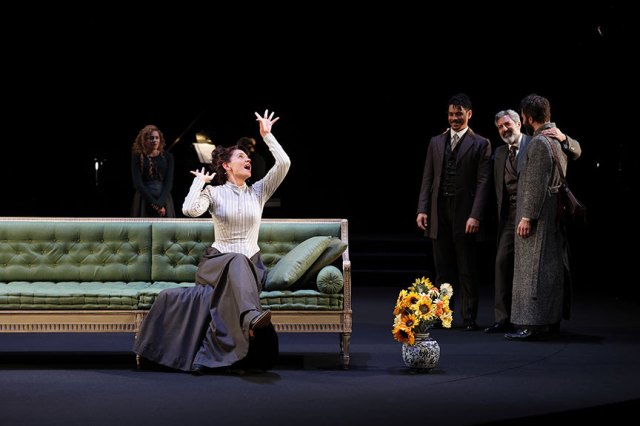
(© Rich Soublet II)
Mark Wendland’s sparse set includes a revolving stage, a long functional couch, and an intricate stove that looks like it had been designed by Charles Addams. David I. Reynoso’s costumes are elegant, late 19th-century European attire.
The current adaptation of Ibsen’s Hedda Gabler clocks in at half the length of traditional versions, and since I haven’t seen other stagings, it’s difficult to know what was omitted. Erin Cressida Wilson’s version creates characters who do not grow and remain as lost as when they started, which may be why this feels like a sendup of the Norwegian playwright instead of a traditional interpretation. It may be the first time a reviewer picks the word “amusing” to describe an Ibsen production.




Featured In This Story
Latest Reviews
See all
Latest Videos
Watch the New Broadway Cast of Operation Mincemeat Take a Bow
The show just entered its second year of performances at the Golden Theatre.