
Review: Indigo Girl Emily Saliers Gives Cyrano a Major Nose Job in Starstuck
The world-premiere musical, with lyrics by Beth Malone and Mary Ann Stratton, runs at Bucks County Playhouse.
 |
New Hope
|
|
New Hope
|
March 5, 2026
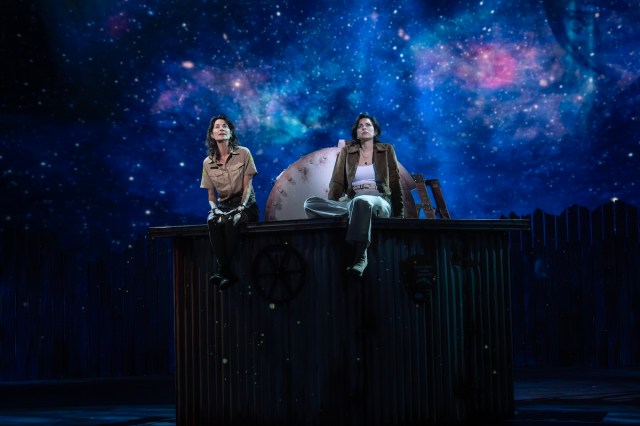
(© Joan Marcus)
The quest to successfully musicalize Cyrano de Bergerac continues with Starstruck, the charming but slight new attempt receiving its world premiere at Bucks County Playhouse in New Hope, Pennsylvania. Working with librettists Beth Malone and Mary Ann Stratton, composer Emily Saliers—one half of the Indigo Girls—puts a queer spin on the Rostand classic, transporting the proceedings to the contemporary Northwest. Yet despite the familiar folksiness of the music and a trio of warm performances at the show’s center, the result falls short by more than a nose.
Here Cyrano becomes Cyd DeBerg (Malone), a crusty park ranger on a mission to have her small town of Sawtooth, Idaho, recognized as the first International Dark Sky Reserve in the United States. Despite her standoffishness, she finds herself drawn to Roxanne (Krysta Rodriguez), a travel podcaster who comes to town to cover Cyd’s efforts. Roxanne also catches the eye of Chris (Sam Gravitte), Cyd’s ditzy protégé, and Cyd soon begins using his text messages as the vehicle for her unrequited feelings.
The musical also introduces the quirky cast of characters who populate Sawtooth—think Stars Hollow with a Western twang. They include the wise Sunny (Aurelia Williams), who runs the town’s combined coffeehouse, pawn shop, and bed-and-breakfast; Crash (Sandra Valls), an improbably aspiring comedian; Linda (Sydney Patrick), a spunky singer-songwriter back home after a brush with the law; and J.D. (Scott Strangland), Linda’s father, who runs the local biker bar. The garishly illuminated sign hanging above J.D.’s establishment becomes a bête noire for Cyd, as it disturbs the pristine nighttime darkness she wishes to conserve.
Malone, Stratton, and Saliers jam a fair amount of plot into the show’s two-hour running time, and it often feels like no single strand gets seen through to a satisfying conclusion. The love triangle between Cyd, Roxanne, and Chris would seem the natural focal point, but whenever the complex romance gets cooking, the action shifts to a slice of small-town life or to Cyd’s meteorological efforts. Some potentially compelling elements, like a sweet secondary romance between Chris and Linda, are barely nodded at before they’re dropped. (This subplot does supply one of the show’s best songs though, the bluesy ballad “Easy.”) Conflicts resolve with a level of patness that feels anticlimactic, and even if an audience could anticipate the ending through familiarity with the source material, a greater sense of surprise would be welcome.
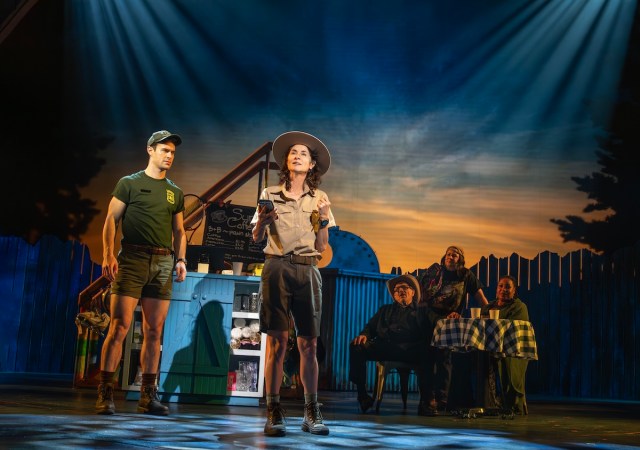
(© Joan Marcus)
Director Lorin Latarro, who also choreographs, keeps the action moving at a steady clip—sometimes too much so. Although the three principals each give pleasingly nuanced performances in their own right—Malone especially as the lovable curmudgeon with a voice for days—their relationships to each other appear telegraphed. We have to go on faith that their emotions are as deep and attractions as combustible as the story suggests. On the flipside, the townsfolk increasingly emerge as eccentric stereotypes, and despite blue-chip voices, none create character profiles that are especially memorable.
Beowulf Boritt’s scenic design captures a certain country charm, particularly in its depiction of Cyd’s makeshift observatory. This is where Cyd, a natural loner, feels closest to the vast universe she loves so much, and it’s impossible not to feel that connection too. It’s also moving when she first lets down her guard and welcomes Roxanne to share the space with her. But too often, the garish and frontal lighting by Paige Seber contradicts one of the show’s dramaturgical messages. It should be darker and more mysterious to fully evoke what Cyd feels she must protect.
In her debut as a musical-theater songwriter, Saliers proves she can write a catchy tune. Still, the 20 or so original songs in the show sometimes blend together in a manner that leaves you feeling like they could be assigned to any character—or perhaps recorded by Saliers and her partner Amy Ray for the next Indigo Girls records. Surprisingly, the song that works seamlessly from a narrative standpoint is a jukebox addition: the popular “Closer to Fine,” which opens the second act. It captures Cyd’s inner turmoil and desire for love in three concise minutes. The rest of the show is frequently close to fine, but not better.




Featured In This Story

Latest Reviews
See all

Latest Videos
West End vs Broadway: Oh, Mary!—From an Angry Inch to an Angry First Lady, With John Cameron Mitchell and Mason Alexander Park
Mitchell and Park celebrate a decade-long friendship in our latest installment.