
Review: Brigadoon, Reworked and Revised by Alexandra Silber at Pasadena Playhouse
Katie Spelman directs and choreographs the Lerner and Loewe classic in California.
 |
Pasadena
|
|
Pasadena
|
May 26, 2026
(© Jeff Lorch)
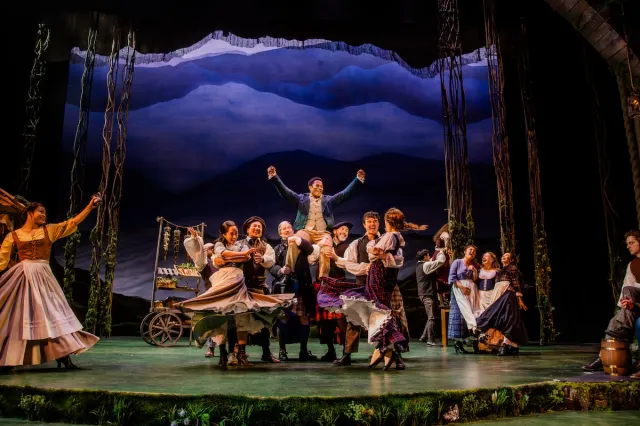
Pasadena Playhouse has remounted and revised the 1947 classic Brigadoon, and the timeless Lerner and Loewe score deserves to be heard, especially as sung by this Broadway-caliber cast in this lush production.
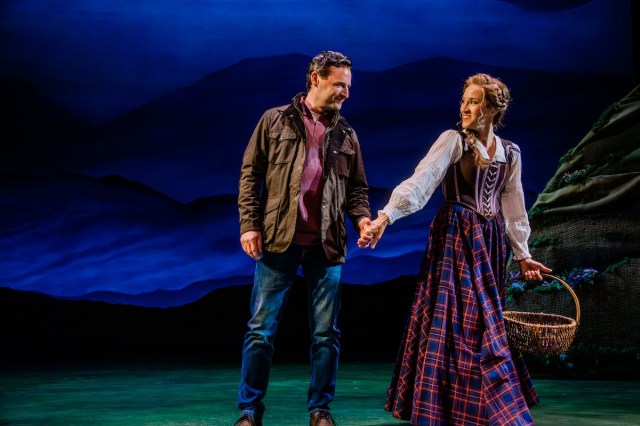
Pals Tommy (Max von Essen) and Jeff (Happy Anderson) wander the moors of Scotland when they stumble upon an odd town that appears on no road map, a place where everyone seems centuries out of step. Tommy, adrift in recent years with a meaningless executive job and an engagement that never felt like love, becomes quickly bewitched by both the mysterious town of Brigadoon and townsperson Fiona (Betsy Morgan). The two fall under a spell, and Tommy witnesses the wedding of Fiona’s sister Jean (Kylie Victoria Edwards) to Charlie Dalrymple (Daniel Yearwood). Everything feels celebratory, yet the town holds a secret that proves difficult to grasp and even harder to believe. Only the wise Widow Lundie (Tony winner Tyne Daly) can reveal it with the weight needed to make Tommy listen.
Brigadoon offers a confection of musical delights: “Heather on the Hill,” “I’ll Go Home with Bonnie Jean,” and “From This Day On” are as pleasing to the ear as candy is to the tongue. But Alexandra Silber’s revision of Lerner’s libretto does not fully solve the original structural issues and introduces new ones.
There are too many central characters to give any of them the focus they need. Lyrics can express longing, but Tommy and Fiona still require time to fall in love. Silber strengthens a key scene in which Fiona, already taken with Tommy, calls out his flippancy, yet the relationship still needs more development before “Almost Like Being In Love” feels earned. That time could be found by trimming other storylines. Meg, the flirtatious townswoman, remains a delight, and Donna Vivino plays the role with zest, but her two bawdy numbers add color while pulling focus away from the central arcs.
(© Jeff Lorch)
That lack of focus affects a secondary character most of all. The love triangle of Charlie, Jean, and Harry receives proper attention, but the nonverbal Maggie (Jessica Lee Keller), who loves Harry, ends up sidelined. When she later erupts into a feral dance of grief in Act Two, the moment doesn’t feel earned.
Changes to the character of Jeff also fall flat. The role never solidifies into a fully realized person and instead serves mainly as a device for Tommy’s choices. The dialogue leans on outdated humor, including jokes about alcoholism that feel out of step today. Although the production places Tommy and Jeff in a contemporary frame through modern costuming, Jeff’s voice still sounds rooted in a bygone era.
Director and choreographer Katie Spelman locates both grit and emotional warmth in Lerner and Loewe’s songs. Morgan and von Essen bring classical voices and project a convincing love through the music. Yearwood, lighting up the stage, and Edwards, perform a striking dance for “Come To Me, Bend To Me,” a ballet between two almost-betrothed figures, he blindfolded, she half-dressed for the ceremony, that feels almost angelic. Daly, though in a small role, delivers a commanding explanation of Brigadoon’s miracle. The story’s essence is fragile and must be handled with care or it collapses into the ridiculous, and Daly understands that balance.
As Harry, the villager trapped in Brigadoon while watching the only person he has ever loved marry another, Spencer Milford captures both repression and the rigid constraints of the town. Brigadoon denies Harry both the ability to fulfill a life within its borders and the freedom to leave and build one elsewhere. That tension makes the character compelling.
(© Jeff Lorch)
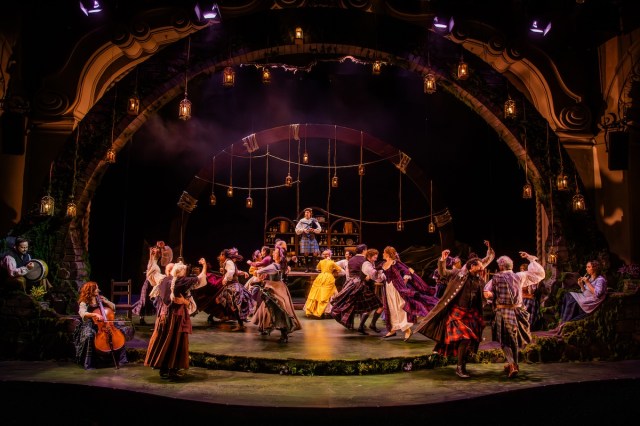
The choreography, blending ballet with Scottish forms such as flinging and shearing, remains precise and vibrant throughout. Because the original production was directed by Agnes DeMille, several ballets anchor the storytelling, particularly at the wedding. Milford lets a burst of exhilaration break through just before the Act One climax as Harry dances in the Sword Dance at the wedding of his unfulfilled love. The dance builds in intensity and pride, which makes the character’s later unraveling land with greater force.
Conductor Brad Gardner leads a crisp orchestra and music supervisor Darryl Archibald ensures the cast sounds excellent. Raquel Adorno’s costumes present authentic tartans, kilts, and ankle-high socks, while Jason Sherwood’s scenic design frames the proscenium with lush greenery and drops gnarled tree roots into the backdrop, giving the countryside a sense of scale.
Brigadoon arrived at a time when fantasy and immortality offered an antidote to a world recovering from World War II. In an era that can feel equally uncertain, Brigadoon still offers that escape, inviting audiences to believe, if only for an evening, in the impossible.




source on Google
Featured In This Story
Latest Reviews
See all




Latest Videos
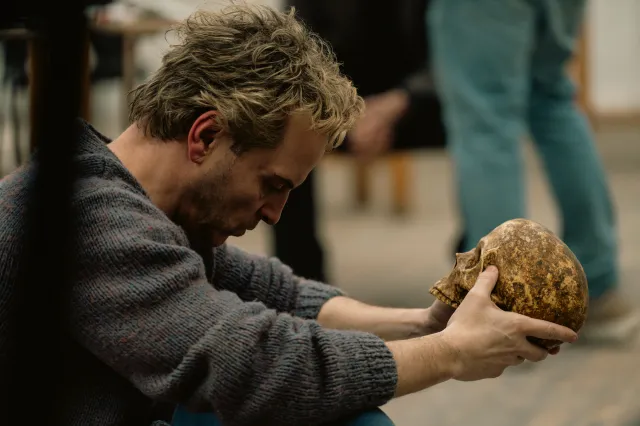
Watch the Trailer for Elsinore Starring Andrew Scott
The film is based on the true story of Ian Charleson, who played Hamlet at London’s National Theatre after being diagnosed with AIDS.