
Review: Beyond the Stardust, an Afrofuturist Dance Party
The Illustrious Blacks and Niegel Smith transform the Flea into a space-age nightclub.
 |
Off-Broadway
|
September 18, 2026
(© JJ Mack)
I am all too familiar with the sound an iPhone makes as it slips from the hand of a dozing theatergoer and clatters onto the house floor. I hear it multiple times a week. It is the sound of an institutional theater running on fumes, afraid to slow down and check the map lest it alienate its already dwindling audience. So, I’m always excited when a theater takes an unexpected turn, and that is exactly what Niegel Smith (artistic director of the Flea) has done with Beyond the Stardust, the interactive dance party at the theater’s home on Thompson Street.
The Flea has been transformed into the Stardust Club, a dance floor for queer Black people from outer space (literally or metaphorically, depending on one’s interpretation of the text). Smith, who directs the production, also wrote the book, while the songs are by Monstah and Black!, the musical duo collectively known as the Illustrious Blacks. They preside as DJs as we file in for the pre-show.
While there is seating along the perimeter, most theatergoers remain standing during this 70-minute nightclub concert experience. It begins with our MC, Amazonian Rockstar, teaching us the Stardust Shimmy, a line dance simple enough for an awkward New York theater critic to master after a few repetitions. We return to it later in the show.
(© JJ Mack)
Amazonian musically informs us that there are two Black planets, Monstah and Black!, who have been “pulled to each other’s Blacklicious spell.” But Maggie and Marcus Mainstream (portrayed by the ensemble) tell them to “Get into the Box.” The Mainstreams command, “Be white, be rich, be straight, be quiet,” which the Illustrious Blacks simply cannot do.
They overcome the box with “Let the Music Set You Free,” and demand space with “Get Out the Way.” But the box keeps coming back. They lead the whole audience in shouting, “What’s Up with That?” They call for “Order.” They perform a “Shimmy for the Ancestors,” and then there are a bunch of aerial acts. That’s about as much as I was able to follow. But I don’t really go to the club for the plot.
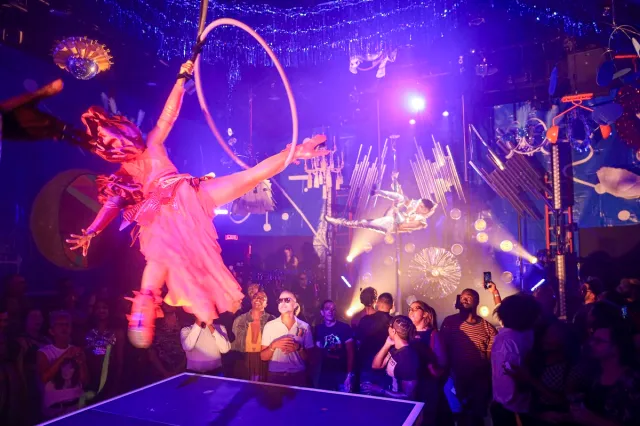
Smith is more interested in creating a vibe than telling a story, and in that he is partially successful with a production that is memorably designed and impressively performed. The aerial dancing by Queen Ravenden and DeShawn Marshall is astoundingly beautiful. Blaine Petrovia appears to be twirling around a pole by just his little toe, displaying the kind of freakish upper-body strength one rarely encounters outside of Marvel movies.
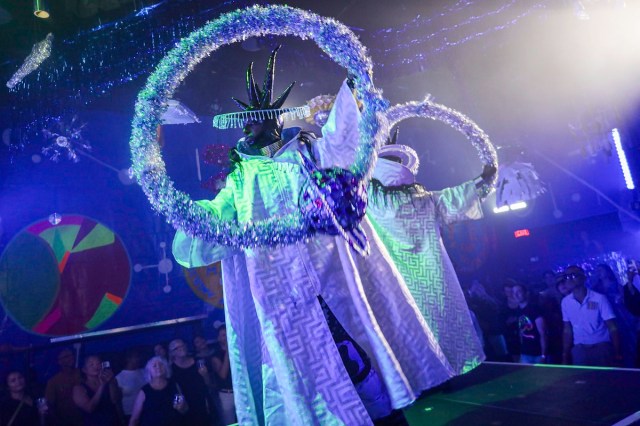
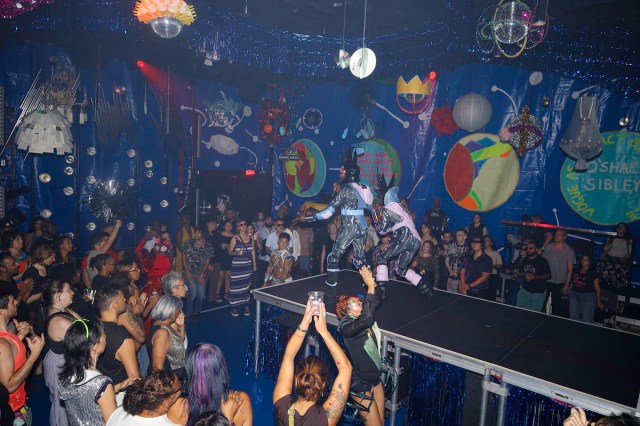
The Illustrious Blacks have a magnetic stage presence, and they look spectacular in Delta Major FKA DeShon Elem’s intergalactic bridalwear. The club itself makes an immediate impression, with glow-in-the-dark shrines to queer Black icons like Joseph Beam and Bayard Rustin. I was particularly delighted by a chandelier made of trombones. Scenic designer Oscar Escobedo’s whimsy, playfully lit by Kate McGee, are just two of many things this unique theatrical nightclub act has going for it. It feels a lot like having an Octavia Butler-themed hallucinogenic trip at House of Yes—at a sensible 7pm.
(© JJ Mack)
At least, that’s what it should feel like. The night I attended, the vibe of the crowd was less joyfully liberated than politely playing along. I have seen off-Broadway audiences surrender themselves to similar immersive experiences, most notably Here Lies Love and Ed Sylvanus Iskandar’s extravaganzas during an earlier era of the Flea. I wondered if there was anything Smith and his team could do to break through the energy barrier between audience and performer.
I kept hoping that we would be asked to dance the Stardust Shimmy to ward off any vibe-killing conformist, that we could use the power of dance to break down the box (something all NYC tenants should do). It could have been a real “if you believe in fairies, clap your hands” moment. Unfortunately, it was just a missed opportunity.
But everyone in this cast is giving 100 percent, and Beyond the Stardust is worth seeing for them. They’re great. Sadly, it’s the audience that needs some work.




source on Google
Featured In This Story

Latest Reviews
See all



Latest Videos
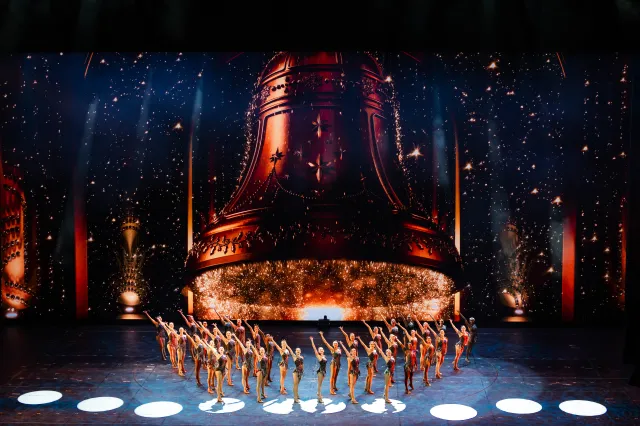
Watch the Radio City Rockettes in the New Christmas Spectacular Number "Ring"
The modern tap number is choreographed by Emmy Award nominee Chloé Arnold.