
Review: Benevolent Depicts Sisterhood in a Charity Home for Wayward Women
Sophie McIntosh’s play makes its debut with Good Apples Collective at IATI Theater.
 |
Off-Off-Broadway
|
|
Off-Off-Broadway
|
August 28, 2026
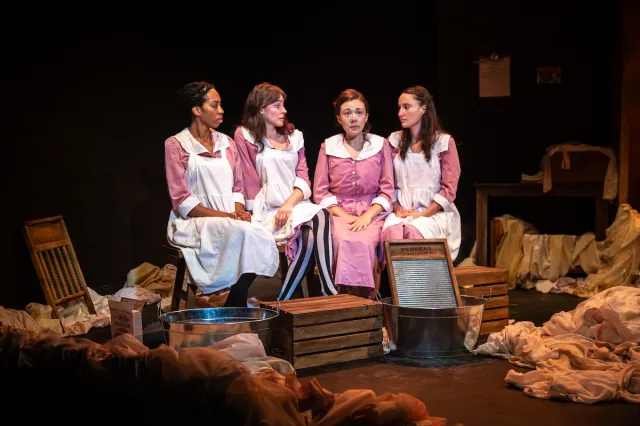
(© Nina Goodheart)
The four women in Sophie McIntosh’s Benevolent are employed against their wills. Few people would describe them as enslaved, but it’s clear that none of them would choose to spend their youth scrubbing soiled undergarments in the basement of a New York benevolent society for wayward women, which is what they will do every day until they are released. Laundry duty isn’t fun, but it beats prison, the only alternative on offer.
McIntosh’s illuminating historical drama, now making its world premiere with Good Apples Collective at IATI Theater, is set in 1917. But viewers are likely to notice the uncomfortable ways the story resonates in 2026—how social control disguises itself as charity, and how divide-and-conquer is still the primary strategy the ruling class uses to dominate everybody else.
Emma (Mia Fowler) and Margaret (Chani Reese) are in their mid-twenties and already intimately familiar with this institution, having served extended stints for prostitution—though Emma is quick to point out that while Margaret worked at a classy $10 brothel, her rate was 50 cents. Nineteen-year-old Sarah (Rachel Ravel) was brought in for singing on the Coney Island boardwalk, which seems to have been suspicious enough behavior for a judge to sentence her to this involuntary servitude.
At 17, Abby (Livvy Marcus) is the greenest inmate in more ways than one. She comes from a well-to-do family (her late mother was once the chairwoman of the benevolent society) and claims that her father sent her here to clean up her act after she received an unchaperoned visit from a young member of the Astor family. We only understand the full implications of that when she discovers that she’s pregnant. This leaves the women with a moral quandary: Do they rat her out to curry favor with the matron? Or do they close ranks and help her find a solution?
The specific and layered performances delivered by this excellent ensemble cast keep us guessing about who is trustworthy in this microcosm governed by scarcity and fear. Marcus’s good-girl act is believably grating and regularly comical, but we also get the instant sense that she’s hiding something. With her wicked laugh and screw this posture, Reese immediately lets us know Margaret is a bad influence (Saawan Tiwari delightfully costumes her in Beetlejuice stockings, breaking up the monotony of her uniform), and that makes us hang on her every word. So does Sarah, whom Ravel endows with a little-sister curiosity. Her scenes with Reese are among the most tender and touching in the play, telling the story of how a little bit of light can go a long way in such a dark place.
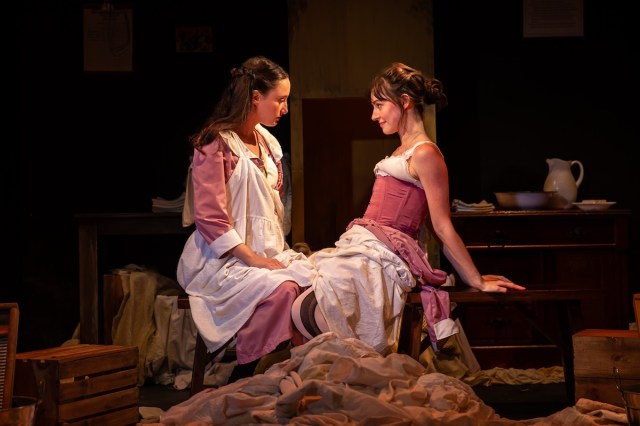
(© Nina Goodheart)
As Emma, Fowler is fascinatingly inscrutable, if only because her character is playing her cards close to her chest. She intends to secure an actual paid position with the benevolent society once she finishes her time, and we suspect that she won’t do anything to jeopardize that opportunity. But McIntosh is a clever enough playwright that our initial suspicions about all these women are proven incorrect during the play’s 100-minute run.
Director Nina Goodheart has staged a tight and polished production without any distracting flourishes. Scenic designer Charlotte Shi takes advantage of the snug confines of the theater to convey the dungeon-like atmosphere of this institutional basement, with mountains of laundry in the corners and a fourth wall of soiled garments serving as a membrane dividing us from this purgatory. Paige Seber bathes it all in antique incandescence, with caged lightbulbs evoking a sepia-colored past. Max Van’s eerie sound design (muffled groans and shrieks coming from the upper floors) occasionally tips the tone into horror. And for so many women living in institutions like this, that’s exactly what it was.
Over a century later, we still live in a country in which the rich and powerful seek to control women’s bodies through the law, and to launder their own reputations through corrupt charitable endeavors. Benevolent is a sad testament to how little has changed.
While this Equity showcase is slated to end its run on September 5, I hope this vital new historical play returns for a longer run.

(© Nina Goodheart)




source on Google
Featured In This Story

Latest Reviews
See all









Latest Videos

Watch the Trailer for Elsinore Starring Andrew Scott
The film is based on the true story of Ian Charleson, who played Hamlet at London’s National Theatre after being diagnosed with AIDS.