
Review: Anna Ziegler's Antigone (This Play I Read in High School) Needs More Antigone
Susannah Perkins and Celia Keenan-Bolger star in this Public Theater premiere.
 |
Off-Broadway
|
|
Off-Broadway
|
March 11, 2026
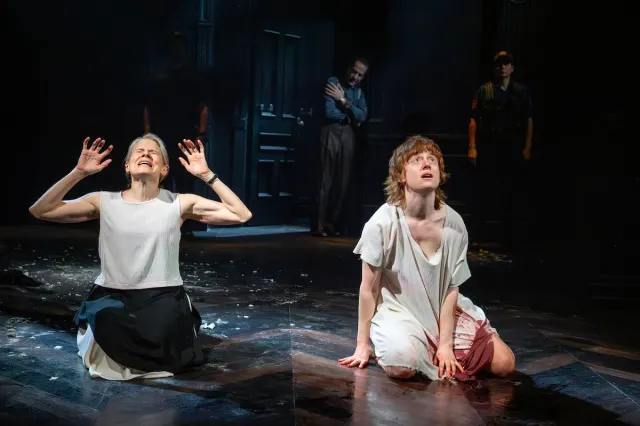
(© Joan Marcus)
By the end of Anna Ziegler’s Antigone (This Play I Read in High School) at the Public Theater, there are puddles of blood all over the stage. Yet something about this new play doesn’t cut deep. This mostly modern adaptation of the Greek tragedy has a lot of great ideas, but the execution doesn’t bring them all together.
In the play, a character called Chorus (Celia Keenan-Bolger) is flying home when she sees a teenager reading Antigone. This awakens something inside Chorus, a newly pregnant 40-year-old, and she concocts her own version of the story.
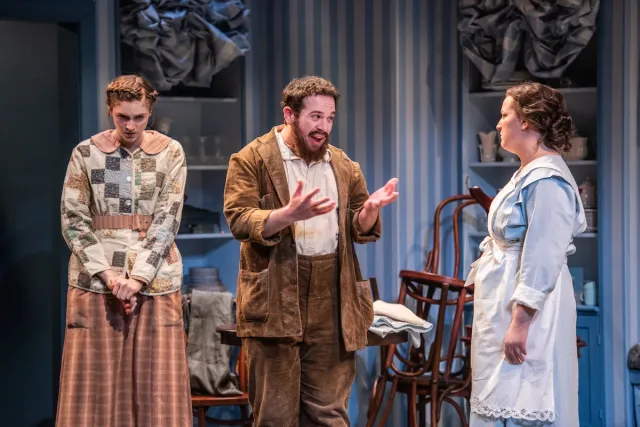
Her version starts with what you might remember from English class. Antigone’s (Susannah Perkins) two brothers died in a war over the throne and her uncle, Creon (Tony Shalhoub), is now king. Antigone is engaged to his Creon’s son Haemon (Calvin Leon Smith), who, in this iteration of the story, impregnates her. Antigone’s sister Ismene (Haley Wong) wants to move up the wedding to hide this fact, but Antigone is sure she doesn’t want to be a mother. This puts her in opposition with both her uncle and the government, as Creon has forbidden abortion in hopes that more children will revive the fragile nation-state.
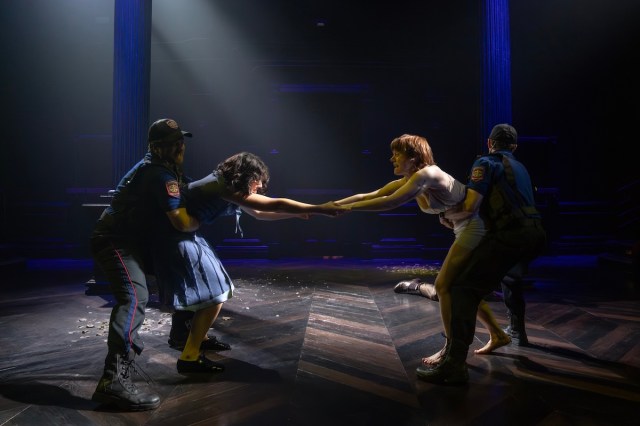
(© Joan Marcus)
Theoretically, all hell should break loose, but the drama stays mostly contained. This is despite Perkins doing everything they can do unleash it. In a performance very different but no less stirring than their most recent role in Practice, Perkins’s Antigone is messy, scrappy, and compelling. You can understand why everyone is a little obsessed with this Antigone, ready to follow her into battle even if no one is sure what exactly she is fighting for. Perkins’s magnetism is missed in the stretches when they are not onstage.
Keenan-Bolger matches Perkins’s intensity, but the function of her Chorus is murky. Was I mixing up her story and Antigone’s, or did she want an abortion in “real life” and then change her mind? It’s an issue Zegler doesn’t make clear, though Keenan-Bolger is not at fault: her performance hits emotionally, even if the logistics aren’t panning out.
As a plot device, Chorus also doesn’t really work as a narrator, over-explaining the inner lives of Haemon and Ismene, and flattening the subtlety Smith and Wong built into the characters. This is especially disappointing with Smith, a vibrant and compelling foil to Perkins who could have used more stage time.
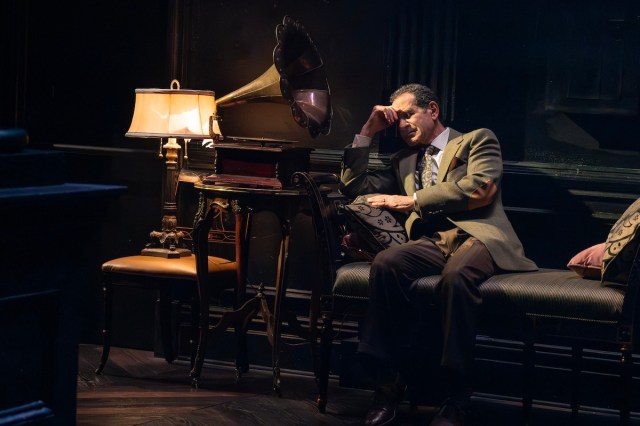
(© Joan Marcus)
Shalhoub’s performance is believable as a reluctant ruler interested only in law, order, and keeping the peace, but it doesn’t lead to dramatic tension. That Creon and Antigone are kept apart doesn’t help; their time is monopolized by other roles that never rise above caricatures. When Creon and Antigone do finally meet, their debate about the role the state plays over a woman’s body is an impersonal slow burn when we are hoping for fireworks.
Despite this, their meeting culminates in the most effective sequence of the play, where Antigone talks about each of the scars on her body, to prove the rights of the corporeal are more important than the protection of the state. Perkins shines in this sequence, matter-of-factly disrobing while discovering and sharing the facts of Antigone’s body. It works well in the moment, but because there wasn’t a strong build-up to it, it feels out of place alongside the rest of the show. Just like the blood Antigone leaks all over the stage, it isn’t quite earned.
Tyne Rafaeli’s direction mostly helps the proceedings, using every area of the space to eke out more tension. But the weaknesses of Zegler’s script are vast. The characters slip into poetic language that mimics the original play but most of the actors struggle to make it sound natural. The stylization works for Enver Chakartash’s costumes, which effectively use color to create arcs for the characters that don’t exist otherwise.
Fortunately, there’s Perkins’s stunning performance to hold onto. If only there were even more Antigone in the play that bears her name.




Featured In This Story
Latest Reviews
See all



Latest Videos
West End vs Broadway: Oh, Mary!—From an Angry Inch to an Angry First Lady, With John Cameron Mitchell and Mason Alexander Park
Mitchell and Park celebrate a decade-long friendship in our latest installment.