
Review: About Time Concludes Maltby and Shire’s Trilogy of Musical Revues
The writers of Starting Here, Starting Now and Closer Than Ever return with a new show about growing old.
 |
Off-Broadway
|
|
Off-Broadway
|
March 9, 2026
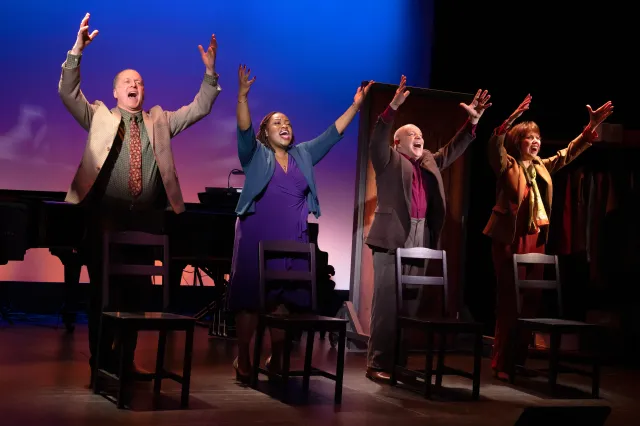
(© Julieta Cervantes)
They’ve still got it. Seven decades into their extraordinary partnership, composer David Shire and lyricist Richard Maltby Jr. can still whip up a catchy tune that will stimulate your brain and pluck your heartstrings. Their latest musical revue at the Marjorie S. Deane Little Theater, About Time, is full of such songs. It’s a wonderful showcase for one of this country’s great songwriting teams, even if it’s a mediocre work of theater.
Presented as the final installment of a trilogy of revues, beginning with Starting Here, Starting Now (1976) and continuing with Closer Than Ever (1989), About Time is both a reasonable exclamation to greet the long-awaited show and a literal description of its preoccupation.
“But you’re not… young and perky,” says Eddie (Eddie Korbich in the role of the imaginary composer) when he gets a look at his graying fellow cast members (Allyson Kaye Daniel, Darius de Haas, Daniel Jenkins, Sally Wilfert, and Lynne Wintersteller). Musical revues are meant to be a collection of songs that can instantly find homes in the audition binders of bright-eyed BFAs. “I’m sorry,” he says like a casting director who hasn’t been to HR reeducation camp, “but I don’t want… you.”
“Then don’t write a show about being your age,” Sally snaps back. This is a revue entirely focused on the issues of the AARP set, with songs like “Keys” (De Haas summons the authentic rage that comes with not being able to find them) and “Free” (the ensemble celebrates the excitement of sending the last kid off to college, only to realize that a crappy job market and sky-high housing costs are driving their children right back home). The male ensemble lustily performs “Vroom! Vroom! Vroom!,” about the joys of late-life motorcycling. And the women perform the juke joint number “Over-Ripe Fruit,” in which a woman earnestly compares her body to “a week-old mandarin orange” (this strains credulity).
Maltby and Shire excel at infusing serious songs with comic relief, as in the number “Little Susan Lawrence,” in which a gushingly sincere Wilfert reflects on her character’s deep first love for the ludicrously named Buzz Babcock. Behind the chuckles, we recognize the emotional armor we don to survive as adults, and the relief of momentarily removing it. Wilfert hilariously returns with a thick Long Island accent to play a disco-queen-turned-bubbe for “(All I Want to Do Is Go) Dancing,” the closest thing we’ll ever get to a Maltby & Shire dance anthem.
Maltby directs a limber concert production on a stage dominated by two abutting Steinway pianos (Annie Pasqua and music director Deniz Cordell provide most of the accompaniment with bassist Scott Chaurette). The one major set piece, an apartment door marked “234,” feels superfluous (James Morgan is the scenic consultant). Tracy Christensen’s costumes resemble an Eddie Bauer runway show—unglamorous but authentic. And Mitchell Fenton’s lighting accentuates the mood the performers so brilliantly conjure.
One of the benefits of the revue is the ability to include songs that don’t quite fit the assignment but are delightful nonetheless: Jenkins has us howling with the song “Smart People,” which features a series of fake-out rhymes like, “It’s not a new idea, though to me it’s kind of newish / That when your cast talks really fast, it simply means they’re…smart people.”
But it doesn’t always work. Obviously indebted to English music hall, Maltby and Shire have written the tribute “Kensington Kenny,” which recognizes the stage’s proud tradition of crossdressing (with the addition of a blonde wig, Kenny becomes Gwenny). Korbich sells it for all it’s worth, but he cannot quite overcome the hurdles of a song that is both doing too much and feels out of place.
Similarly, Wintersteller valiantly performs the number “Done,” about a veteran actor who cannot seem to land the role of Madame Morrible on Broadway and is ready to quit the business. She sings about attending a performance of Fun Home only to realize that the dreaded Wicked is playing next door. Fun Home closed at Circle in the Square in 2016, which should give you an idea of how long this song has been a-mouldering in the trunk.
Both of those numbers appear in the show’s second half, which is not as strong as the first. Maltby and Shire seem to want to leave us with a sense of the profound: “What Do I Tell the Children?” is the song of a man who cannot square the emphasis on “character” he makes when advising his children with the reality of our national politics. With clunky lyrics like, “When Supreme Court justices accept expensive trips / Then judge a case on ethics and announce that bribes are tips,” it feels a lot like a musicalized Facebook post from the #resistance—limp and instantly forgettable.
Most disappointingly, About Time doesn’t touch the most universal experience of aging: death. The closest we get is “Saying Goodbye,” in which a man (Jenkins) receives a terminal diagnosis and decides to call up all his old girlfriends to share the news, only to discover they’ve become lesbians and literal witches. It’s funny, especially if you’re unbothered by the transgression of certain feminist shibboleths, but it does feel like a comedic deflection of a pressing subject for the audience that deserves more serious consideration.
But Maltby and Shire don’t want to bum out their audience, and the matinee crowd with which I caught the show seemed grateful for that. They might have been even more grateful for a leaner, more impactful 90-minute revue, which undoubtedly lives within About Time and may even be unearthed after some muscular editing.




Featured In This Story
Related Articles
See all
Latest Reviews
See all
Latest Videos
West End vs Broadway: Oh, Mary!—From an Angry Inch to an Angry First Lady, With John Cameron Mitchell and Mason Alexander Park
Mitchell and Park celebrate a decade-long friendship in our latest installment.