
Interview: Lindsey Kraft Discovered Songwriting at 40 and Has No Regrets
Kraft’s collaborators Ben Folds and Machel Ross join her for a conversation about her new solo musical We’ve Been Here Before.
 |
Off-Broadway
|
|
Off-Broadway
|
August 12, 2026
(© Michaelah Reynolds)
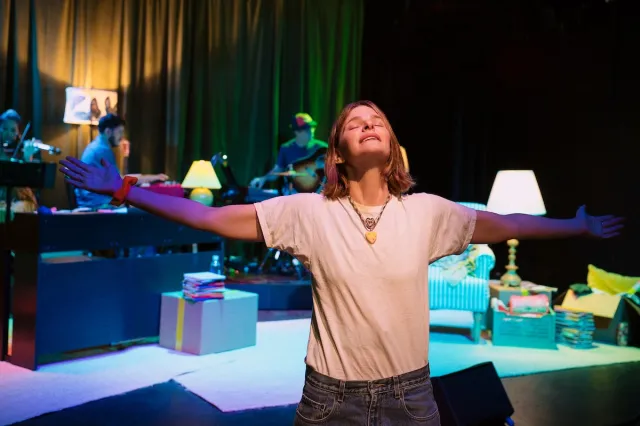
At 39, Lindsey Kraft, a successful actor known for roles on hit TV shows like Grace & Frankie and Getting On, sat down at a piano and started from scratch. Fewer than five years later, she’s a bona fide singer-songwriter, opening for her musical lodestar Ben Folds on hundreds of stages and now performing a two-week run of her own semiautobiographical solo musical, We’ve Been Here Before, at SoHo Playhouse (August 4-17).
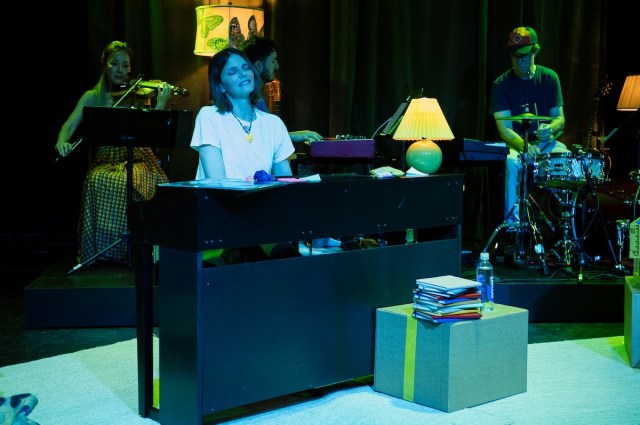
“She doesn’t have the normal maybe-I-shouldn’t-be-doing-this gene,” says Folds, admiring the mettle that turned his friend from piano plunker to top-tier musician. “Her artistry is preserved in ignorance.” Folds music directs and lends additional onstage accompaniment (though he insists his contributions are minimal) while Kraft plays and sings the story of Liv, a woman who, at 40, starts her own healing relationship with a piano.
TheaterMania talked to Kraft, Folds, and the show’s co-director Machel Ross ahead of their New York sit-down. You could call it the next step in Kraft’s extended leap of faith, which, so far, has only proved that it pays to be audacious. “I just sort of want to share it, and then if it works, we’ll go from there,” says Kraft. Folds adds with a shrug: “People say, ‘Don’t play in New York until you’re ready…”
“Eh. We’ll get ready in New York.”

(© Michaelah Reynolds)
The following conversation had been condensed and edited for clarity.
The story in We’ve Been Here Before mirrors your own: Liv, your main character, is a 40-year-old woman who is suddenly inspired to learn piano and start writing music. Do you consider the show an autobiography?
Lindsey Kraft: It’s semiautobiographical in terms of me having learned the piano when I was 39 and realizing that the songs that I was writing were about my life.
Ben Folds: I’m a songwriter and people always ask, “Is it autobiographical or not?” There’s nothing that an artist does that’s not autobiographical in some way. Even if it’s about some other son of a bitch. [Laughs] When Machel started working with Lindsey, one of the first suggestions was to change the name of the character. It’s really interesting the way that’s freed her. It’s not exactly her story—It’s been turned into what things feel like, which is the real honesty.
Lindsey, how did you go from learning to play and write music for the first time to writing and starring in your own musical within just a few years?
Lindsey: I went through my whole life not knowing that I could play the piano or write songs. I started writing during the pandemic because I just kept hearing these songs inside my head and I had to figure out how to get them out. I kind of feel like it decided for me that it was a musical. It seemed like the most organic way to tell the story. It’s just sort of about my experiences of growing up and the people that I’ve met along the way and realizing that there were some cycles that I needed to get out of. The musical helped me get out of them.
You started working out a lot of this material as Ben’s opening act on tour. How did this musical partnership come to be?
Ben: At first, her musician friends are all encouraging her and teaching her stuff, because it’s unusual for someone to take that intense of an interest at 40. I was hearing her songs, and you know when there’s something there, even though they were sprawling and they didn’t have normal form. I realized if she is going to do a show like this, there’s nothing like having 200 shows onstage where she has to play and sing. That’s boot camp. And she went through it. The first few shows, she’s singing and the microphone’s at her forehead. At this point, she’s a pro.
Lindsey: He had me come on tour, and I’m like, “Who’s gonna play the piano?” And he’s like, “You are! You better work your butt off.” And I just kind of continually got better. In the beginning it was a little wonky. But I think the storytelling helped. I was accepting where I was at each stage of the journey.
(© Michaelah Reynolds)
It takes a lot of nerve to be willing to be a novice in these intimidating spaces.
Ben: It’s part of the charm. Her main thing is to share what she’s feeling. Having her on tour, it just brightened everything up because the audiences were seeing something truly unusual. It started with just three or four dates and then I was like, “This is going great, let’s do another few.” It wasn’t a master plan, but after doing 250 shows, she’s great.
Machel, how has it been for you collaborating with someone so game to try new things and take risks?
Machel: I said to Lindsey yesterday in rehearsal, “You should be incredibly proud of the evolution of the material.” I think it takes a lot of guts and vulnerability to showcase and share parts of your real life, and I feel like this show is an invitation for audiences to really get a glimpse of this remarkable artist’s evolution as a person. Getting to direct and help shape this vision with Lindsey has been such a beautiful process.
Lindsey, now that you’ve experienced being yourself as a singer-songwriter in front of over 250 audiences, how does the feeling differ from being an actor playing a character?
Lindsey: When I first started acting, I think I was so excited to not be myself. As I played a bunch of quirky characters over and over again, I started to feel like I had something more to say than these characters have to say. I was so happy to share the songs and tell the stories. I mean, I would share in my living room. And then when I was doing it for these crowds in the Midwest, the people that come to talk to me are not even coming to talk to me about the songs or the stories I tell, but to tell me about their stories and about wanting to end a toxic friendship or wanting to learn something new at 60. That’s what’s so interesting to me and so rewarding. I never thought that was gonna be something that would come from it.
I get the sense that the show still feels a little like singing for people in your living room.
Ben: She could literally do this with a Casio sitting next to someone in a hospital and it works. That’s when you know you’ve got good material.
Machel: The show can work in any format. I think the magic of the show is the fact that Lindsey is a vessel for truth, and the truth is really clear when you are hearing all of these songs that she’s spent so much time writing and constructing.
Lindsey, what would you tell your past self who started down this musical rabbit hole not knowing where it was headed?
Lindsey: I feel like I would tell her nothing. If she knew anything more, I don’t think she would’ve gotten the songs that are here today. My parents are like, “We wish we had put you in those [music] programs, but we just didn’t have the money to do those things.” I’m actually so grateful that they didn’t, because the songs that I am writing first aren’t when I’m 13 when most people write their first songs.
Ben: She came out of the gate saying all the yearny things that we are singing most times when we’re 20 years old, but she has the experience of a 40-year-old to leverage against those feelings. You never get to hear that. Everyone writes all their best shit when they’re 20, but you’re an idiot when you’re 20.
Lindsey: I’ve experienced things. Things that 20-year-olds don’t experience for that first time of getting it out. So I feel like that’s really special. I would just tell her to keep going. Girl, you got it!




source on Google
Featured In This Story
Latest Reviews
See all


Latest Videos
Watch the Trailer for Elsinore Starring Andrew Scott
The film is based on the true story of Ian Charleson, who played Hamlet at London’s National Theatre after being diagnosed with AIDS.