
Interview: Julie Andrews Pays Tribute to Beloved Poodle in New Children's Book Shy
Nearly 70 years after a singing canine joined her warm-ups, the icon and her daughter, Emma Walton Hamilton, transform the backstage tale into their latest picture book.
 |
New York City
|
|
New York City
|
August 13, 2026
(provided by Abrams Books)
Julie Andrews and her daughter, Emma Walton Hamilton, have a history of turning their real-life backstage experiences into children’s literature. Their famed Great American Mousical was inspired by a real mouse that the legendary Andrews discovered in the dressing room backstage at the Marquis Theatre while she was performing in Victor/Victoria. Waiting in the Wings is about a pair of ducks that Walton Hamilton discovered nesting in a flower box outside Bay Street Theatre in Sag Harbor, which she founded in 1991. And considering one of the roles that made Andrews an icon, the idea behind The First Notes: The Story of Do, Re, Mi is perhaps the most obvious of all.
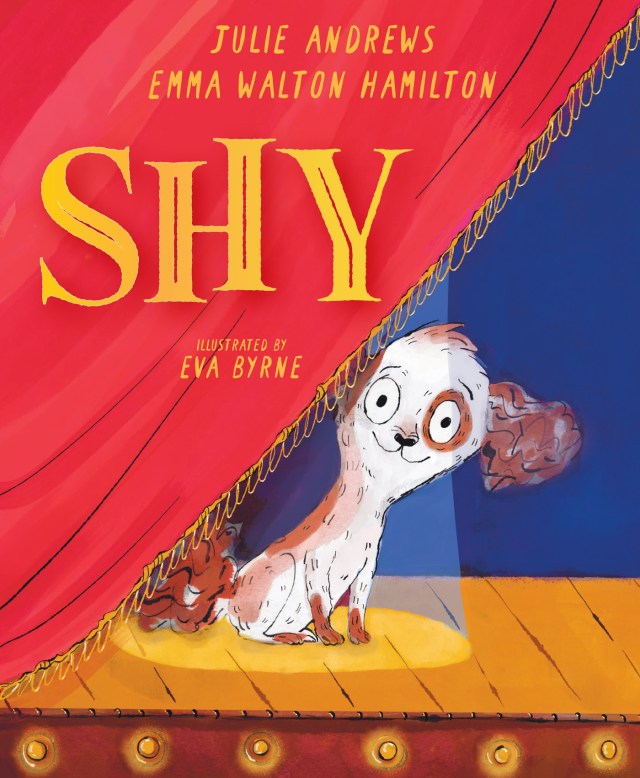
The latest real-life story to make its way into a book by these mother-and-daughter authors involves a poodle named Shy, who had a surprising affinity for music. In their new picture book, Shy, available now from Abrams Books, the shyest dog at the shelter is adopted by a pianist and discovers her voice while he practices for a recital at Carnegie Hall. “One never knows if it’s the right time for an idea,” the authors say, “but the memory came up in discussion a couple of years ago and it struck us that it might lend itself sweetly to a picture book about finding one’s voice, which seems to be a bit of a recurring theme for us, as are the arts in general. Once we realized that was the story, it almost wrote itself.”
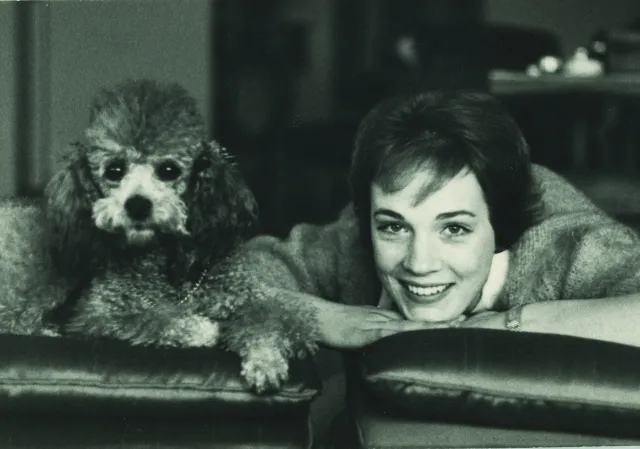
The real Shy was adopted by Andrews in 1958, while she was starring in My Fair Lady in London. “Julie had to vocalize every day to warm-up her voice for the performances,” Walton Hamilton explains, “and one day while she was doing so, little Shy lifted her nose in the air and started to howl along with her.”
It made getting ready difficult for Andrews, who at first wasn’t sure whether Shy was expressing discomfort or trying to join in. She tried putting her new pup in another room, and “Shy would simply poke her nose under the door and continue to ‘sing along,’ which seemed to suggest she wanted to participate in the music,” Andrews says. It got to the point that Andrews could go up and down the scales and her four-legged friend “would almost adjust her pitch accordingly.”
(© Dane Dupuis)
Of course, Shy wasn’t barking along to “I Could Have Danced All Night,” just vocal exercises, and unlike the Shy of the book, who finds her way on stage, the real Shy stayed happily in Andrews’s dressing room when she came to the theater. She never had run-ins with the likes of Rex Harrison or Stanley Holloway, although, as Andrews remembers, “the hair and wardrobe team loved her.”
Translating that real-life memory into story form required the collaborative touch that has already crafted more than 30 books for young audiences. But even when a story draws directly from Andrews’s personal history, their process remains the same. “Once we have an idea we brainstorm an outline for the story, then we write together in a process of finishing each other’s sentences,” they say.
“Julie tends to bring more of the inspirational ideas to the process—openings, closings, quirky character details, and great one-liners,” Walton Hamilton says, while Andrews notes that Walton Hamilton, who does the typing, is “more of the nuts-and-bolts person, focusing on structure, plot, theme, and so forth.” Like all great collaborators, “if we’re ever stuck, the best idea wins, and somehow we both seem to intuit what that is without getting defensive.”
Most importantly, they know that when adapting real life for a story, a little artistic license is essential. “Whenever we write from an idea inspired by a true event—which many of our books have been—we ‘never let the truth get in the way of a good story,’ as the great Jane Yolen would say.”
(© David Gordon)
Once the words took shape, the visual look of Shy came into focus. The book’s bright illustrations, by Eva Byrne, call back to the era of Madeline. Andrews and Walton Hamilton “had hoped the illustrations for Shy might have a sort of Ludwig Bemelmans feel, with loose lines and watercolor washes, and plenty of humor.” They had fallen in love with Byrne’s work in the picture book Along Came Coco, and were thrilled when Byrne joined the project. “It’s not often that authors who don’t do their own illustrations for picture books get a say in who the illustrator will be, so we have been very blessed in that regard.”
The illustrations also added to the story after the writing was complete. “Often, when the art comes in, we do find we adjust a word here or there because the illustrations are showing a certain detail, so we don’t need to say it in the text,” the authors explain. “The ideal marriage of art and text in a picture book is when the story is revealed from both, rather than one just mirroring the other.”
And that is how a dog whose singing was once confined to the Theatre Royal Drury Lane nearly 70 years ago now gets to take the stage at Carnegie Hall.




source on Google
Featured Artists
Related Articles
See all

Latest Reviews
See all

Latest Videos
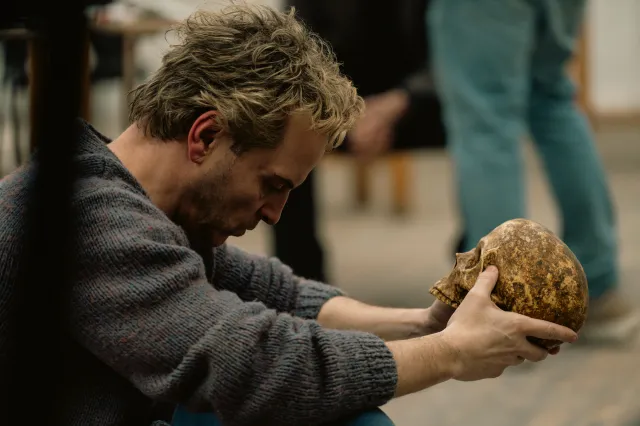
Watch the Trailer for Elsinore Starring Andrew Scott
The film is based on the true story of Ian Charleson, who played Hamlet at London’s National Theatre after being diagnosed with AIDS.