
Interview: John Ortiz on His Return to Broadway in Dog Day Afternoon
The LAByrinth Theater member talks about Stephen Adly Guirgis, Jon Bernthal, and his first Broadway role in 15 years.
 |
Off-Broadway
|
|
Off-Broadway
|
April 21, 2026
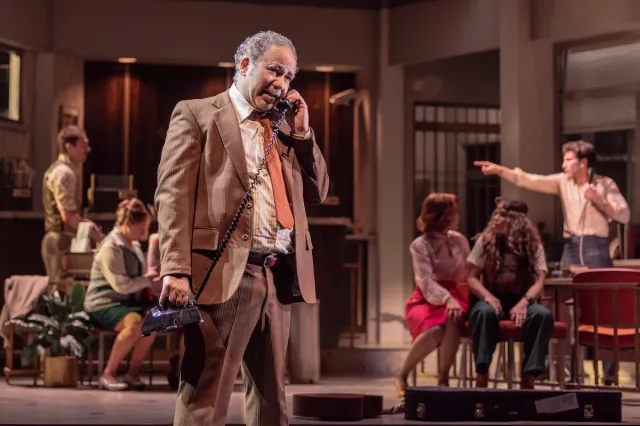
(© Matthew Murphy and Evan Zimmerman)
A highly accomplished stage and film actor, John Ortiz is best known as a key member of the LAByrinth Theater Company, a New York-based theater collective whose members have included Philip Seymour Hoffman, Ethan Hawke, Pedro Pascal, and Kara Young.
Another of its key members is Ortiz’s close friend, playwright Stephen Adly Guirgis, who wrote the new Broadway adaptation of the 1972 film Dog Day Afternoon, in which Ortiz plays Brooklyn cop Benny Fucco alongside stars Jon Bernthal, Ebon Moss-Bacharach, and Jessica Hecht.
TheaterMania recently spoke with Ortiz about his relationship with Guirgis and how it led to him being cast, what it’s like working with Bernthal, and why he has returned to the stage after nearly 15 years.
This interview has been edited for clarity.
How did your long association with Stephen play into the process of becoming Benny?
He’s been working on the play for a very long time, and I read the role of Sonny in the first public reading about 15 years ago. When the show got closer to production about two years ago, I told him if I was still in my 30s, I would fight tooth and nail for that role, but he should find a more suitable actor. I wasn’t part of the readings for a while, but then he thought it would be interesting to see me up against Jon, who had been cast as Sonny. After that reading, he reimagined the role of Benny, and when I gave him my pledge that I would do it, then he formally asked me to do the part. I will do anything Stephen writes because I know it will be special between us.
How special is it that the cast also includes some other LAByrinth actors?
Stephen was pivotal in bringing along some of those actors to this production. I think it’s important because Dog Day is rooted in a New York story about people who weren’t being heard. Our stories at LAByrinth were like that. And our plays represented each of the boroughs; this one is for Brooklyn. Honestly, I think this show’s producers connected those dots, which is why they saw Stephen as the person who would hear the voices of the disenfranchised. He made so many of the smaller characters from the film three-dimensional!
Speaking of the film, did you watch it before the show began performances?
I watched it twice before rehearsals started. I had only seen it once many years ago; I am not good at rewatching old movies just for the heck of it. The first time I saw it again, I was struck as how brilliant it is. So then I watched it again with my wife and son, and they were blown away. Of course, I was inspired by Charles Durning, who played my role in the film. But there is such freedom in knowing how different we are and how Stephen changed the part for me, so I was really inspired to put my own stamp on the role.
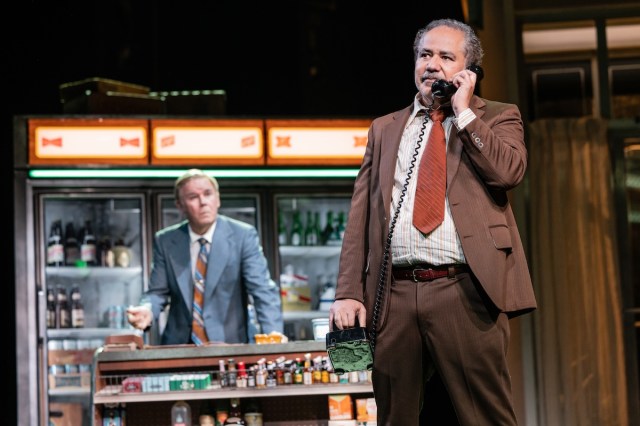
(© Matthew Murphy and Evan Zimmerman)
I think the same can be said of Jon Bernthal, who did a great job taking on Al Pacino’s role. What’s it like working with him?
I have really grown to admire Jon on so many levels. As soon as rehearsals started, there was no ego, no pretense, no star privilege. He was just a soldier down for the nitty-gritty and willing to bare his soul. I connected with him immediately, and I still do every day.
I think it’s interesting that this very American play is being directed by a Brit: Rupert Goold. Any thoughts?
I have nothing but admiration for Rupert, who clearly feels a connection to the art of theater and whose craft really shines in every aspect of his directing. He’s also so damn smart. And I think his distance from the world of the play has actually helped. What many people don’t know is that he saw LAByrinth do [Guirgis’s play] Jesus Hopped the A Train in London, and he directed a production of [Guirgis’s] The Last Days of Judas Iscariot there. I didn’t get to go, but Philip Seymour Hoffman saw it and thought it was amazing. So, 25 years of connection between him and LAB has evolved into this collaboration. Personally, I hope we can continue this relationship; maybe I’ll do something with him in London.
So, you’re back into loving theater after all this time—this is your first play in almost 15 years. What happened?
Eventually, I felt exhausted as a theater actor with nothing more to give. When this show first came about, I was only doing readings for friends. But then I realized that I finally felt differently at my age; I had new things to access, and there are character roles that I haven’t gotten to do yet. Benny is a man in his 50s who is closer to end of career than the beginning, but because of what happens in the play, he has a chance to rekindle the drive that first led him to become a cop. I relate to that. And because of our audiences, many of whom are seeing a play of any kind for the first time, I’ve learned to love the feeling of live theater all over again. I love not having a safety net if something goes wrong onstage. I feel totally reenergized.




source on Google
Featured In This Story

Latest Reviews
See all






Latest Videos
Watch the Trailer for Elsinore Starring Andrew Scott
The film is based on the true story of Ian Charleson, who played Hamlet at London’s National Theatre after being diagnosed with AIDS.