(Photo © Scott Suchman)
NIXON’S THE ONE
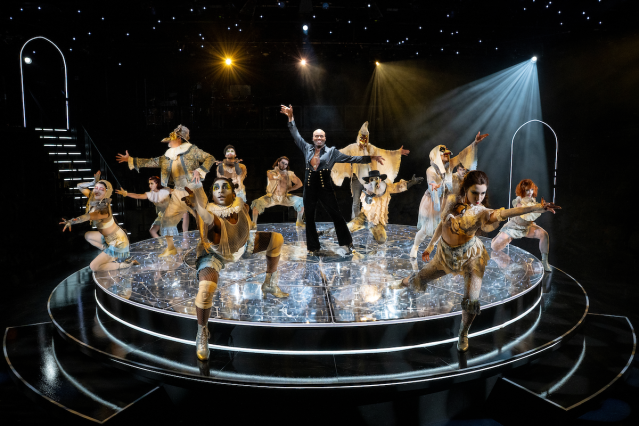
What’s the most challenging, most rewarding female musical theater role of the past several seasons? My vote goes to the title role in the Tony Kushner-Jeanine Tesori stunner Caroline, or Change. True, Caroline Thibodeaux doesn’t have to do a one-handed cartwheel like Janet Van De Graaff in The Drowsy Chaperone; nor does she have to rise into the air on a broom like Elphaba in Wicked or work a puppet like Kate Monster in Avenue Q. But any woman who plays the part must draw on tremendous emotional and vocal reserves in this powerful show about a black maid’s uneasy relationship with the Jewish family for whom she works in Lake Charles, Louisiana during the early years of the Civil Rights movement. Tonya Pinkins received a Tony Award nomination for her performance in the 2004 Broadway production, and now Julia Nixon is scoring a triumph in director Greg Ganakas’s superb staging of Caroline, or Change at The Studio Theatre in Washington, D.C.
A recording artist whose theater credits include Dreamgirls, Blues in the Night, and Juba, Nixon had never seen the show before she took on the role. “I didn’t know anything about it,” she says. “I was in Florida doing my cabaret act, and my agent submitted me for the part. When I came back, the audition was set up. I got to know the show through the script and the recording, and I thought it was fascinating that someone’s imagination could come up with the idea of a singing washer and dryer and bus. The music is so unusual; it really sticks with you. At first, I was put off by it, but then I realized that there’s really something very cool about it.”
One of the trickiest things about the Caroline role is that it’s not overtly sympathetic. “That was my fear when I was going through the script and listening to the music,” says Nixon: “I wasn’t sure how she was going to come across to the audience, but it turns out that they like her a lot. I wanted to do the part because it spoke to me; years ago, I made a choice to drop out of theater and raise my son, who’s 20 now. I felt he needed me more than the theater did. I was married, but then I got divorced and brought him up myself as a single mother, so I can relate to Caroline in that way. As I told Greg Ganakas, this was the first time that I ever wept when I read a script. I wept at the line in ‘Lot’s Wife’ when she sings, ‘Take Caroline away; I can’t be her, I can’t afford her.’ ” (Caroline’s searing aria of epiphany is particularly difficult for Nixon because “I’m not one of those people who can sing and cry at the same time. I take my hat off to anyone who can do that.”)
She’s a big fan of sixth-grader Max Talisman, who plays opposite her as young Noah Gellman. “He’s wonderful,” Nixon enthuses. “He gravitated towards me immediately in rehearsals, and he has this huge respect for my voice. Max will tell me things like, ‘God, you were incredible tonight,’ but he’s pretty incredible himself; he’s a powerhouse, and so professional. He knows everyone’s part, and he really dove right into whatever Greg asked him to do.”
Caroline, or Change ends on a note of hope. “Life can deal you some pretty rough blows,” says Nixon. “If you decide to live in a place of bitterness, hate, and anger, that’s a choice you make — whether you’re the poorest or the richest person in the world. But, in ‘Lot’s Wife,’ Caroline becomes someone who could actually befriend Noah and her own children. She comes to grips with her feelings and decides to put some joy back into her life.”
********************

THEATERS COME, THEATERS GO
“I’m sick about it,” says Carolyn Rossi Copeland, producing artistic director of the Lamb’s Theatre Company on West 44th Street in Manhattan. She’s referring to the fact that, as of September 30, the company will have to vacate the venue, which was designed by the legendary architect Stanford White and built in 1904 as a home for The Lambs Club. Copeland’s company has received an eviction notice from The Manhattan Initiative, which manages the building on behalf of the Church of the Nazarene, its owner. The Hampshire Hotels Group plans to turn the landmarked structure into a hotel.
“You can never duplicate what we’re losing, “says Copeland. “This is a one-of-a-kind theater: a 360-seat Off-Broadway house in the middle of Times Square. When I started our company in 1978, you couldn’t get people to walk down this block. The only things here were Café Un Deux Trois and the Belasco, which was never lit. Now, it’s a beautiful block with seven restaurants. When we came in, we had to rake the seats, rebuild them, and restore the beautiful interior paneling and the ceiling of the theater; before that, it was used as more of an auditorium by the Lamb’s Club. We really had to work on it before we could have productions there.” (In addition to the 360-seat venue on the third floor, the building houses a 140-seater on the ground level.)
The Lamb’s is only one of several venerable Off-Broadway theaters that will soon be closing for good or have already shuttered. The Douglas Fairbanks, home of Forbidden Broadway for several years, was recently demolished along with the John Houseman and three other smaller venues. On May 31, Playhouse 91 on the Upper East Side closed its doors for good. The Perry Street Theater in Greenwich Village and the Century Center for the Performing Arts in Union Square are not long for this world. And it has just been officially announced that the Promenade on Broadway at 76th Street will fade into history following the closing of Tryst there on Sunday, June 11. (The McGinn/Cazale theater, located above the Promenade, is apparently safe for the time being.)
An article in today’s New York Times quoted Ben Sprecher, president of the organization that owns and operates the Promenade, as saying that the economics of managing a 399-seat Off-Broadway theater have become untenable. Pretty much the same opinion is echoed from a different vantage point by Gerard Alessandrini, creator and director of Forbidden Broadway. “The rent is so high at the new Off-Broadway theaters that no one can actually do shows there unless they’re backed by the Shuberts or some similar group,” Alessandrini told TheaterMania. “A show like Forbidden Broadway could never be mounted nowadays. We managed to put a deal together with the 47th Street Theater to move in there; we just couldn’t afford to go to the Beckett or the Lion or the Acorn. Because those theaters are so expensive, they tend to house vanity productions. There’s almost no way you can have a commercially successful Off-Broadway show in any of those spaces.
This view is certainly borne out by the 499-seat Little Shubert on 42nd Street and the New World Stages complex of five theaters (formerly Dodgers Stages) on 50th. The former, now vacant and with no future tenant announced, has been empty far more often than it has been active since it opened in 2002. The latter almost seems to be cursed in its inability to attract financially viable productions, with the notable exceptions of Altar Boyz and Drumstruck.
Hoping to buck the downbeat economic trend is the dynamic Catherine Russell, star and general manager of Perfect Crime. When the Duffy Square theater that housed the long-running hit was razed in 2005, Russell picked herself up and forged a partnership with the Snapple corporation to move into a brand new, two-space venue at Broadway and 50th Street. Perfect Crime is now playing there, and a revival of another Off-Broadway marathon hit, The Fantasticks, will begin performances in the other space in July.
“I think we need to rethink the economics of Off-Broadway,” says Russell. “I’m really happy that we have Snapple as a partner. They’ve been so generous; they totally get Off-Broadway and want to support it. They co-designed the lobbies with me, and there’s a lot of Snapple branding there, but it’s subtle. I know that people are very divided about corporate sponsorship of theater. Some people think corporations are evil. The way I see it is this: Art and commerce aren’t the same, but you can have more art if there’s commerce supporting it. Given that Snapple doesn’t at all tell me what I can and can’t do here, I don’t feel that anything’s being compromised.”
New theaters are welcome but, of course, they lack the sense of theater history that is so much a part of the older venues. For example, the Promenade has housed such shows as No Place to Be Somebody, Godspell, Hurlyburly, and Edward Albee’s Three Tall Women; Playhouse 91 has been home to Quartermaine’s Terms, After The Fall (starring Frank Langella), Spook House (starring Harvey Fierstein), Pamela Gien’s The Syringa Tree, etc.; and the Lamb’s Theatre’s tenants have included Painting Churches, Beau Jest, and john & jen.
Says Carolyn Rossi Copeland, “We’ve been looking for somewhere to move the interior of the theater, but it’s not an easy thing.” As for the Lamb’s Theatre Company itself, Copeland would like to find another space but doesn’t sound very hopeful about her chances for success.