
Exiled Russian Director Dmitry Krymov Stages a Bold Revision of Uncle Vanya
The adaptation will debut at La MaMa March 28–April 12.
 |
Off-Off-Broadway
|
|
Off-Off-Broadway
|
March 19, 2026
(© Krymov Lab NYC)
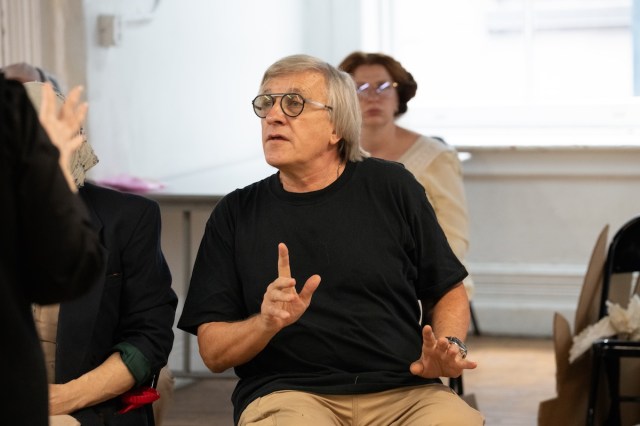
Dmitry Krymov was on his feet following a recent run-through of his new adaptation of Anton Chekhov’s Uncle Vanya, which will premiere at La MaMa’s Ellen Stewart Theatre March 28-April 12. Seventy-one years old and into his fourth year of exile in the United States, the laureled Russian director exhibited no signs of fatigue as he bounded across the rehearsal room, delivering a torrent of Russian notes to a mostly American cast (Tatyana Khaikin, producer of Krymov Lab NYC, live-translates with a speed and confidence that would put most UN translators to shame). But he has plenty of reasons to feel exhausted. This cozy studio in downtown Manhattan is certainly not where he envisioned himself back in the winter of 2022, when he had nine productions simultaneously playing in Moscow.
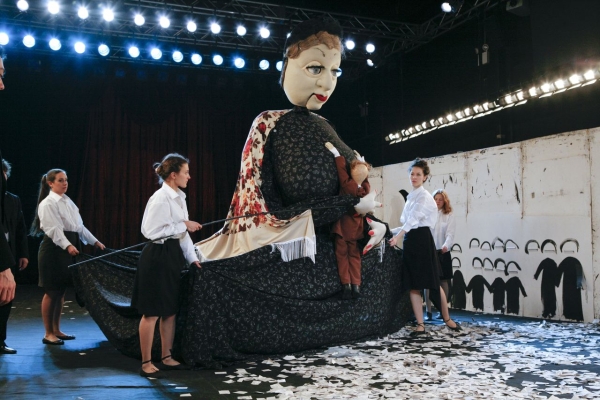
I first became aware of Krymov’s work when his Opus No. 7 played St. Ann’s Warehouse in 2013. Partially about the composer Dmitri Shostakovich and how he survived the Stalinist purges, it featured a giant “Mother Russia” puppet, the tiny composer smothered in her ample bosom. Large metal pianos rammed into one another, creating a palpable sense of danger. One even caught fire in a strange foreshadowing of events to come for Krymov, who survived a 2023 apartment fire. Political and historical commentary has always been a part of his work, but the window of opportunity for such criticism in Russia has all but shut.
After Krymov publicly opposed Vladimir Putin’s invasion of Ukraine, his Russian stage career evaporated. He flew to Philadelphia the day after the 2022 invasion to direct a production of Chekhov’s The Cherry Orchard, and he has not returned since. Once presented with lavish budgets from state-subsidized theaters, he now struggles to mount one production a year in a country where costs only ever rise and the donor class is easily distracted. But the show must go on, even if it’s playing off-off-Broadway.
Despite being one of Russia’s most celebrated directors, Krymov has never actually staged a production of Uncle Vanya. Chekhov’s tale of a spoiled academic who sneers at the country people who work in and around the estate that has afforded him his cosmopolitan lifestyle, Vanya has received three major productions in New York in the last three years—and yet Krymov’s take, which he adapted in Russian then translated into English with dramaturg Shari Perkins, feels different.
(© Krymov Lab NYC)
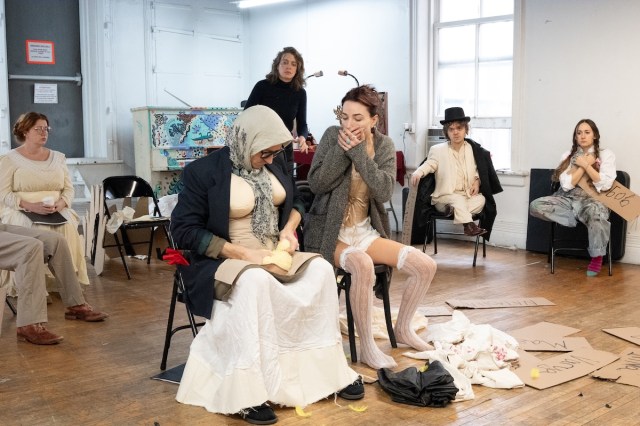
While American productions tend to present Vanya as a story of male competition and resentment, Krymov quite literally centers Yelena, the professor’s attractive young wife. I have often thought of Yelena as one of those women with a Tinder profile in the top one percent: Not only is she married to a famous writer, but she is the object of desire for the title character (Zach Fike Hodges), who feels he has wasted his life propping up an undeserving fraud. Astrov (Javier Molina), the local country doctor, also wants her. She’s the hot commodity in the marketplace of love, and Krymov’s production gives us a visceral sense of just how terrifying that position is to occupy.
Krymov arrays the other characters in a semicircle around Yelena, like they’re staging an intervention. One by one they approach to pour their neuroses on her. “She arrives and everybody comes to her with their problems,” explains Krymov, “They all want her because they have all been together for so long and they’re fed up with one another. She’s a new person and she is a beautiful woman to top it all off.” Shelby Flannery, who plays Yelena, delivers a balancing act of empathy and bewilderment with undertones of terror that will feel familiar to any woman who has suffered to just sit and listen to a disgruntled man rant.
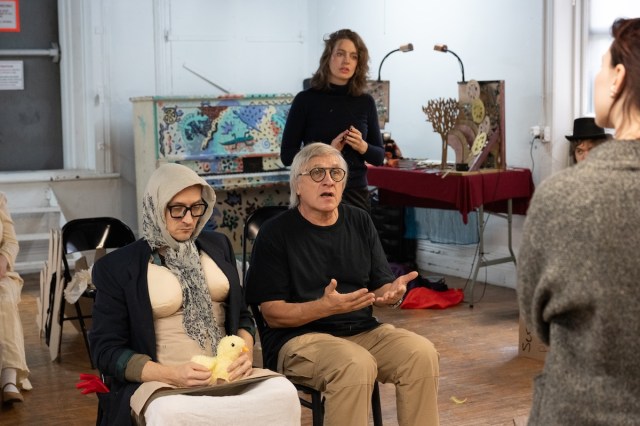
This is a distilled version of scenes that Chekhov actually wrote, but Krymov’s great liberty is the creation of a new character, a chicken who has watched a hawk fly off with 11 of her chicks, leaving just one alive. Once she removes her giant chicken head, the actor MaryKate Glenn takes the form of a battered woman with smudged makeup. She chain-smokes and complains bitterly of the rooster, who is no help at all. I sensed a distinctly feminist attitude undergirding these directorial choices, but Krymov insists it’s simpler than that: “The humans have their own problems, but the chicken is the one who is really suffering, and they don’t even notice that she is living this Greek tragedy.”
(© Krymov Lab NYC)
The relativity of tragedy is something that clearly fascinates Krymov. At the end of notes, he relayed to his cast an opinion that a world leader once shared with him about the time (2008) when Putin and Dmitry Medvedev swapped offices, with the later taking the presidency of the Russian Federation and the former becoming Prime Minister. In 2012, they swapped back again in a do-si-do of performative democracy.
“It’s better without blood,” Krymov quoted the leader as saying. “It could be Shakespeare, but now it’s Chekhov.” For the ruling class especially, one can certainly understand the appeal of bloodless transitions of power over a society that quietly accepts its fate, like an unhappy country doctor slowly poisoning himself with alcohol. But Krymov disagrees with the leader’s analogy, noting that the specter of death is never far from Chekhov’s plays. “And now we see, as this story has moved forward, how much blood it has produced.”
The tragedy of Putin’s Russia seems to be reaching its third act, but it is hard to discern America’s dramaturgical path as we approach the semiquincentennial of our declaration of independence. I asked Krymov if he ever feared that he had fled one crumbling empire ruled over by criminals only to land in another.
“I can see this, with horror,” he responded, “but I want to focus on the good people around me and the work we are doing. I fear that if I let this smoke inside me, it will be very bad.” And in that instant, I’m sure I could see the flames of a distant but vividly remembered conflagration flicker across his eyes.




Featured In This Story
Related Articles
See all
Latest Reviews
See all


Latest Videos
West End vs Broadway: Oh, Mary!—From an Angry Inch to an Angry First Lady, With John Cameron Mitchell and Mason Alexander Park
Mitchell and Park celebrate a decade-long friendship in our latest installment.