
Special Reports
Where or When? In Blue Moon, Meet Lorenz Hart on the Night Oklahoma! Changed Everything
Richard Linklater, Robert Kaplow, and Ethan Hawke discuss this new film about the end end of the legendary lyricist’s life.
 |
New York City
|
|
New York City
|
October 21, 2025
(© Sony Pictures Classics)
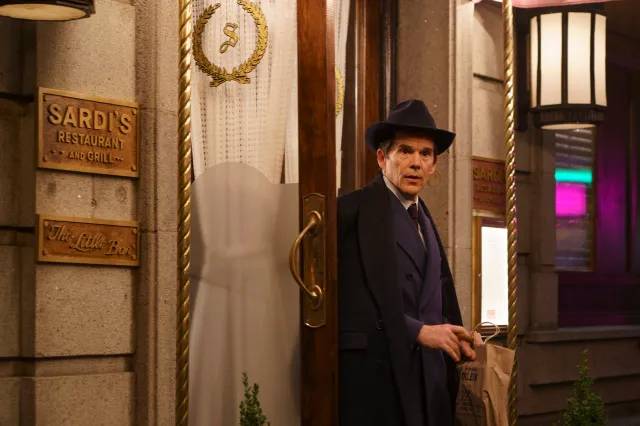
Save for a short, wordless opening showing Lorenz Hart drunkenly collapsing in the rain and catching his death of pneumonia, the new Richard Linklater film Blue Moon is set, almost claustrophobically, in Sardi’s.
For all practical and professional purposes, Hart died eight months before his actual demise when that landmark musical Oklahoma! reached Broadway on March 31, 1943. The ultimate in urbane lyricists, Hart was hardly the buckaroo type, drawing a line with “Way Out West on West End Avenue” and not budging beyond that—unlike Richard Rodgers, his longtime partner who enthusiastically embraced the project with a new wordsmith, Oscar Hammerstein II.
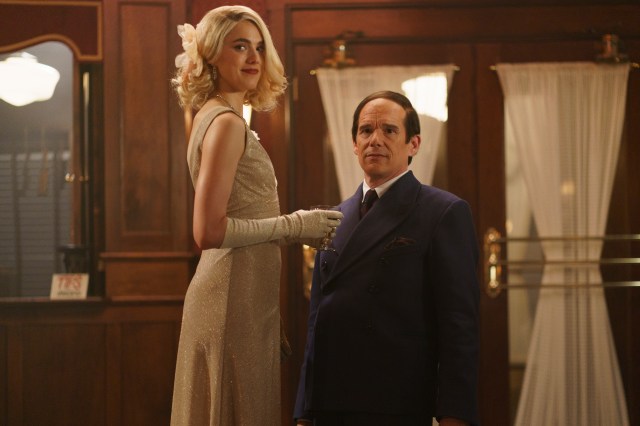
In point of fact, Hart couldn’t take all of the opening-night performance and rushed to Sardi’s to repair himself—totally unprepared for the ecstatic first-nighters who soon swamped the joint.
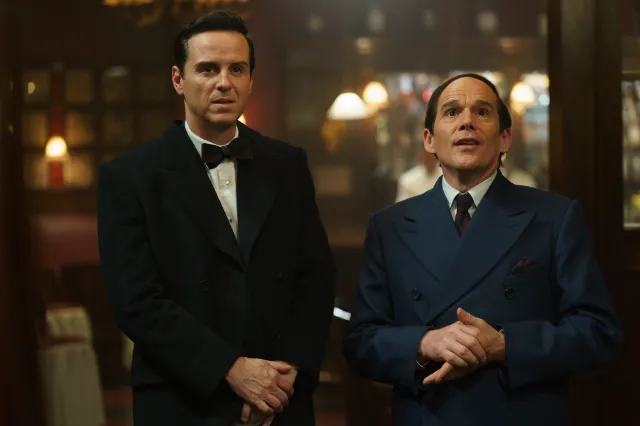
Noting the jubilant afterparty, it begins gradually to dawn on Hart (Ethan Hake) that he may be the odd man out in this situation, and this is confirmed to him when his old partner shows up. On a Sardi’s staircase bustling with activity, Rodgers (Andrew Scott) lays down the new rules: he and Hammerstein were already planning Carousel, and Hart would have to be content with writing a few new songs for a revival of their hit, A Connecticut Yankee (which he subsequently did, including the comedy classic, “To Keep My Love Alive”).
This particular Sardi’s was built—faithfully true to its 1943 specifications—in Dublin, where the picture was made, and it is interesting to see how little the place has evolved over the years.
Screenwriter Robert Kaplow claims the genesis of this film goes back about 12 years. He and director Richard Linklater had made a previous film together (Me and Orson Welles) and kept in casual contact. “One day, Richard called up and asked, “What are you working on right now?’ I said, ‘I’m trying to write this thing on Lorenz Hart.’ There was a pause, and then Richard said, ‘I’m very interested in Lorenz Hart. Could I read it?’” And that was how this movie was born.
“Everything that’s in the movie was already there,” Linklater recalled, “the wit, the humor, all the yearning—and we had 12 years to keep working on it. I sent it to Ethan at some point—not to star in the movie necessarily. It was more like, ‘Look what Robert wrote. Isn’t this dazzling?’
The actor was indeed dazzled: “It was like an epic poem, a howl into the night, the cry of an artist who was being left behind by the times, and by his partner. That’s what’s really moving about it. The writing of this was so lucid and so clear and so funny—I just felt right off the bat that I knew this man. I wanted to see him in a movie, and I knew that Rick would be the right person to figure out how to make a movie that would happen in real time in one night.”
(© Sony Pictures Classics)
Hawke was working on a play for director Jack O’Brien when the movie was finally green-lighted. “I asked Jack if he knew anything about Lorenz Hart, and he said, ‘Yes.’ I told him Rick had this idea about making a movie about him on the opening night of Oklahoma! And Jack said, ‘That. Is. The. Greatest. Idea. I’ve. Ever. Heard. Of. In. My. Life!’ I called Rick and said, ‘We gotta get going. Jack O’Brien approves.’ It was like showing up at your ex’s wedding.”
The movie was shot in 15 days in Ireland. “There was no easy day and no easy hour,” Hawke said. “Because we were filming so quickly, we were making the movie every minute of the day.”
To this, Linklater added a sunny post-script: “But we rehearsed for about ten years. We had readings. We thought about it, how we would do scenes, so, by the time we were actually filming, our instincts were pretty honed. Our goal was to make it like a Rodgers and Hart song, too—that it could be beautiful, kinda sad and funny—all those things, all at the same time.”
Blue Moon is not the first time that movies have leafed through the Rodgers and Hart Songbook. MGM’s 1948 all-starrer, Words and Music, which featured Mickey Rooney (inevitably) as Hart and Tom Drake as Rodgers, was mostly a vocal exercise for the studio’s name-brand singers. The one word that somehow never came up in this film? Oklahoma!
(© Sony Pictures Classics)




Latest Reviews
See all
Latest Videos
West End vs Broadway: Oh, Mary!—From an Angry Inch to an Angry First Lady, With John Cameron Mitchell and Mason Alexander Park
Mitchell and Park celebrate a decade-long friendship in our latest installment.