When directors Bill Rauch and Zhailon Levingston began reimagining the iconic Andrew Lloyd Webber musical Cats not as a fantasia on feline themes but as a full-bodied ballroom competition, they weren’t simply updating a classic, they were interrogating it for a whole new audience. What if the “cats” imagined by T.S. Eliot weren’t literal at all, but part of a long queer lineage? What if the Jellicle Ball took place not in a junkyard but in a warehouse, where chosen family members vogue for trophies, and winning carries far higher stakes than ascension to the Heaviside Layer?

Interviews
What Is a Jellicle Ball? Bill Rauch, Zhailon Levingston, and More on Reinventing Cats
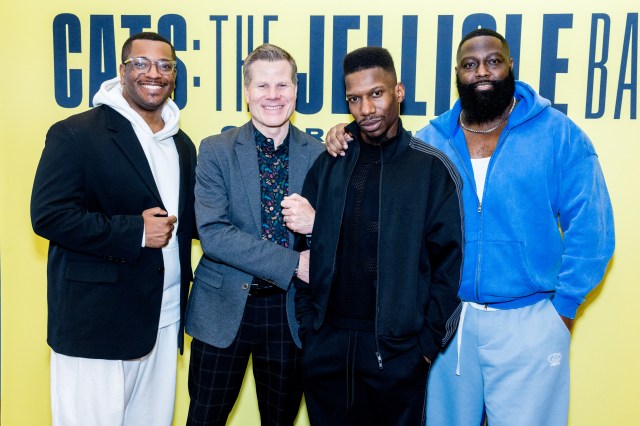
The two directors, joined by choreographers Omari Wiles and Arturo Lyons, share the secrets of this ballroom-flavored Andrew Lloyd Webber reinvention.
 |
Broadway
|
|
Broadway
|
March 23, 2026
When Cats: The Jellicle Ball premiered in the summer of 2024 at PAC NYC, it set the theatrical world on fire. And now, at long last, it’s coming to Broadway’s Broadhurst Theatre, which is being decked out with a runway and seats on the stage. Getting the mega-musical to this place wasn’t something that happened over night; it took six workshops, multiple conversations with Lloyd Webber’s team, and a deep collaboration between codirectors Levingston and Rauch and cochoreographers Omari Wiles and Arturo Lyons.
The resulting product not just expands the legacy of a musical everyone thinks they know, but reinvents a classic right before our eyes.
(© Tricia Baron)
This conversation has been condensed and edited for clarity.
Whose idea was it to do Cats as a ballroom competition, and how long did it take to get people to buy into it?
Bill Rauch: Zhailon had been musing about Cats without cats, and I had the idea of looking at Cats in a queer context. I started thinking about a gay bar and Old Deuteronomy being an older gay man. Then I started working with Josie Kearns, our dramaturg and gender consultant, and Omari Wiles, the ballroom icon, and by that point, we knew that ballroom was an appropriate setting, with Grizabella not as an older gay man, but as a transgender woman. We spent a year creating a pitch deck to share with Andrew Lloyd Webber’s team, and then Zhailon entered the story.
Zhailon Levingston: I was directing a show, and I had had this interaction with my roommate where we were like, “What if there was a production of Cats where no one was a cat?” Everyone used the term cat [to refer to people] in the early 20th century. Why would we stop using the word that way? I was at a bar after my show and was talking to the casting director, who ultimately is the casting director of Cats: The Jellicle Ball, and he was like, “You need to talk to Bill Rauch.”
Bill: In our first conversation, we agreed to co-direct, which was quite beautiful. We did five or six different workshops. It was a very intensive developmental process.
Zhailon: All of which Lloyd Webber Entertainment was involved with. We had lots of conversations with them and lots of ways in which we needed to make sure we were honoring the material itself. There was a moment where we learned we really could not alter the original orchestrations, beginning to end. And one of my favorite moments is watching Omari and Arturo put choreography on the original orchestrations and then seeing, like, “Oh, shit, this could work.” That was deep in the process, but to me, that was the moment where I was like, “we could be making something that is actually quite special.”
(© Evan Zimmerman)
Omari and Arturo, tell me about your process with this and how you sort of chose which characters moved which way.
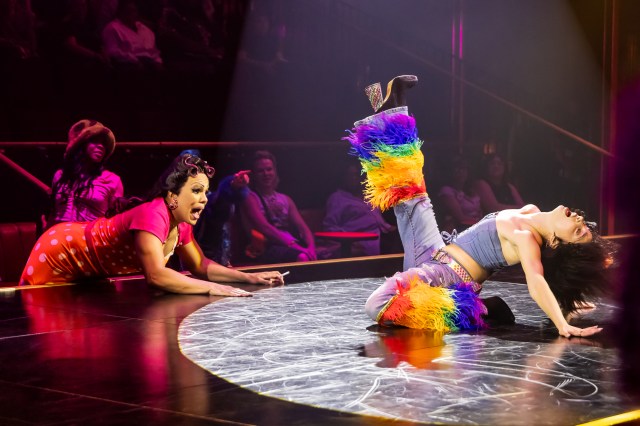
Omari Wiles: We had a dance workshop, which was originally only three dancers, and I was really intrigued with the original choreography, the ballet. I was trying to fuse the ballet with the voguing as much as possible to give tribute to the original Cats. And it did feel right in the beginning. But as the story started to develop and Arturo came on board, it felt like the vocabulary of the dancing needed to feel more queer nightlife and more ballroom, and also of that demographic, those Black and brown bodies and Latino bodies. It was important that we pulled movement from those backgrounds and experiences. We went away from the ballet and started to think about how queer movement and club dance fit the score.
Arturo Lyons: We basically put more of ourselves into the choreo instead of trying to fuse something that wasn’t natural. Now it’s more based on the categories for the characters. Mr. Mistoffelees is runway, so he doesn’t need a high-tempo beat for that. We can use the original score and align the choreography with that.
Omari: Mistoffelees being a runway walker, but also a majorette-type dancer, as well, really taps into the Southern queer ballroom scene and the Southern queer lifestyle, as well. It felt nice knowing that we’re representing not only New York City, but also different queer communities across the United States. That felt good with each individual character.
(© Tricia Baron)
How was it determined which character would embody each category?
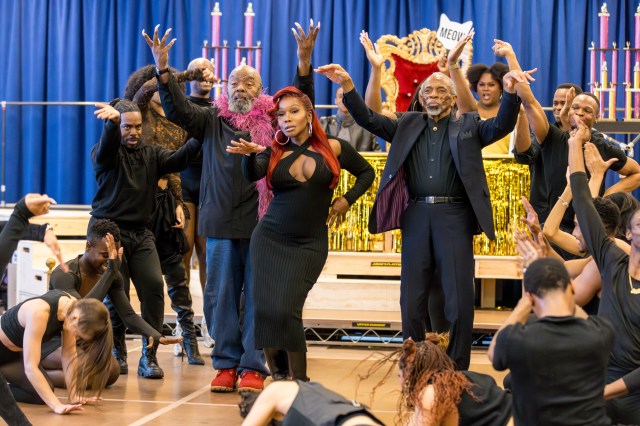
Bill: One of the things that really moves me is how Omari had such a keen eye for how this story and ballroom could merge. A lot of the things we pitched to Lloyd Webber Entertainment, category-wise, are the same to this day: Virgin Vogue being for Gumby Cat, and Realness being for Tugger, and Body being for Bustopher. Skimbleshanks was one of the ones that we had to search the hardest to find.
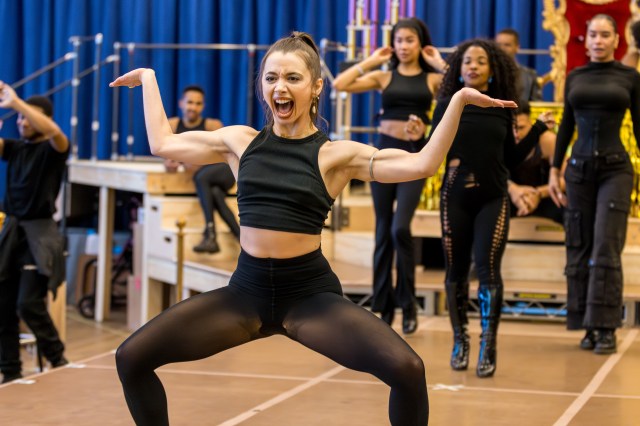
Zhailon: We could not figure that number out. It’s one of my favorites because it’s one of the hardest to figure out how to make work, but on paper, it made so much sense. Skimbleshanks is a railway cat. She works for the MTA. That was always pretty clear. But how to actually make it happen as a ballroom category?
Bill: The other one that was really hard was Macavity. We struggled with Macavity for a long time. It was when labels came into it and the idea of fashion that it made sense, but it took a long time to get there.
Omari: It fit the whole mysterious thievery. I feel rich, I feel grand. Remember back in the day, the girls crafting. They would be there; they wouldn’t be there. That type of energy felt good with Macavity’s story. Even with Skimbleshanks. Once we realized Skimbleshanks speaks Spanish, we understood her background. In ballrooms, a lot of the Latinos within the community do walk New Way and Old Way, so let’s connect that lineage to Skimbleshanks.
(© Tricia Baron)
How much reworking are you having to do to set the show for a more traditional space, as opposed to the openness of PAC?Zhailon: Every idea that we’ve had gets to expand because of the new space. We get to play vertically and horizontally in a different kind of way. There are more levels and more access to the story at certain points. It was much harder downtown to get everyone in the room to see one particular thing. On Broadway, there are moments where we are able to tell everyone to look there. There haven’t been a ton of conceptual changes outside of just restaging something and reimagining the movement. But also, there’s how many new actors on stage?
Bill: Five new onstage cast members and one new track.
Zhailon: So a lot of what’s new is also going to be some of the bodies and the way they interpret the role. We went from a male Macavity to a female Macavity, and that’s a completely different energy.
Bill: And a female Jellylorum to a male Jellylorum.
It’s also two years later, and every single thing in life has changed.
Bill: The world certainly has changed. Somebody said to us that they loved Cats back in the summer of 2024, but we need Cats now.
Zhailon: If Cats was a joy bomb downtown, we hope that it continues to be that, but for some people, it will be a battle cry.
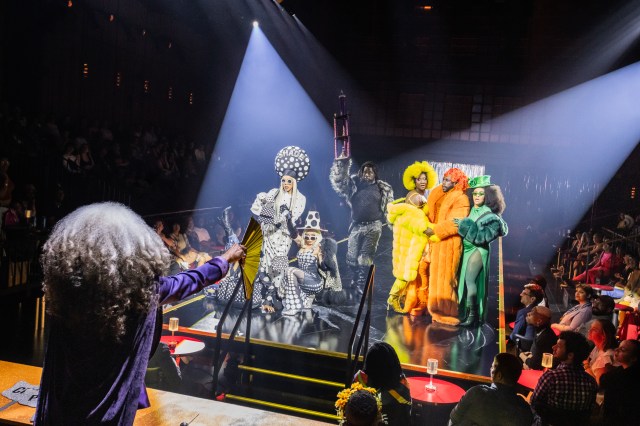
(© Evan Zimmerman)




Featured In This Story
Latest Reviews
See all

Latest Videos
West End vs Broadway: Oh, Mary!—From an Angry Inch to an Angry First Lady, With John Cameron Mitchell and Mason Alexander Park
Mitchell and Park celebrate a decade-long friendship in our latest installment.