
Review: White Men Try to Raise Mixed-Race Daughters in Indian Princesses
Eliana Theologides Rodriguez makes an impressive debut with this ambitious, intelligent, and affecting new play.
 |
Off-Broadway
|
|
Off-Broadway
|
May 19, 2026
(© Ahron R Foster)
In a note included as an insert in the program for Indian Princesses, playwright Eliana Theologides Rodriguez explicitly states that her play is in part “about the personal impacts of systemic miseducation.” Given the play’s title, which refers to the YMCA program that appropriated Native American rituals in the name of father-daughter bonding, the social-justice tenor of that statement makes sense. But while Rodriguez has racism and similar topics on her mind, she admirably transcends political screed in Indian Princesses, making its off-Broadway premiere in an Atlantic Theater Company and Rattlestick Theater co-production.
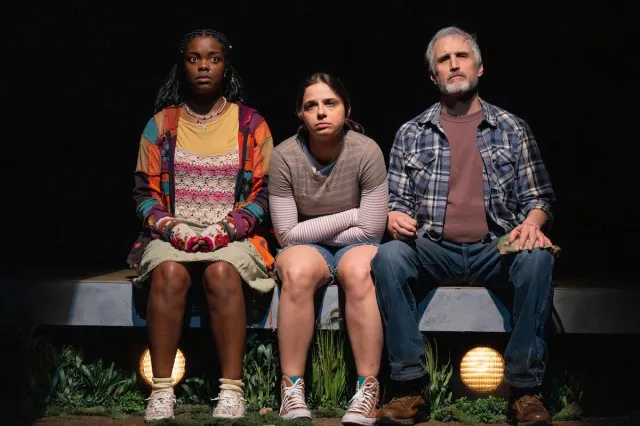
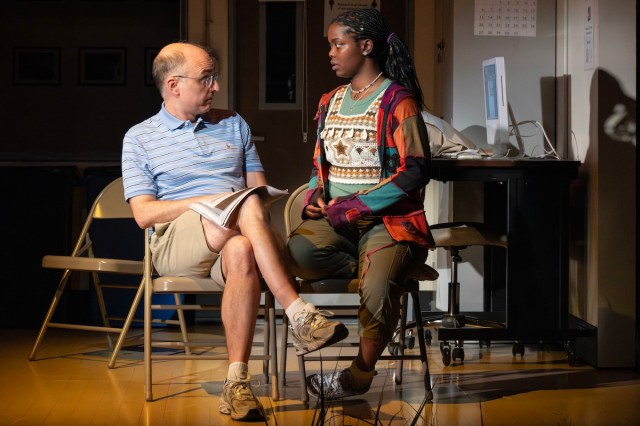
The play, set in 2008 in an undefined part of the Midwest, centers around four patriarchal relationships with five preteens. Glen (Frank Wood) is the grandfather of Samantha (Haley Wong), who is half-white and half-Japanese. Chris (Greg Keller) is the stepdad of Lily (Anissa Marie Griego) and Hazel (Serenity Mariana), both of whom are half-Yaqui and half-Tewa (as is the playwright herself). Maisey (Lark White) is the adopted Black daughter of Wayne (Ben Beckley). And Andi (Rebecca Jimenez) is the half-white, half-Mexican daughter of Mac (Pete Simpson). All the men are white.
(© Ahron R Foster)
Maisey is arguably the most memorable, blessed with an imagination that allows her to see herself as a wizard who can divine the future. Under the inadvertent influence of her religious grandfather, Samantha develops a disturbing habit of punching herself in her upper body as penance for harboring sinful thoughts. Lily dreams of playing Penny in a Broadway production of Hairspray, while the less overtly theatrical Hazel is the most innocent of the bunch. And tomboyish Andi (Jimenez adopts a deep voice to emphasize the boyishness) develops a crush on stepdad Chris.
But Rodriguez portrays their male caretakers in an especially humanistic light. It’d be a stretch to call them “good” parents. Chris, formerly a lawyer in New York, tries to be culturally sensitive (Keller played a similar character in the original off-Broadway production of The Thanksgiving Play in 2018). By contrast, Mac’s outward disdain for politics disguises a conservative streak. Glen has a deeply religious side. As for Wayne, he’s currently unemployed and, at one point, voices his concern over whether these children are at the right age to absorb certain political ideas. Without excusing their flaws, Rodriguez makes clear that these parental figures are all doing what they feel is best for their kids.
(© Ahron R Foster)
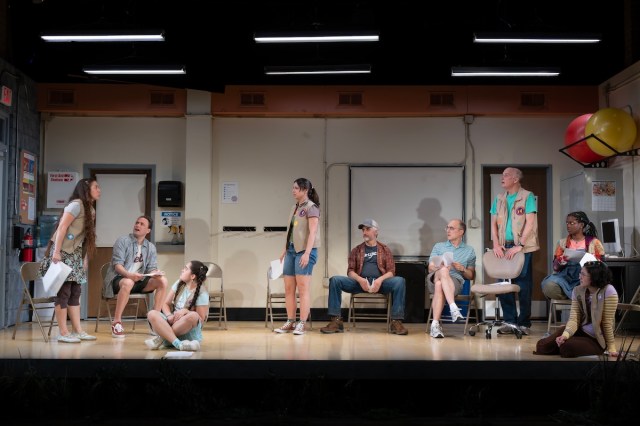
Indian Princesses is most affecting, though, as a collective coming-of-age tale. Though these preteens are trying to find themselves personally and culturally, they find a sense of community with each other amid their struggles and curiosities. Catharsis comes for them in the form of a swerve into magical realism toward the end of the play. A reconciliation leads to a bit of primal-scream therapy (reminiscent of the finale of John Proctor Is the Villain) before giving way to a speculation on the future that’s uplifting yet tinged with a wise-beyond-their-years acknowledgment of the real-world challenges ahead.
A terrific cast under Miranda Cornell’s sensitive direction makes Rodriguez’s vision hum. The female performers convey youthful curiosity without lapsing into cutesiness, while the male performers channel genuine familial warmth even at their most oblivious. Costume designer Sarafina Bush finds the perfect attire to evoke each character’s personality. Emmie Finckel’s set design and Mextly Couzin’s lighting effortlessly make transitions between classroom interiors and outdoor settings (though Cornell makes the distracting decision in some sequences to have some actors stay mostly stuck in place in the background while others play out scenes in the foreground). Indian Princesses announces a fresh voice with a welcome amount of empathy and intelligence to back up high ambition.




source on Google
Featured In This Story

Latest Reviews
See all







Latest Videos

Watch the Trailer for Elsinore Starring Andrew Scott
The film is based on the true story of Ian Charleson, who played Hamlet at London’s National Theatre after being diagnosed with AIDS.