
Review: Very Blue Light, an Awkward Reunion in the Desert
Daphne Silbiger’s play opens at the Tank.
 |
Off-Off-Broadway
|
|
Off-Off-Broadway
|
September 14, 2026

(© Travis Emery Hackett)
In 2026, Americans exist in a state of limbo, acutely aware that the old world has died, but unclear about what comes next. That’s true in national politics, but also personally for the four individuals in Daphne Silbiger’s Very Blue Light, now making its New York premiere at the Tank. Pensive and inert, with characters digressing into dense political tirades yet holding their tongues about the interpersonal friction happening onstage, it reflects the Chekhovian reality of educated and terminally online Millennials adrift.
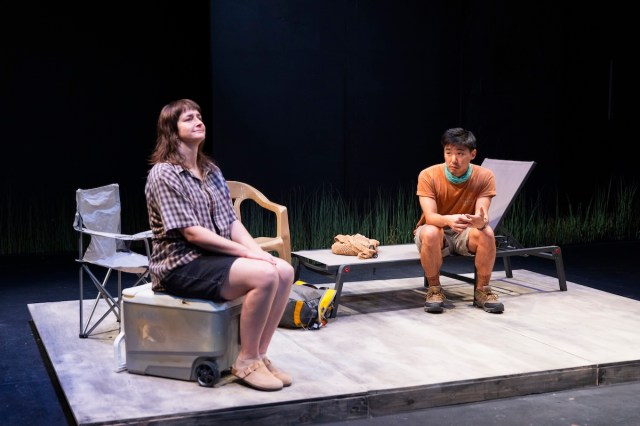
It takes place in Marfa, Texas, where Magna (Dom Martello) and Angela (Ellenor Riley-Condit) have relocated, ostensibly to make art. Their friend from high school, Coleman (Sam Im), is visiting from Austin. He followed a much more traditional career path and now works for Tesla. He also hasn’t seen Magna, his childhood best friend, since she transitioned, and still thinks of her as “Mike.”
Angela has just taken a job as the social media manager of a bird conservancy in Alaska, but she’s clearly open to being wooed back to Austin by Coleman, to await the end of days in wedded bliss. Add to this already volatile reunion the outspoken Michigan (Anita Parrott), on whom Magna is crushing, and you have a recipe for passive-aggressive combustion.
To the extent there is action in Very Blue Light, it transpires mostly on Angela and Magna’s porch, where they chat about rent, Coleman’s shitty roommate, and Magna’s plan for a public art project made out of giant mounds of clay, which we suspect will never come to fruition.

(© Travis Emery Hackett)
Things only start to heat up a third of the way in, when Magna bluntly asks Coleman, “How do you feel about making America great again?” Coleman, a garden variety tech bro, responds that MAGA voters are a “bunch of fucking cucks,” but expresses the opinion that real power has quietly shifted to a handful of major tech firms and everything else (especially the culture war) is a massive and intentional distraction. He seems at peace with a future ruled over by the likes of his boss, Elon Musk.
Chiming in, Michigan calls Coleman’s perspective “a little old school” and insists that the politics of mass distraction were baked into the system from the beginning. It’s not a new development, but fashionable nihilism is. Coleman seems blindsided by this retort and later describes Michigan as “exhausting,” but only after they have left the stage.
And unless you’re someone with a zeal for charting the territory revealed by the newly opened Overton window, you too might find this Kushnerian salon exhausting. But Silbiger at least deserves points for giving a fair hearing to political perspectives that exist beyond the red-blue binary, especially when so much of the institutional theater is still mentally trapped in the Obama era.
The four actors deftly navigate Silbiger’s thick academic prose while delivering highly realistic performances of people whose in-person social skills have withered in the sickly glow of the screen.
Playing an aggressively agreeable woman with bangs, Riley-Condit’s Angela nervously attempts to smooth over the differences that have developed like geological formations between Magna and Coleman. She’s not an Austin wife, but her plastered smile suggested that the Marfa art scene has become just as oppressive—bad enough for her to consider Coleman as an escape pod.
(© Travis Emery Hackett)
Im wordlessly conveys the kind of siloed existence that allows an ostensibly intelligent man to mistake ignorance for virtue. Martello’s Magna exudes make-the-best-of-it dread. She’s not sure she wants to welcome this figure from her past but is too polite to tell him to buzz off. And as Michigan quickly sizes up this strange situation, Parrott’s searing gaze silently judges all.
Emily Moler’s somewhat lethargic direction, full of sauntering exists and entrances, does little to energize this talky script. One staged transition, in which the actors walk onstage in straight lines staring down at their phones, suggests an attempt at rigor that was quickly abandoned, like a half-finished art project in the desert.
Raphael Mishler’s set gives us the full experience of unadorned drear that is Magna and Angela’s patio, though it pushes all other scenes to the periphery. Annie Hoeg’s costumes capture the wilting whimsy of a variety of Millennial tribes (Magna’s cowboy boots are an inspired choice). And lighting designers Jiahao (Neil) Qui and Elijah Thomas create a spectacle on a budget when they create the very blue light of the title.
As dull as Very Blue Light can be, Silbiger is at least honest with how her characters end up, scattered to the winds and distracting one another with animated features on a Zoom call. No matter how much we proclaim the death of liberalism, it is not yet finished turning us all into nomadic zombies.




source on Google
Featured In This Story

Latest Reviews
See all








Latest Videos
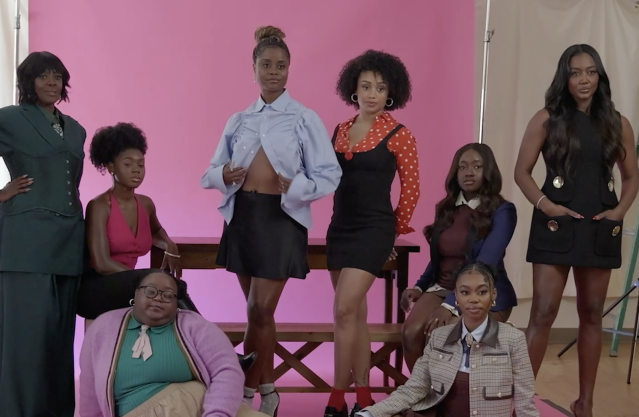
Jocelyn Bioh, Whitney White, Jasmine Amy Rogers, and Patina Miller Talk School Girls
The playwright, director, and stars of School Girls; Or, the African Mean Girls Play discuss the comedy, sisterhood, and themes behind the new Broadway production.