
Review: The Maids, Class War in the Age of Social Media
St. Ann’s Warehouse hosts a revival of Jean Genet’s play about domestics plotting to murder their boss.
 |
Off-Broadway
|
|
Off-Broadway
|
May 26, 2026
(© Julieta Cervantes)
America will soon have its first trillionaire. Protesters bray outside the Met Gala like sans-culottes at the gates of Versailles. New college graduates jeer their AI-pushing commencement speakers, light candles to Saint Luigi, and sharpen their guillotine blades.
Class war is in the air, so there has never been a better time to revive The Maids, Jean Genet’s poisonously funny drama about two domestics who plot to off the boss. Director Kip Williams is somewhat successful at harnessing the electric rage coursing through our society in his high-tech modern adaptation for Donmar Warehouse, now making its off-Broadway debut at St. Ann’s Warehouse. But like the TikTok filters he deploys throughout the show, Williams’s take on the text is superficial and easily interchangeable. It only dips a pinky toe into the ocean of resentment in which Genet’s woman swim.
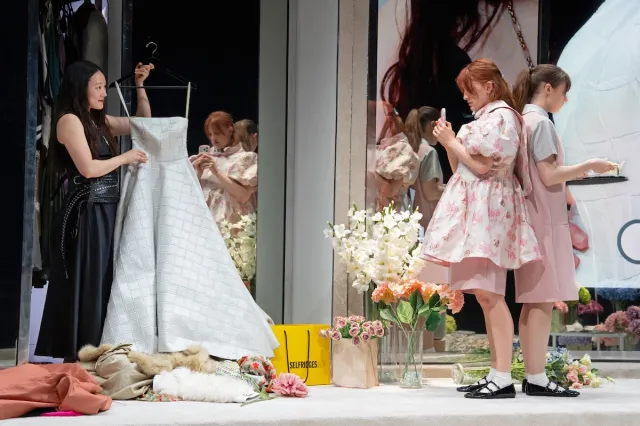
The maids don’t just dream of killing their mistress. They also want to be her. The play opens with Claire (Lydia Wilson) pretending to be Madame while her sister Solange (Phia Saban) pretends to be “Claire.” As she tells her maid how disgusting she is, the rich and beautiful woman orders her poor servant to prepare an appropriate outfit for court. Her lover is in jail, accused of theft. Little does she know, the maids are the ones who reported him—and she is the next target.
(© Julieta Cervantes)
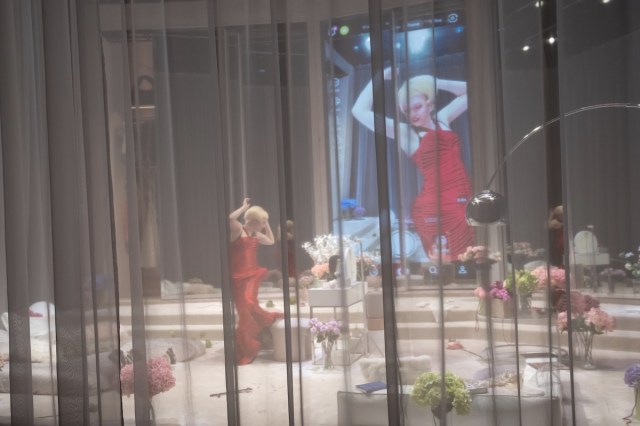
Voyeurs to this gauzy fantasy, we observe through the sheer curtains that surround Madame’s fabulous sunken dressing room with wall-to-wall white carpet (Rosanna Vize is the set designer). Ostentatious couture gowns peek out from the floor-to-ceiling closets, a marvelous array of costumes for this macabre game of dress-up (the costumes are by Marg Horwell).
Jon Clark’s cinematic lighting and the classical underscoring the women pipe through the sound system (both Tchaikovsky’s “Dance of the Sugar Plum Fairy” and Mozart’s Requiem are deployed in the early minutes of Dan Balfour’s unrelenting soundscape) suggest a scene that has played out many times, with new flourishes added at each rehearsal. But before it can reach its climax, the fantasy suspends, the curtains draw back, and the real Madame arrives.
Yerin Ha, best known to television audiences for her portrayal of the wronged yet resolute maid Sophie on the recent season of Bridgerton, steps onstage with the force of a tornado. Magnificent and volatile, she swings wildly between delusions of grandeur and fits of paranoia. Her boundless self-regard only briefly suspends when she discovers something out of place in her boudoir—a piece of lingerie or a charging iPhone that is not hers. Her pointed questions cause everyone in the room to shorten their breaths, lest they be noticed.
(© Julieta Cervantes)
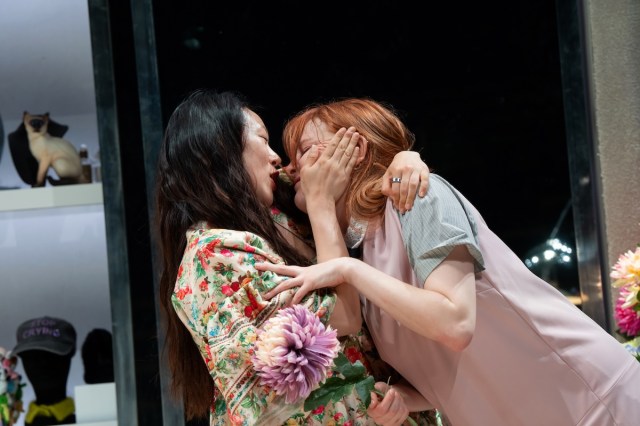
Madame’s psychological torture of her two servants includes recording them with TikTok filters to make them appear old and ghoulish (video designer Zakk Hein projects these images on the upstage wall so we are privy to this digital hazing). But like a big sister, she also encourages Claire to don makeup—some of the old stuff she no longer uses, of course. “Ohmygod you look snatched. Truly,” she compliments, a knife sheathed in her sweet voice. Wilson’s Claire looks simultaneously thrilled and terrified to be invited ever so briefly into this world of glamor, knowing that at any moment her employer could cast her out.
As Claire, Wilson delivers a fascinating portrayal of a woman clever enough to understand the injustice of her lot, but not quite clever enough to do anything about it. “Like, I am an actual genius, you know that, right,” she tells Solange who, if she doesn’t quite believe it, is at least smart enough not to dispute.
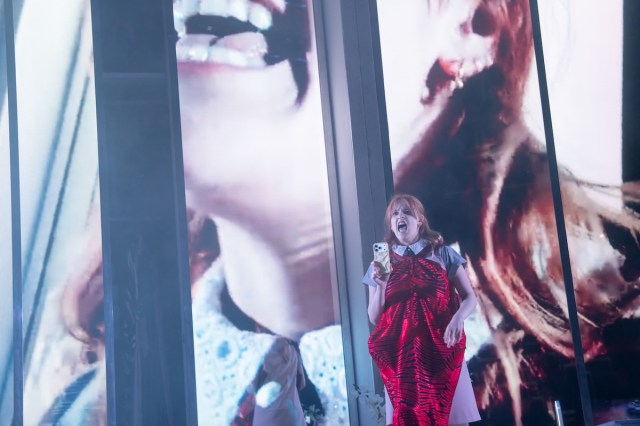
Saban’s take on Solange (typically played as older, but here demoted to little sister status) is the least developed of the three. She seems just happy to be invited to play, but her rushed delivery of an aria-like final monologue reveals the shallowness of Williams’s adaptation.
(© Julieta Cervantes)
“Eternity of wealth. Eternity of pleasure. Eternity of orgasm,” she describes the abundance that awaits them in their reward, “Eternity of sugar. Eternity of Ozempic. Eternity of eyelid surgery. Eternity of collagen. Eternity of machine learning. Eternity of brunch. Eternity of fracking. Eternity of podcasts. Eternity of foreign wars…” It’s almost like Williams wasn’t confident his audience could tie the themes of this 1947 play to our own time, so he wanted to make it explicit.
But that connection was already clear over a decade ago, in the relative nascence of the social media age, when Isabelle Huppert and Cate Blanchett starred in Sydney Theatre Company’s revival. What have we learned since then, now that the richest and most powerful people on Earth now dance across the screens to which we are addicted? Williams declines to say.
As with his Broadway adaptation of The Picture of Dorian Gray, Williams seeks to dazzle us with screens and stagecraft, perhaps driven by the belief that our attention spans have been so thoroughly obliterated by the endless social media scroll that the only way to hook an audience is by replicating that dopamine-pounding sensation. With the addition of DJ Walde’s original music droning underneath the scene, it is an assault on the senses that mostly detracts from the script, rather than supporting it. It’s a missed opportunity to unleash the true superpower of the theater, a sanctuary from the techno-tyranny to which we have all willingly submitted.




source on Google
Featured In This Story
Related Articles
See all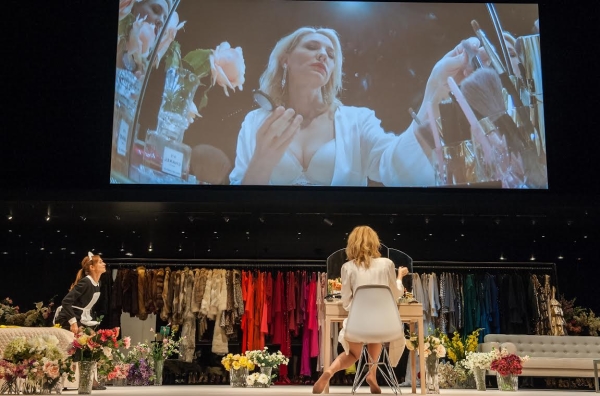
Latest Reviews
See all






Latest Videos

Watch the Trailer for Elsinore Starring Andrew Scott
The film is based on the true story of Ian Charleson, who played Hamlet at London’s National Theatre after being diagnosed with AIDS.