
Review: Spare Parts Asks, Can You Buy Immortality?
David J. Glass’s anti-aging anti-tragedy opens off-Broadway.
 |
Off-Broadway
|
|
Off-Broadway
|
March 8, 2026
(© Russ Rowland)
America is a country that looks at the ancient tragedies—tales of powerful men ruined by hubris—and sees a challenge. Oedipus just didn’t have reliable data, I can imagine a spokesman for Palantir claiming. Jason really should have insisted on a prenup, one of our craftier divorce lawyers might argue. We are a nation convinced that sheer will, so central to our pursuit of happiness, must overcome all obstacles—even death.
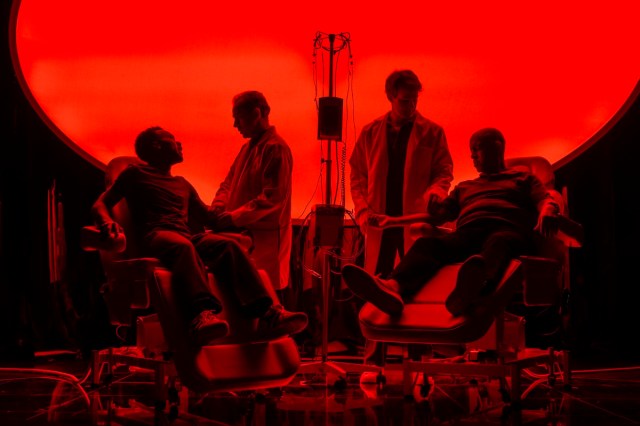
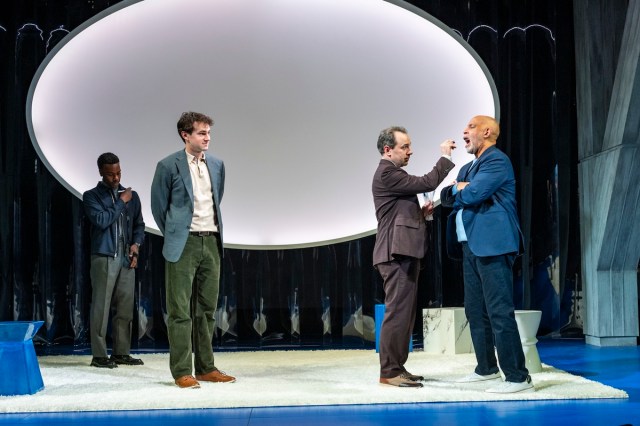
That is certainly the belief of the great king at the center of Spare Parts, the captivating new anti-tragedy by David J. Glass, now making its world premiere at Theatre Row. Zeit Smith (Michael Genet) is a tech billionaire who would like to slow and eventually arrest the aging process, and he is willing to spend vast sums of money to do it. With the help of his personal assistant, Ivan (Jonny-James Kajoba), he sets up a meeting with Professor Chris Coffey (Rob McClure), an anti-aging researcher at Columbia University.
Coffey has been able to extend the lifespans of flies and worms through a process of gene editing, but Smith isn’t much interested in insects; he wants to know what Coffey can do to extend his life now, even though the professor claims such technology is decades away.
(© Russ Rowland)
“Professor Coffey is just being careful,” interjects his hungry young graduate assistant Jeffrey (Matt Walker). He smells money and he’s not going to let something as insignificant as ethics prevent him from taking his best shot at escaping academic penury. He mentions experiments in which the blood of younger mice is pumped into the circulatory system of older mice, resulting in longer lives for the latter. That is enough to convince Smith that something similar could be done for him. He sneers at Coffey’s government grants and university salary and immediately offers the two men more money than they know what to do with.
There are more twists and turns in Glass’s script, which addresses the ethics of cloning and our tech-driven slide away from that other American notion—that all men are created equal. Buttressed by big ideas and gripping performances, Spare Parts is both livelier and more entertaining than his previous play, Love + Science (Glass is a doctor and biotech researcher moonlighting as a playwright). Glass exhibits an intimate knowledge of the subject and a shrewd understanding of its dramatic potential.
Director Michael Herwitz stages a competent production, despite a few design hiccups. Scott Penner’s sprawling set is divided into thirds, with the central playing space occupied by a giant ovular disk and marble geometric shapes (only the poor sit on chairs that look like chairs). But one gets the sense he didn’t quite know what to do with the enormous width of stage 3 (there are laboratories on both sides of the billionaire’s lair). Amanda Roberge’s costumes are appropriately contemporary and muted. Zack Lobel’s lighting evokes a sinister future, especially in the scene transitions underscored by Ryan Gamblin’s slightly fuzzy original music, which suggests a day spa in the Borg cube. But anyone with a smart speaker will instantly recognize the disembodied voice of George, Smith’s AI assistant, who acts as an all-seeing spy for the data lord. He is Siri as a Pinkerton detective.

(© Russ Rowland)
But it’s the live performances that really leave an impression: One of the theater’s irrepressible nice guys, McClure excels in the role of the mild-mannered and unflappably ethical Coffey, and he delights the audience with a brief turn as a kind of Ivy League Maury Povich (oh yes, there are blood tests). Kajoba is particularly moving as a man navigating a crisis of faith and conscience after discovering that most of what he thought he knew about his life was a lie. While Ivan’s attraction to Jeffrey feels genuine (this gay romantic subplot is both shoehorned and ho-hum, a tepid rivalry), the enigmatic Walker keeps us speculating about his character’s intentions long after the final bow. Is this love, or just a very aggressive form of networking?
While Genet is not as nipped and tucked as we might expect from an egomaniac intent on transcending his own biology (a corset and a good makeup designer might have worked wonders), he compensates with the authentic performance of a toddler elevated to the Ottoman throne—quick to anger and completely disinterested in the feelings of those around him. In short, he’s a real bastard. When fate finally comes for our AI Agamemnon, as we know it must, I felt neither pity nor fear, but an exhilarating rush of schadenfreude. This is not the catharsis Aristotle promised, but it is hugely satisfying nonetheless.
This may all be wish fulfillment from Glass to the off-Broadway audience, but it is grounded in a sobering reality: Some of the wealthiest and most powerful men on earth are pouring their money into research to extend their lives and perhaps even solve the problem of death. They have clearly shown their intention to reign over us in perpetuity as vampires, accumulating wealth and feasting on the blood of the young. But the will to change the world is not yet their exclusive intellectual property, not in America. So the question Spare Parts leaves us with is, When will you sharpen your stake and storm the castle?




Featured In This Story
Latest Reviews
See all



Latest Videos

West End vs Broadway: Oh, Mary!—From an Angry Inch to an Angry First Lady, With John Cameron Mitchell and Mason Alexander Park
Mitchell and Park celebrate a decade-long friendship in our latest installment.