
Review: Rarely Revived Ivanov Gets the Boring Knocked Out of It
The New American Ensemble gives Chekhov’s lesser-known play a comic gut-punch.
 |
Off-Broadway
|
|
Off-Broadway
|
March 19, 2026
(© Bronwen Sharp)
You can attend a lot of theater in New York without ever coming across a production of Anton Chekhov’s Ivanov. Compared with his other dramatic works (Uncle Vanya and The Cherry Orchard crop up quite a bit), it’s a relatively neglected play.
No wonder, since it’s not an easy one to put on. It was Chekhov’s first to be staged, and it shows some of his early missteps as a playwright with its awkward tonal shifts and imbalanced pacing. Plus, its main character—a self-loathing 19th-century Russian who suffers from boredom and considers himself as a “superfluous man”—can be tough to empathize with. As a result, the work is often overlooked. Poor Ivanov, Chekhov’s superfluous play.
Or is it? Give it a solid production, as the New American Ensemble is doing now at the West End Theatre, and you’ll find not only the thematic seeds of Chekhov’s four biggies (add The Seagull and The Three Sisters to the two above) but also the stuff of a cracking good comedy. I use the word “comedy” loosely—this is Chekhov, after all, and the play is still about a man suffering with severe depression—but yes, this one can often be pretty funny.
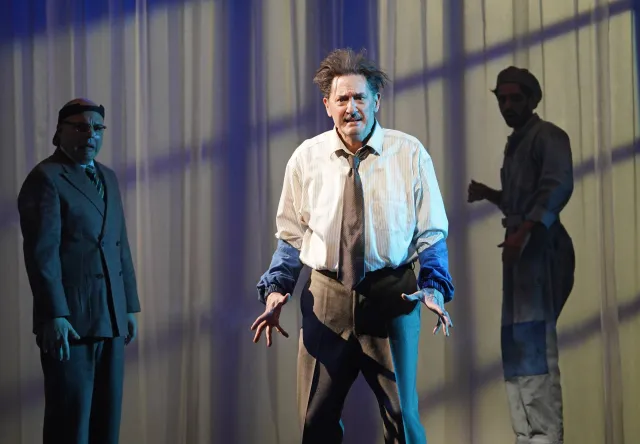
You wouldn’t know from the opening moments though, which are somber enough. As we take our seats, director Michael DeFilippis has Ivanov (played with unflagging commitment by Zachary Desmond) standing upstage and staring with droopy-eyed apathy into the void, like a tired child forced to stand in a corner. It takes a lot of energy to look that bored.
(© Bronwen Sharp)
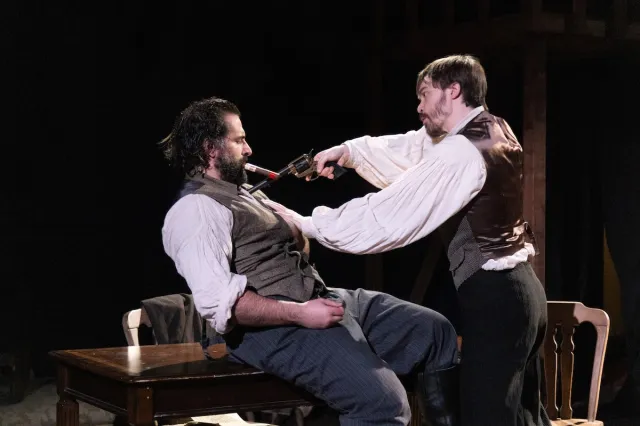
But things lighten up with the entrance of Borkin (a hilariously energetic Mike Labbadia), playfully startling Ivanov with a rifle to the head and then coddling him like a lover. Borkin is the working-class antidote to the upper-class weariness that has infected Ivanov and the other denizens of his rural town. You’d never see Borkin wearing a mask.
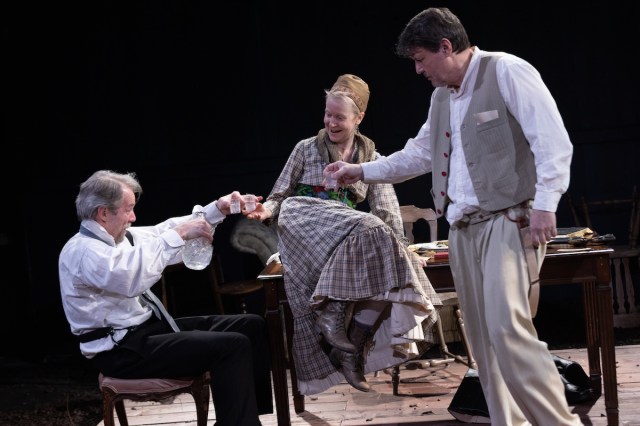
Also largely immune to this ennui, by virtue of vodka, is Ivanov’s cynical, hanger-on relation, Count Matvey Shabelsky (Ilia Volok playing the drunk uncle to perfection). He can be a little mean and casually antisemitic to Ivanov’s estranged wife, Anna (Quinn Jackson), who’s wasting away with consumption after leaving her faith and parents behind to marry Ivanov. But her protective doctor, Lvov (intense performance by Lambert Tamin), won’t tolerate any rough treatment from the count or Anna’s self-absorbed husband.
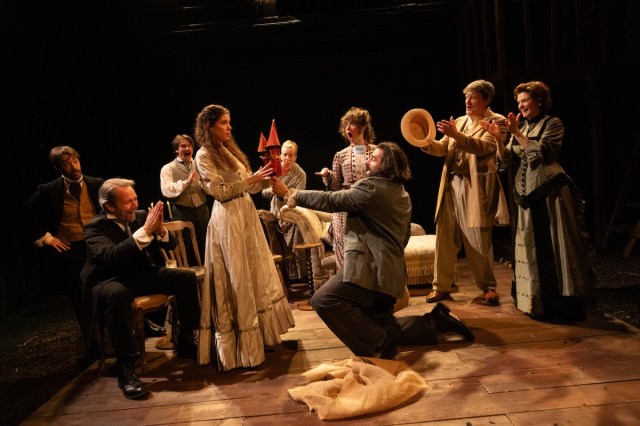
A protracted exchange between Anna and Lvov threatens to have us all putting on masks to hide our yawns, but the scene soon shifts to a “party” at the home of Lebedev (a gregarious Paul Niebanck), his gooseberry-obsessed wife, Zinaida (Mary Bacon), and their sensible daughter, Sasha (Maya Shoham providing a breath of salubrious air). Sasha is fed up with everyone’s kvetching, but she becomes infatuated with Ivanov anyway. Slim pickings in this one-horse town.
(© Bronwen Sharp)
DeFilippis really revs the party up with the object of Shabelsky’s money-hungry affections, the young widow Martha (hysterical performance by Alexandra Pearl), who leans back on the couch with her bird’s-nest hair and screams, “God, how boring! I’ll die before this is over!” Her desperate outburst is what saves us all. I was howling.
The energy stays high throughout the first act, especially when the ceiling explodes with theatrical fireworks during Ivanov and Sasha’s ill-fated tryst (Sarah Woods’s lighting design and Stan Mathabane’s sound create the colorful, dramatic display). And minor characters Avdotya (Maude Mitchell), an elderly and eccentric matchmaker, and Ksoykh (Casey Worthington), a tiresome tax office employee who won’t shut up about a card game, act as welcome diversions from the general melancholy.
But then there’s the ominous uprooted tree trunk that set designer Ashley Basile has hung with rope above the stage like a sword of Damocles. It’s a symbol of the precarious future of this decaying class of wealthy whiners and a foreshadowing of the fate of Madame Ranevsky’s cherry orchard.
Of course, Ivanov doesn’t end happily, as you might guess from the gun in the first scene (“One mustn’t place a loaded rifle on the stage if it isn’t going to go off,” Chekhov once wrote). Still, for two and a half hours I was intrigued by a play that I had feared would bore me to tears. I was never happier to be wrong.




Featured In This Story

Latest Reviews
See all

Latest Videos
West End vs Broadway: Oh, Mary!—From an Angry Inch to an Angry First Lady, With John Cameron Mitchell and Mason Alexander Park
Mitchell and Park celebrate a decade-long friendship in our latest installment.