
Review: Public Charge, a Diplomat Recalls Hillary Clinton’s State Department
Julissa Reynoso and Michael J. Chepiga’s theatrical memoir makes its world premiere at the Public Theater.
 |
Off-Broadway
|
|
Off-Broadway
|
March 25, 2026
(© Joan Marcus)
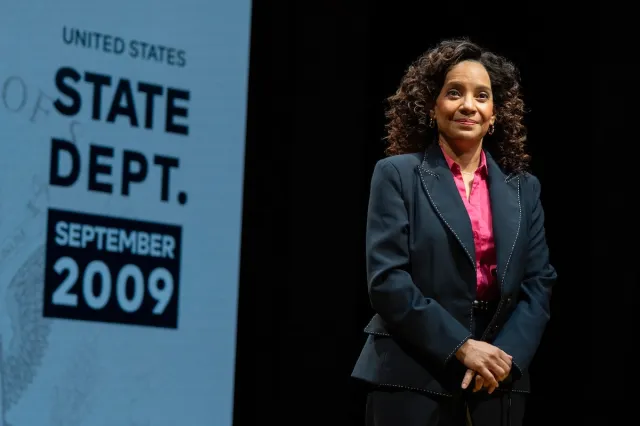
As I have previously observed, the Obama years are the Public Theater’s happy place, so it is unsurprising that it is hosting the world premiere of Julissa Reynoso and Michael J. Chepiga’s Public Charge. Reynoso was Deputy Assistant Secretary of State for the Western Hemisphere during Obama’s first term, then Ambassador to Uruguay in the second. Chepiga was her law partner before that (he also penned the short-lived Broadway play Getting and Spending). Together, they have written a theatrical memoir of Reynoso’s time in the State Department that both strokes liberal nostalgia for the diplomacy of a bygone era and provides vital insight about why it all came crashing down.
The play opens in 1981 at the US Embassy in Santo Domingo, where Uncle Nelsido (Al Rodrigo) has taken 6-year-old Julissa (Zabryna Guevara) to apply for a visa to join her mother in the Bronx. The consular officer (John J. Concado) takes one look at her, considers mom’s meagre wages, and determines that Julissa is likely to become welfare dependent—a public charge. He sends her away empty-handed.
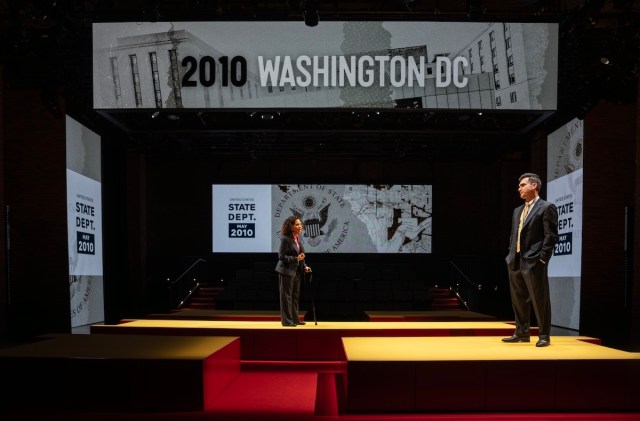
By 2009 Julissa is a successful attorney and valuable part of the Obama campaign (the play covers little of her journey from there to here). Recently confirmed Secretary of State Hillary Clinton recommends her for a job, and after eight separate interviews she speaks with Ricardo Zuniga (Dan Domingues, intimidatingly dismissive), the director of Cuban affairs left over from the Bush administration. When Julissa observes that the US has no formal diplomatic relations with Cuba, he retorts, “And it’s my job to see that doesn’t change. … Presidents come and go. We stay.” He is a member of the deep state MAGA is always warning about.
(© Joan Marcus)
Yet the new administration is interested in thawing relations with Cuba. Clinton’s chief of staff, Cheryl Mills (Marinda Anderson) not only hires Julissa, but makes her Zuniga’s superior. “Review our policies with Cuba and send me a comprehensive memo,” she commands. “Do not share it with Ricardo.”
But Julissa soon discovers that she needs Zuniga’s expertise when USAID worker Alan Gross is taken prisoner in Havana, leaving his wife (a moving Deirdre Madigan) completely distraught. Subsequent negotiations with Cuban envoys Bruno Rodriguez (Armando Riesco) and Josefina Vidal (Maggie Bofill, having so much fun being bad) show us exactly how this wily regime has survived for six decades just off the shore of the mightiest empire on earth. Communists in the truest sense, they always get more than they give.
Tasked with imparting the complexities of US Latin American policy on a public that is habitually bored by the subject, Chepiga and Reynoso fall back on ersatz Sorkinese, loading the exposition with quippy one-liners meant to impart the cleverness of characters as they make basic points. While explaining to Julissa why the Cuban government objected to Gross distributing electronic equipment that could bypass their Internet firewall, Zuniga says, “Julissa, that would create false expectations, confusion, uncertainty, anxiety, unhappiness, and possibly, just possibly, democracy. Which, after all, is USAID’s stated goal. The democracy part, not the unhappiness and anxiety part.” Ha.
Director Doug Hughes delivers a suitably caffeinated production. In lieu of the West Wing walk-and-talk, the actors shout across the little canyons created by Arnulfo Maldonado’s set, which resembles a series of runways in a daycare for the children of government employees (handy little drawers in the platforms provide storage for props). Haydee Zelideth costumes the actors in bureaucrat drag, smartly leaving room for seasonal modifications in ways that real high-level public servants rarely do. When they are in Latin America, lighting design Ben Stanton bathes the stage in a sweltering Orange. Sound designer David Van Tieghem and video designer Lucy Mackinnon supplement the stage action with the sights and sounds of the 2010s. It’s not quite the historical spectacle one might expect from a James Graham-Rupert Goold collaboration, but it gets the job done.

(© Joan Marcus)
The performances are more uneven. Fully inhabiting her role as a no-nonsense Black woman at the center of power, Anderson seems prepared to take a 2am phone call from Shonda Rhimes. Rodrigo makes an impression in multiple roles, and he is a dead ringer for the late Uruguayan President José Mujica, a cuddly charmer on the no-fly list. But Guevara feels less committed in her performance, shaky on her lines in a manner that suggests either last-minute script revisions or a general lack of comfort with the material.
That’s too bad because Public Charge is a worthwhile look back at American foreign affairs, and how the tension between political appointees and career civil servants has long been one of the great challenges of democracy. What we’re discovering the hard way in Iran today was just as true with Cuba in the 2010s: Governments that don’t have to answer to voters can afford to play the long game. Now that we’re living under the move-fast-and-break-things ethos of the second Trump administration, when Cuba might finally be brought under American suzerainty—it also might unleash a new wave of refugees onto Florida’s shores—it’s easy to wax nostalgic about a slow and deliberate process that never quite moved fast enough for the aspirations of elected officials.
“We’re gonna be the most progressive, inclusive country in the world. You watch,” Julissa fantasizes in the final scene about eight years of President Hillary Rodhan Clinton, to the knowing guffaws of the off-Broadway audience. As the cost of everything else in theatrical production keeps rising, we can rest assured that smug hindsight will always be free.




Featured In This Story
Latest Reviews
See all


Latest Videos

Get a First Look at Megan Thee Stallion as Zidler in Moulin Rouge! on Broadway
Megan Thee Stallion starts performances on Tuesday, March 24.